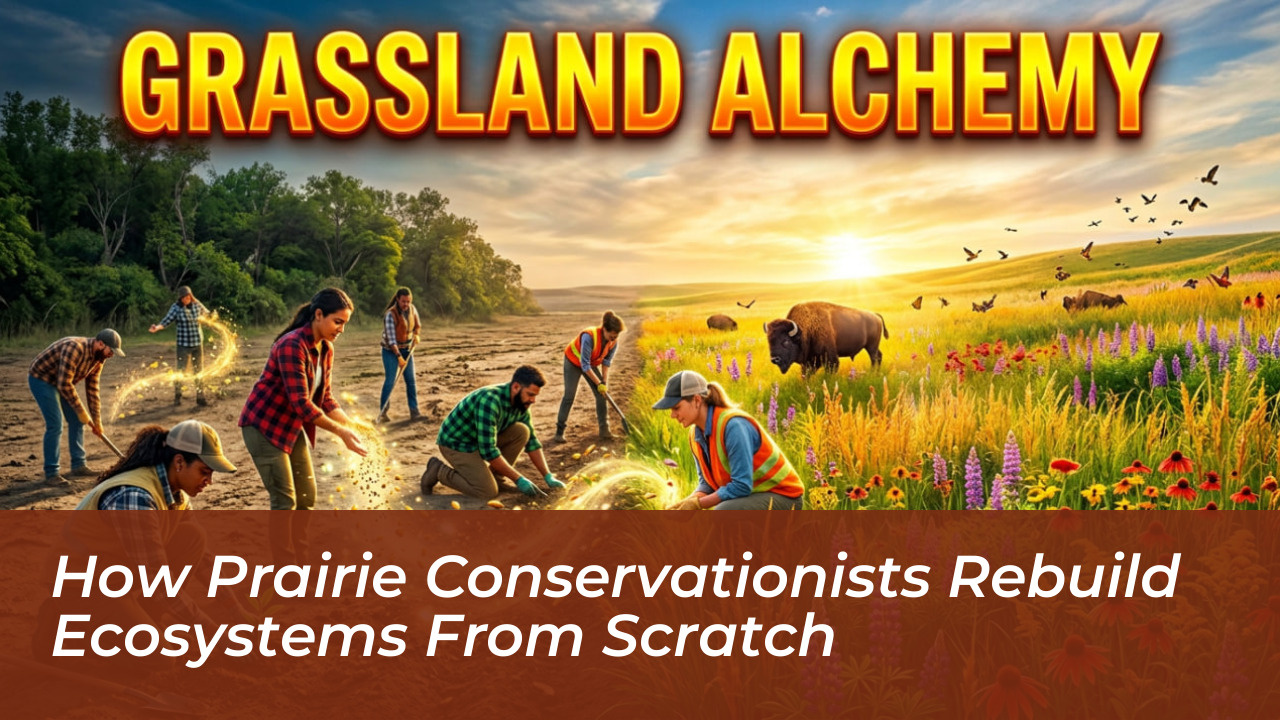

Professional conservation managers do not revive disappearing native grasslands by simply fencing them off or planting tidy rows of saplings; they release massive herds of free-roaming American bison paired with targeted fires to reshape the earth. At the Joseph H. Williams Tallgrass Prairie Preserve in northeastern Oklahoma, this disturbance strategy transformed an initial group of 300 bison into a herd of over 2,000 animals, revitalizing an imperiled ecosystem where more than 96 percent of historical acreage has been wiped out.
With less than 4 percent of North America’s original tallgrass prairie surviving after decades of aggressive farming and urban sprawl, traditional preservation methods routinely fall short. Tree-planting initiatives and uniform cattle pastures fail because native prairies evolved under violent, rhythmic disturbances rather than static protection. Reintroducing apex grazers alongside fire forces natural ecological turnover that artificial landscaping cannot replicate.
The Keystone Grazer: How Bison Engineer Dynamic Ground Cover
Standard livestock operations and agricultural pastures strive for uniform grass height across an entire acreage, but authentic prairie preservation requires structural chaos. As a recognized keystone species, the American bison does not mow vegetation down into a flat lawn. Instead, selective feeding habits create a living mosaic of heavily cropped turf interspersed with tall, untouched stands.
This uneven structural profile produces critical micro-habitats across the landscape. The diverse vegetative heights open up nesting and feeding zones for grassland birds, native pollinators, insects, and amphibians that perish within uniform monocultures. By moving continuously across vast distances, the animals churn the soil, distribute organic matter, and disrupt dominant plant species that would otherwise choke out sensitive native wildflowers.
Bison shape the environment around them, creating different conditions across the landscape rather than allowing the grassland to become uniform. Yet grazing alone represents only half of the biological engine driving tallgrass recovery.
The Patch-Burn Mechanism: Why Fire Guides the Herd
To maximize landscape diversity, land managers deploy patch-burn conservation. Specialists systematically ignite prescribed fires across specific, rotating parcels of the prairie rather than burning an entire territory at once. This technique mimics the historical wildfire patterns sparked by lightning and Indigenous land stewardship over thousands of years.
Once flames clear a section, tender, nutrient-dense shoots rapidly sprout from the blackened earth. The herd gravitates toward this fresh growth, concentrating their grazing on the recently burned plot while ignoring older sections. Unburned tracts receive a multi-season rest period that allows deep-rooted vegetation to recover while halting the encroachment of woody shrubs and invasive trees across the open plains.
Managing 39,650 Acres of Semi-Wild Terrain
The scale of this ecological project requires balancing wildlife independence with hands-on herd oversight. Located near Pawhuska, Oklahoma, the preserve spans roughly 39,650 acres (approximately 16,000 hectares), holding the title of the largest protected remnant of tallgrass prairie left on the planet. Originating in 1993 through a donation of 300 animals by Kenneth and Dianna Adams from the Ken-Ada Ranch to The Nature Conservancy, the site has grown into a major restoration benchmark.
- Managing Organization: The Nature Conservancy
- Protected Area: Approximately 39,650 acres (16,045 ha)
- Initial Bison Count (1993): 300 animals
- Summer Population Peak: Up to ~2,700 head (including calves)
- Public Access Route: 15-mile designated driving loop
While the herd operates as a wild ecological force across thousands of open acres, veterinary safeguards require an annual autumn roundup to prevent overcrowding and disease transmission.
The Autumn Muster: Behind-the-Scenes Herd Logistics
Every autumn, preserve managers, veterinary specialists, and wranglers coordinate an extensive roundup to inspect the animals before releasing them back onto the open range. The intervention follows a strict operational sequence:
- Gathering: Teams muster the free-ranging animals across tens of thousands of acres into secure handling corridors.
- Health evaluation: Handlers guide individual animals through designated inspection lanes to examine physical wellness and herd trends.
- Weighing and vaccination: Field specialists record individual body weights, administer preventive vaccines, and verify that overall numbers align with the land’s grazing capacity.
By keeping the herd calibrated to the resource limits of the 39,650-acre reserve, managers protect the ground from overgrazing while ensuring the animals remain fit to drive natural prairie regeneration for decades to come. Large-scale grazing coupled with intentional fire remains one of the most effective blueprints for rebuilding fragile open grasslands.
Have you observed similar rewilding or native species restoration projects across the country? Share your thoughts and experiences in the comments below.