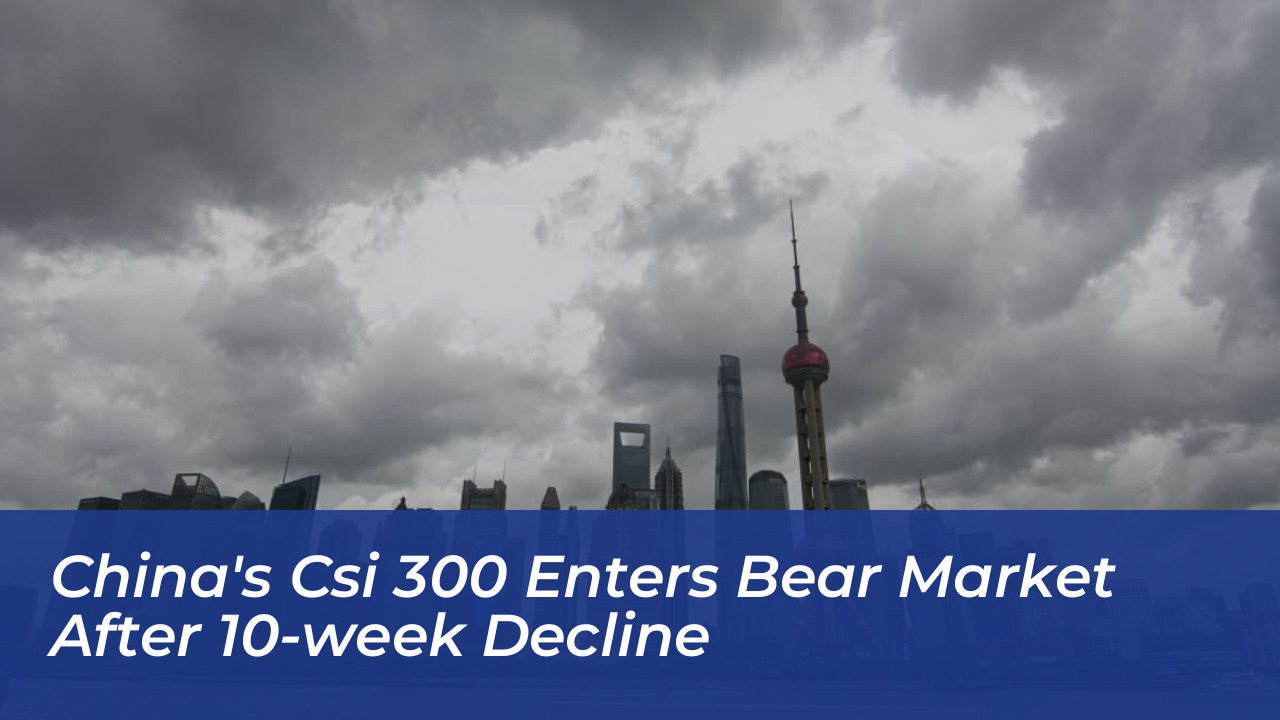

China’s benchmark CSI 300 index officially entered bear-market territory, falling 20% from its June peak amid persistent selling pressure across Shanghai and Shenzhen equities. The index registered a decline for 10 consecutive weeks, reflecting growing concerns over corporate profitability, economic growth, and overall investor confidence in the world’s second-largest economy.
According to data from LSEG, the CSI 300 fell more than 1% during Thursday’s trading session and finished down 2.6% for the week. The index tracks 300 of the largest stocks listed on mainland China’s primary exchanges.
Structural Challenges and Profit Pressures Weigh on Equities
Jordan Cvetanovski, chairman and chief investment officer at Pella Funds, noted that structural economic challenges continue to weigh heavily on Chinese equities. These pressures follow years of excess capacity and heavy overinvestment across multiple domestic sectors.
"I think China is really struggling with reining in the problems that they’ve had in the past from the overbuild of capacity and other things," Cvetanovski said, pointing to ongoing difficulties facing firms even in globally competitive industries, such as lithium-ion battery manufacturing.
Chinese corporations have experienced declining profit growth driven by intense domestic competition. This competition has eroded profit margins and prompted increased government scrutiny. In September, China reported its weakest growth in industrial profits for the year. Meanwhile, the broader economy recorded its slowest growth rate in over three years during the second quarter, constrained by a prolonged downturn in the property sector and persistently sluggish consumer demand.
Retail Investor Behavior and Market Sentiment
Shaun Rein, managing director at China Market Research Group, highlighted that geopolitical uncertainty, concerns regarding an artificial intelligence sector bubble, and deteriorating consumer confidence continue to dampen investor sentiment.
China’s market structure features a massive base of individual retail investors, which amplifies market volatility. On Western exchanges like the New York Stock Exchange, retail trading accounts for roughly 20% to 25% of total volume. In contrast, individual retail investors drive approximately 90% of daily trading volume on mainland Chinese exchanges, according to HSBC data.
"For Chinese, it’s about wealth preservation," Rein explained, noting a widespread shift toward safer assets, such as time deposits, as citizens navigate a weakening property market and sluggish labor conditions.
Earnings Misses and Beijing’s Incremental Stimulus
Market sentiment has also been shaken by disappointing quarterly financial results from major market bellwethers. Contemporary Amperex Technology Co. Ltd. (CATL), a dominant global electric vehicle battery supplier, saw its share price drop 12% following slower-than-expected quarterly profit growth as initial policy supports wound down.
While Beijing’s third-quarter GDP figures met official government expansion targets, the data failed to trigger a sustained market rally. Authorities have largely favored targeted, incremental policy measures and liquidity adjustments over the massive, broad-based fiscal stimulus packages many global investors anticipated. Analysts suggest that while state-backed buying and targeted monetary interventions help curb immediate declines, restore sustained confidence, and address weak domestic demand, additional direct fiscal policy action will be required to spark a lasting market recovery.