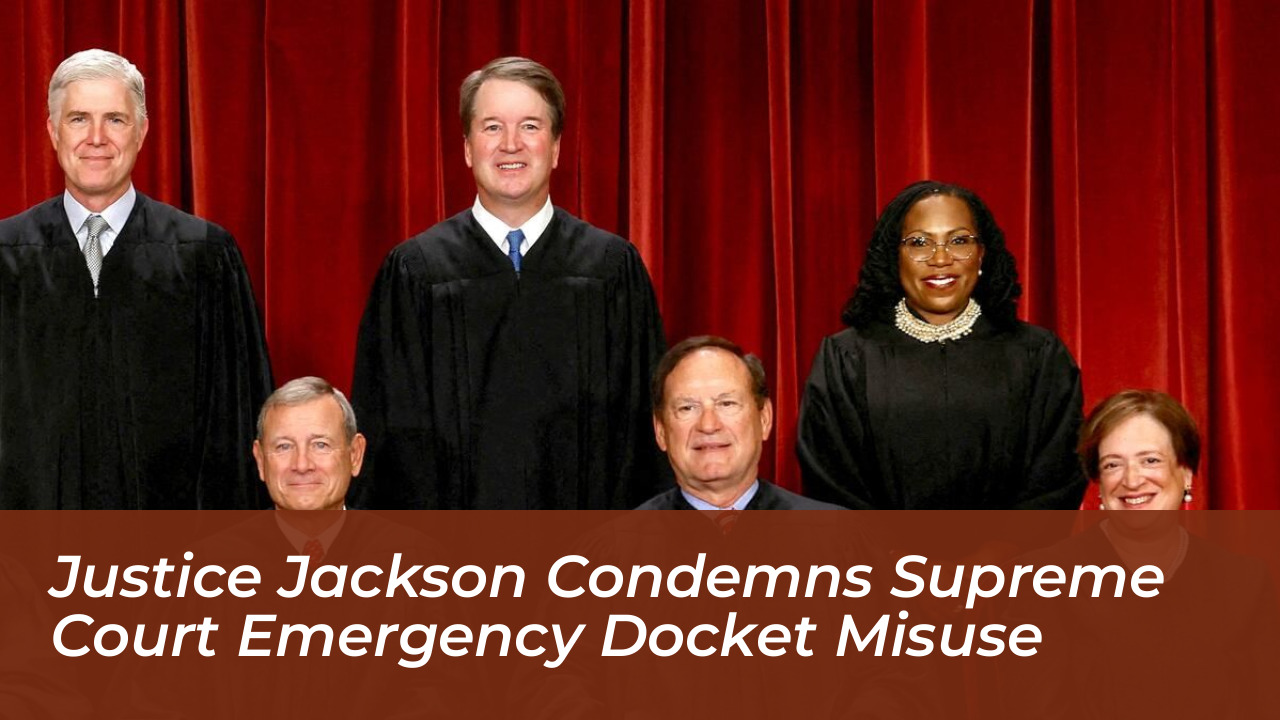
Supreme Court Justice Ketanji Brown Jackson delivered a sharp rebuke against the high court’s growing reliance on the emergency docket, warning of severe institutional damage. Speaking at the University of the District of Columbia School of Law, Jackson addressed the controversial rise of the shadow docket. Her core thesis highlights that routine reliance on rapid, unexplained emergency orders undermines the judicial branch’s credibility and bypasses standard legal percolation. As public scrutiny intensifies over how the nation’s highest court manages politically sensitive disputes, her critique places institutional survival at the center of modern legal debates.
- Understanding the Emergency Docket and Its Evolution
- The Original Purpose of Emergency Relief
- The Shift Toward Routine Policy Rulings
- The Danger of Premature Judicial Intervention
- Short-Circuiting Legal Percolation
- Procedural Harms and Legal Instability
- Comparison of Traditional Review Versus Emergency Docket Use
- Erosion of Public Trust and Institutional Legitimacy
- The Pillars of Judicial Legitimacy
- Real-World Consequences for Plaintiffs
- Proposals for Judicial Reform
- Enforcing a Strict Threshold Exigency Criterion
- Shifting Focus to Equitable Balance of Harms
- Administrative Law Implications and the Regulatory Valve
Understanding the Emergency Docket and Its Evolution
The Original Purpose of Emergency Relief
The historical context of stay requests and injunction applications tells a story of cautious judicial restraint. For decades, the Supreme Court reserved emergency relief for rare, exceptional circumstances such as imminent executions or true administrative emergencies that required immediate intervention to prevent catastrophic outcomes. Justices approached these matters with extreme hesitation, recognizing that stepping into a live controversy without a fully developed record invites error and undermines the appellate structure.
This traditional framework kept the high court firmly anchored as an appellate body of last resort. Lower courts handled the heavy lifting of fact-finding, witness testimonies, and statutory interpretations. Only after lower courts completed their exhaustive work would the justices grant plenary review. Emergency applications were the rare exception rather than the standard operating procedure for major national policy questions.
The Shift Toward Routine Policy Rulings
In recent years, the conservative majority court increasingly deploys the fast-track process for major public policy disputes. This transformation bypasses standard briefs and thorough deliberations. Late-night, unsigned summary orders now arrive with little to no comprehensive legal reasoning attached. This trend alters the nation’s highest court from a final appellate body into an aggressive court of first impression, leaving legal scholars and lower court judges scrambling to interpret sweeping mandates.
When the court issues these fast-track directives, it signals a major departure from historical norms. Parties challenging executive actions or state statutes no longer wait for regional circuits to weigh in. Instead, they seek immediate validation from Washington, D.C. This aggressive use of the emergency docket creates a parallel judicial system where major precedents are set without the traditional safeguards of open debate and judicial consensus.
The Danger of Premature Judicial Intervention
Short-Circuiting Legal Percolation
Regional appellate and district courts build robust records through thorough examination of complex statutes. When multiple judges across different circuits evaluate a novel legal theory, they test its strengths and weaknesses through varied factual scenarios. Premature Supreme Court intervention halts this valuable process of judicial testing. It denies lower courts the opportunity to complete full adjudications and robs the justices of mature legal arguments.
Without legal percolation, the high court decides profound constitutional and administrative questions based on skeletal filings submitted under extreme time pressure. This method invites judicial error. It forces justices to predict the real-world consequences of complex statutes without the benefit of trial court findings or expert testimonies. The resulting legal instability affects businesses, state governments, and individual citizens who rely on predictable, consistent rules.
Procedural Harms and Legal Instability
Allowing emergency applications to dictate policy deprives litigants of standard procedural protections and structured debate. It encourages forum shopping as privileged parties seek fast passes to Washington, bypassing local federal judges who understand the immediate regional context. This dynamic creates widespread legal instability by altering rules overnight via brief, unsigned directives that offer zero guidance for future disputes.
When rules change abruptly, regulated entities and citizens suffer real-world confusion. A business might invest millions complying with a district court injunction, only to have the Supreme Court vacate that order at midnight without explanation. This unpredictability erodes the foundational rule of law, turning judicial dispute resolution into a game of procedural agility rather than reasoned argument.
Comparison of Traditional Review Versus Emergency Docket Use
| Metric | Standard Appellate Review | Emergency Shadow Docket |
|---|---|---|
| Briefing Requirements | Extensive written briefs submitted by all involved parties over several months. | Minimal or entirely absent documentation, often filed within hours. |
| Oral Argument | Conducted publicly with direct questioning from the bench. | None. Decisions rely solely on written emergency motions. |
| Transparency | Detailed opinions outlining full legal reasoning and dissenting views. | Often unsigned, unexplained orders lacking clear doctrinal justification. |
| Timeline | Months of deliberate evaluation, allowing robust lower court records. | Hours or days of rapid turnaround, short-circuiting standard processes. |
Erosion of Public Trust and Institutional Legitimacy
The Pillars of Judicial Legitimacy
Legitimacy for an unelected judiciary rests entirely on transparency, reasoned argument, and strict adherence to established rules. When the Supreme Court green-lights controversial policies without clear justification, the public perceives the institution as acting politically rather than impartially. Citizens must believe that court rulings stem from neutral legal principles rather than the ideological preferences of the majority.
Justice Jackson warned that unexplained emergency orders pierce the armor of institutional credibility. When the court acts like a political legislature by issuing summary policy pronouncements, it invites public cynicism. Rebuilding that trust requires returning to transparent, deliberate decision-making where every vote is tied to a reasoned explanation.
Real-World Consequences for Plaintiffs
Unexplained emergency rulings inflict genuine real-world damages on affected parties before merits are heard. A plaintiff seeking to block a harmful environmental regulation or voting restriction suffers immediate injury when the Supreme Court abruptly lifts a lower court injunction. These individuals experience a profound disconnect between emergency expediency and justice delivered on the merits.
By the time the court finally hears a case on its merits, the practical damage is often irreversible. Families, businesses, and marginalized communities bear the brunt of these rapid interventions. They find themselves bound by laws that took effect overnight without a single sentence of judicial justification.
Proposals for Judicial Reform
Enforcing a Strict Threshold Exigency Criterion
To restore order, the court must reject stay applications that fail to demonstrate true, verifiable emergencies. Jackson outlines a framework where the heavy burden of proving impending, irreversible harm rests squarely on the moving party. Simply disagreeing with a lower court ruling or arguing potential legal error must never qualify as an emergency.
Under this rigorous threshold, routine policy disputes would return to the standard appellate queue. Only situations involving genuine, unavoidable catastrophes where delay guarantees destruction would qualify for emergency treatment. This filter would drastically reduce the volume of shadow docket applications and force litigants to build their cases in lower courts first.
Shifting Focus to Equitable Balance of Harms
Judges handling emergency requests must set aside complex merits evaluations and focus strictly on the equitable balance of harms. Weighing the competing harms experienced by each party prevents severe, irreversible real-world damage before a full trial occurs. If granting a stay causes more immediate, destructive harm to the public than maintaining the status quo, the court must deny the application.
This approach divorces the emergency evaluation from the temptation to prejudge the underlying legal merits. It ensures that temporary relief serves its original protective function rather than acting as a shortcut for policy implementation. Prioritizing equity protects vulnerable plaintiffs from absorbing unverified administrative shocks.
Administrative Law Implications and the Regulatory Valve
Analyzing the emergency docket through an administrative law lens reveals that it functions as an unacknowledged regulatory valve for executive branch agencies. When federal agencies and state governments face nationwide injunctions in district courts, the shadow docket provides a secondary, expedited appeal track. This mechanism allows executive actors to evade public accountability by securing quick relief from sympathetic appellate majorities.
Internal fractures among Supreme Court justices regarding the proper limits of judicial power grow wider with every summary order. Jackson’s public critiques highlight a deep ideological and methodological divide within the institution. While some justices view the emergency docket as a necessary tool for managing the modern administrative state, others see it as an unconstitutional expansion of judicial authority that threatens the separation of powers.