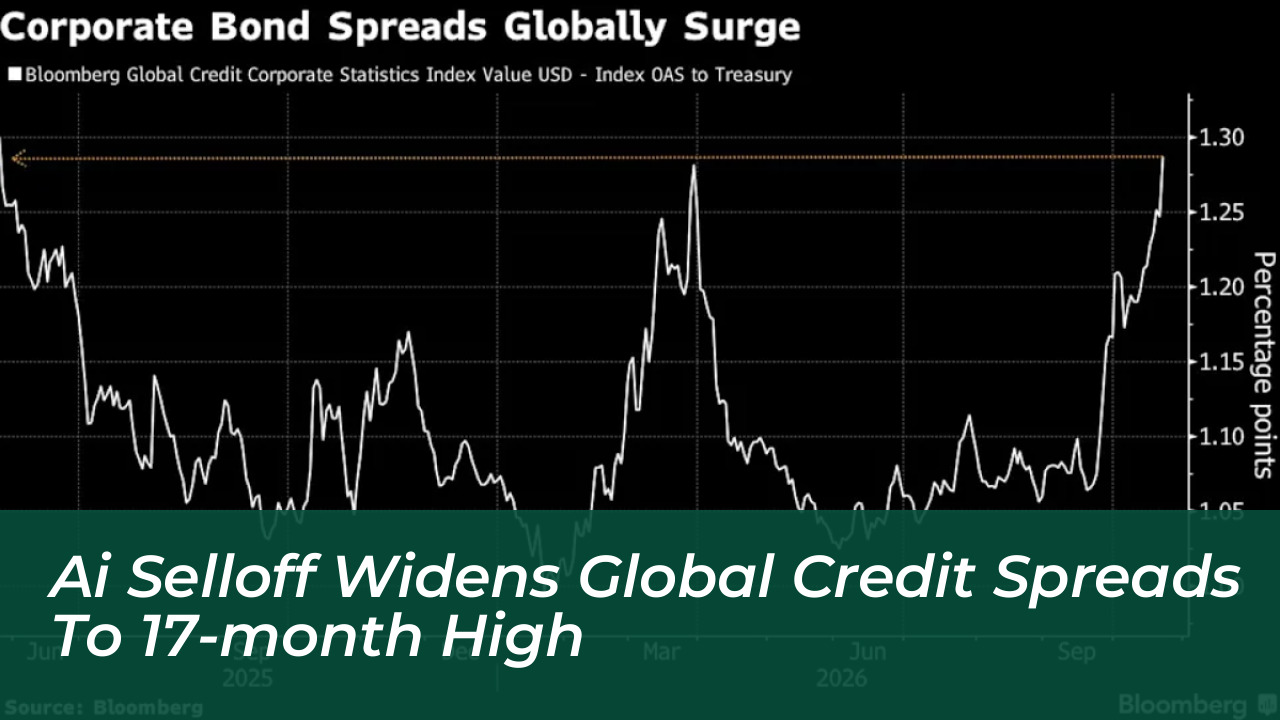

Growing concerns regarding artificial intelligence spending and escalating geopolitical tensions prompted investors to shift toward safer assets on Friday, October 23, 2026. This flight to safety pushed global corporate credit spreads to their widest levels since May 2025, according to Bloomberg index data.
Asian dollar bonds weakened concurrently with broader international credit markets as participants reassessed the financial risks tied to debt-funded AI investments. Investors increasingly questioned whether companies pouring capital into artificial intelligence infrastructure can generate sufficient profits quickly enough to justify their mounting expenditures.
Global Corporate Yield Premiums Reach 17-Month High
Global corporate bond yield premiums expanded to as much as 129 basis points, marking the widest margin recorded since May 2025. Simultaneously, spreads on dollar-denominated bonds issued by higher-rated Asian corporations climbed to their highest levels since July 2025, reflecting a widespread retreat from riskier asset classes.
The sudden repricing highlights deep market anxiety over the rapid, debt-financed expansion of the AI sector. As a consequence, U.S. Treasuries experienced a notable rally, marking one of their strongest single-day performances in more than two years.
Pressure Mounts on Major AI Borrowers and Neoclouds
The credit strain manifested visibly across prominent technology and cloud computing borrowers. CoreWeave, an Nvidia-backed cloud provider carrying approximately $50 billion in debt, saw its stock drop as much as 25% over a three-day stretch in mid-October. The cost of insuring CoreWeave’s debt surged past 1,000 basis points, signaling severe default stress, while its 2031 and 2032 junk bonds yielded between 15% and 16%.
Other major tech firms also faced upward pressure on borrowing costs. Meta Platforms disclosed future spending commitments reaching roughly $825 billion, heavily concentrated in AI computing power, up from nearly $700 billion in July. ICE Data Services estimated Meta’s five-year credit-default swaps (CDS) at around 119 basis points, a record high since the swaps began trading. Meanwhile, Oracle’s five-year CDS climbed to approximately 282 basis points.
Wall Street Divided Over AI Financing and Demand
The widening credit spreads have intensified debate among leading Wall Street figures regarding the sustainability of the AI boom:
- Ken Griffin (Citadel): Warned that investors are almost certainly inside a bubble, with businesses funding complex AI models without reliably capturing adequate financial returns.
- Jon Gray (Blackstone): Disputed comparisons to historical market bubbles like the 1990s telecom bust, characterizing current demand as “almost parabolic” and arguing that capacity is being built to satisfy existing demand rather than speculative hope.
Despite defending the market’s trajectory, Gray acknowledged that smaller AI-focused cloud providers have faced difficulties obtaining adequate financing, though he maintained they would eventually secure necessary capital sources.
IMF Warnings and the Circular Financing Loop
Market anxieties have been further compounded by findings published in the International Monetary Fund’s Global Financial Stability Report. The IMF highlighted that hyperscalers now account for approximately 10% of global investment-grade bond issuance since 2024, a sharp rise from under 1% previously.
The report detailed an interconnected “financing loop” where investors supply roughly $650 billion in debt and $300 billion in equity to AI firms. In return, these technology companies commit roughly $1.4 trillion in future revenue and equipment purchases back to those same investors. Analysts warn that if projected AI returns fall short, losses could simultaneously impact equity valuations, debt portfolios, and anticipated revenues across the financial sector.