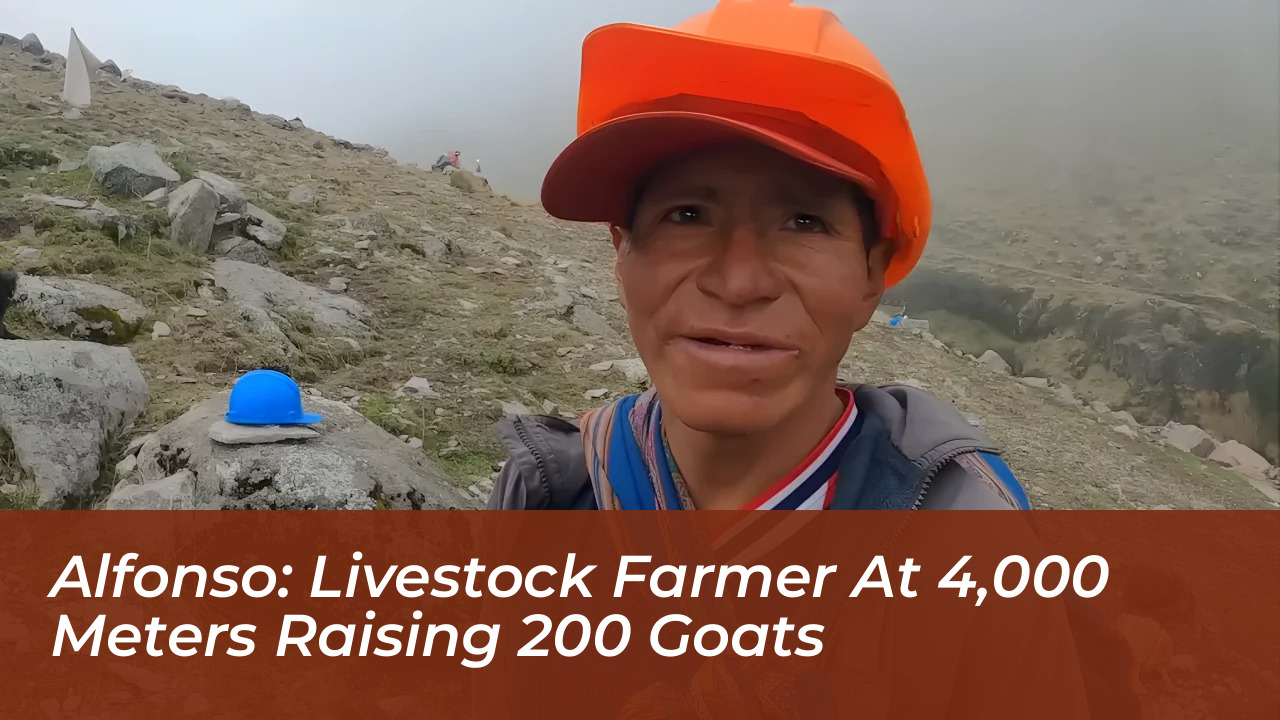

At more than 13,000 feet in elevation in the Peruvian highlands, Alfonso-affectionately known around town as “Juanchito” or “Jonshito”-has completely transformed his life. After spending over three decades living and working in Lima, Peru, a serious illness forced him to return to the rugged mountain terrain. Rather than letting adversity defeat him, he started from scratch as a farmhand, eventually deciding to bet on his own independence and build a sustainable future raising livestock.
Today, his home stands as a to resilience. Known locally as the “cork cottage,” his dwelling is constructed out of natural stone and straw, carefully reinforced with plastic sheeting to withstand the extreme weather of the high mountains. Guarding his property and protecting his valuable livestock is a loyal pack of ten dogs, providing security and companionship in the isolated summit landscape.
A Daily Routine Forged in Hard Work
Alfonso’s demanding daily schedule begins between 4:00 and 5:00 a.m. To warm his home and prepare for the day, he lights a fire using blackberry wood alongside dried cow manure-which he calls “muñeca”-meticulously collected and stored in large quantities during the dry season. Before heading out into the cold morning air, he cooks his own breakfast and lunch.
Between 6:00 and 6:30 a.m., Alfonso begins the essential task of milking his herd. He currently extracts fresh milk from 22 to 23 goats daily. Consistency remains critical: if a dairy goat goes unmilked for even two consecutive days, its milk production drops drastically. Once milking concludes, he turns his attention to the “guachitos”-the smallest or orphaned goat kids and lambs-which he carefully feeds by hand to ensure their survival.
“You have to love it… you feel for your animals. When it comes from the heart, you have to be there until the very end, protecting and caring for them,” explains Alfonso, reflecting on the deep calling required to work successfully with mountain livestock.
From Humble Farmhand to Independent Owner
Upon returning from Lima, Alfonso initially worked as a laborer for other established livestock farmers in the region, including Benito Vivas and Adela. However, a deep-seated desire for autonomy eventually outweighed the security of working for others. “I got tired of being a farmhand. I thought about my future and my animals. I prefer having my own animals,” he recalls.
He launched his independent venture with a modest start of just five goats, acquired slowly through strategic trades and direct purchases. Through ten to fifteen years of steady labor, he successfully expanded his flock into a thriving herd of nearly 200 animals, comprising both resilient goats and sheep adapted to high-altitude survival.
Traditional Artisanal Cheese Production
Beyond selling fresh milk, Alfonso leverages his daily harvest to produce artisanal goat cheese. His traditional method involves curdling the fresh milk with a standard rennet tablet, allowing the mixture to rest undisturbed for 25 to 60 minutes. He then works and kneads the curd entirely by hand, incorporating salt before pressing the mass into traditional wooden or plastic molds. The leftover scraps are molded into small, bite-sized cheeses known as “cachitos,” which he reserves exclusively for his own consumption.
The Journey to Town: Sacrifice and Commerce
To market his goods and acquire essential supplies, Alfonso makes the grueling trek down to town strictly on Tuesdays and Saturdays. The descent from his high mountain summit takes between three and four hours of steady walking. When he carries heavy blocks of fresh cheese, he departs in the pitch black of the early morning hours-around 1:00 a.m.-carrying three to four heavy blocks on his back.
He sells each kilo of his artisanal cheese for 10 soles to a loyal base of regular customers. After finishing his business in town, he rewards himself with a simple lunch of rice accompanied by fresh fried trout, which he catches himself in a nearby river. Throughout his journey, he maintains an attitude of deep gratitude toward God and the neighbors who assisted him along the way.
As he prepares for the long climb back to his mountain home, Alfonso points to the emotional anchors that keep him moving forward despite the physical demands of high-altitude life:
“My daughter especially is my driving force and a reason to keep moving forward for her, and my granddaughter especially, too.”
Frequently Asked Questions About High-Altitude Farming
What elevation does Alfonso live and farm at?
Alfonso operates his livestock farm at an altitude exceeding 4,000 meters (more than 13,000 feet) above sea level in the Peruvian highlands.
How many animals does Alfonso raise?
After starting with just five goats obtained through trades, Alfonso has built a thriving herd of nearly 200 animals, consisting of both goats and sheep.
How does Alfonso process his goat milk?
He milks between 22 and 23 goats daily. He consumes some fresh milk, feeds orphaned kids by hand, and crafts artisanal goat cheese by curdling fresh milk with rennet, kneading it by hand, and pressing it into traditional molds.
How often does Alfonso travel to town to sell his products?
He walks down to town twice a week, on Tuesdays and Saturdays. The journey takes between three and four hours each way, and when carrying cheese, he often starts his trek around 1:00 a.m.
What is the price of Alfonso’s artisanal cheese?
He sells his homemade goat cheese to regular customers in town for 10 soles per kilo.
What motivates Alfonso to maintain his difficult mountain lifestyle?
Despite the extreme weather, isolation, and hard physical labor, Alfonso draws his daily strength and motivation from his daughter and his granddaughter.