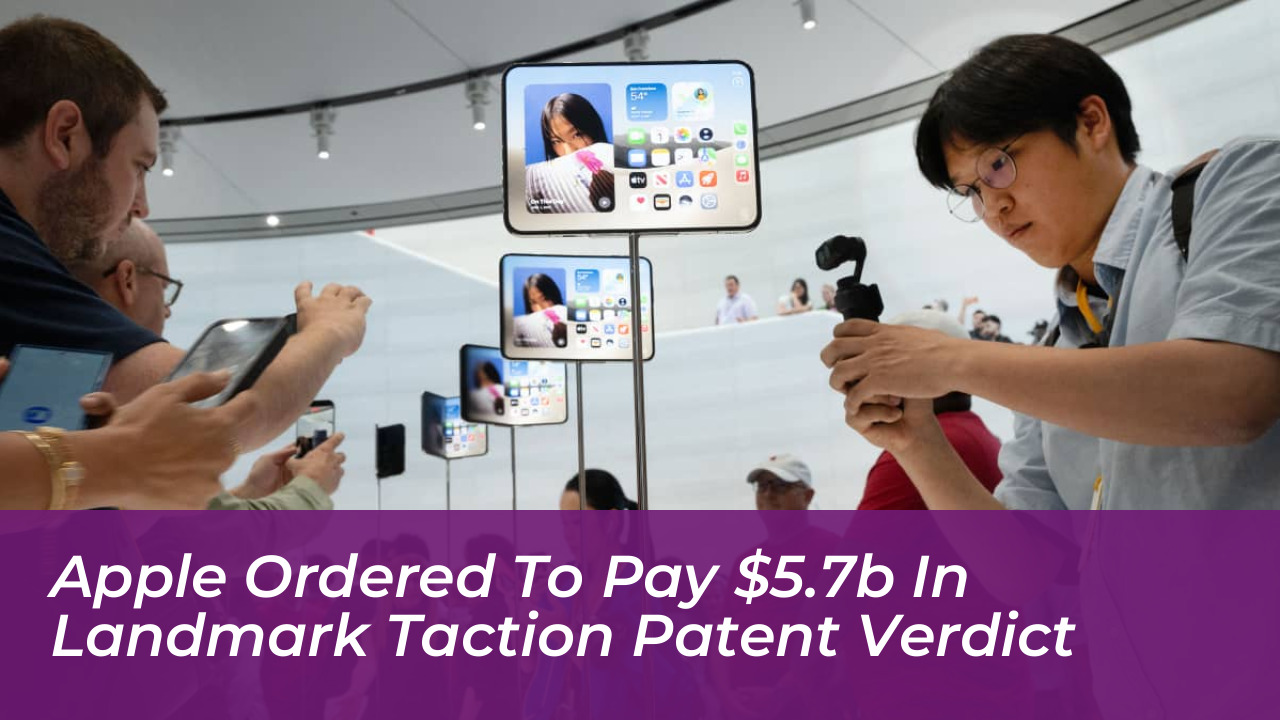
On Friday, September 26, 2026, a federal jury in San Diego delivered a landmark verdict ordering Apple Inc. to pay over $5.7 billion in damages to Taction Technology. The legal dispute centers on advanced haptic feedback technology embedded within millions of iPhones and Apple Watches. This multibillion-dollar ruling marks one of the largest intellectual property judgments in United States history, concluding a multi-year courtroom battle that nearly ended in dismissal before surviving an appellate resurrection.
- Introduction to the Landmark Taction Patent Verdict
- Origins of the Lawsuit: Taction Versus Apple
- The Taptic Engine and Alleged Infringement
- Apple’s Defense and Technical Arguments
- The 2023 Dismissal and Federal Circuit Revival
- District Court Summary Judgment
- Appellate Reversal by the Federal Circuit
- Inside the San Diego Trial and Verdict
- Retrial Proceedings and Jury Deliberations
- The .72 Billion Financial Assessment and Willfulness Finding
- Financial Backing and Litigation Funding
- Strategic Comparison: Similar High-Stakes Patent Battles Involving Apple
- Comparative Analysis of Major Apple IP Disputes
- Unexplored Angles and Content Gaps
- The Impact of Expert Exclusion on Damages Methodology
- Supply Chain and Hardware Redesign Pressures
- Future Outlook: Post-Trial Motions and Appellate Review
- Frequently Asked Questions
- What caused the legal dispute between Taction Technology and Apple?
- Why did the jury decide against a willfulness finding?
- Will Apple appeal this multibillion-dollar verdict?
Introduction to the Landmark Taction Patent Verdict
The trial in the U.S. District Court for the Southern District of California addressed complex questions regarding tactile transducers, engineering designs, and corporate accountability. While the legal teams prepare for intense post-trial motions and appellate reviews, the broader technology industry is closely monitoring the implications for hardware patents and consumer electronics design.
Federal juries rarely award sums exceeding five billion dollars in patent infringement suits, making this judgment an extraordinary outlier in intellectual property litigation. The financial magnitude of the verdict immediately triggered discussions regarding corporate risk management, patent portfolio evaluations, and the aggressive enforcement strategies employed by smaller technology developers against massive platform holders.
Origins of the Lawsuit: Taction Versus Apple
The Taptic Engine and Alleged Infringement
The legal confrontation began in April 2021 when Taction Technology filed a patent infringement lawsuit against Apple. Taction, a developer of specialized acoustic and vibration systems used in headphones and gaming headsets, accused the Silicon Valley giant of unlawfully adopting its proprietary vibration technology without authorization. At the center of the dispute is Apple’s proprietary Taptic Engine. This hardware component generates the physical taps, distinct buzzes, and nuanced vibrational responses that users experience when interacting with touchscreen controls on the iPhone or navigating menus on the Apple Watch.
Taction asserted that Apple’s engineering directly infringed upon two specific patents. The first is U.S. Patent No. 10,659,885, which covers specialized systems and methods for producing damped mechanical vibrations perceived through human touch. The second is U.S. Patent No. 10,820,117, which focuses on tactile transducers designed to regulate planar-motion vibration output in compact electronic devices.
Apple’s Defense and Technical Arguments
Throughout the proceedings, Apple strenuously denied any wrongdoing. The company maintained that its Taptic Engine operates on fundamentally different physical principles than the technology protected by Taction’s patents. Apple pointed to comparative testing performed during the trial to support its position that the internal mechanisms of its devices do not rely on Taction’s patented architecture.
Engineering witnesses testified for the defense, attempting to demonstrate that the coil placement, magnetic arrays, and structural mounting within the iPhone differed substantially from Taction’s design blueprint. Despite these technical defenses, the jury ultimately favored the plaintiff’s interpretation of how the hardware functioned in practice.
The 2023 Dismissal and Federal Circuit Revival
District Court Summary Judgment
The pathway to the $5.7 billion verdict was neither direct nor guaranteed. In 2023, U.S. District Judge Todd W. Robinson issued a summary judgment in favor of Apple, completely dismissing Taction’s infringement claims before the case ever reached a jury. Judge Robinson’s initial ruling hinged on two critical legal maneuvers: the judicial interpretation of specific claim language within Taction’s patents and the exclusion of key technical expert testimony offered by the plaintiff.
Summary judgment allows a court to terminate a lawsuit prematurely when the evidentiary record leaves no genuine dispute over material facts. With the expert testimony barred and the claim scope narrowed, Taction appeared to have lost its legal leverage, leaving many legal observers to assume the litigation was effectively finished.
Appellate Reversal by the Federal Circuit
However, the legal landscape shifted dramatically in August 2025. The U.S. Court of Appeals for the Federal Circuit, the specialized appellate court with exclusive jurisdiction over U.S. patent cases, revived the lawsuit. The appellate panel ruled that Judge Robinson abused his discretion by excluding portions of Taction’s expert witness testimony and committed legal error in interpreting the patent claims.
The Federal Circuit restored the underlying factual disputes regarding Apple’s hardware design, sending the case back to the Southern District of California for a full jury trial. This reversal set the stage for the dramatic courtroom showdown in late 2026.
Inside the San Diego Trial and Verdict
Retrial Proceedings and Jury Deliberations
The retrial commenced on September 14, 2026, under the supervision of Judge Robinson. Seven jurors listened to extensive technical arguments, engineering analyses, and expert testimonies regarding the mechanics of tactile feedback. After two days of intensive deliberations, the jury reached its verdict on Friday, September 26, 2026.
The panel determined that Apple infringed multiple claims across both Taction patents, culminating in a financial assessment of exactly $5,721,961,750. The intensity of the trial reflected the immense financial stakes, with attorneys on both sides presenting complex economic models and detailed teardowns of consumer electronics.
The $5.72 Billion Financial Assessment and Willfulness Finding
Despite the staggering size of the award, the jury delivered a nuanced finding: they concluded that Apple’s infringement was not willful. Under federal patent law, a finding of willful infringement empowers judges to triple the baseline damages as a punitive measure. By explicitly rejecting the willfulness allegation, the jury shielded Apple from potential trebling, though the base award alone stands as a historic financial figure.
This distinction highlights that the jury evaluated Apple’s conduct as falling short of malicious or deliberate piracy, even while finding that the commercial products crossed legal boundaries into patent infringement.
Financial Backing and Litigation Funding
High-stakes patent litigation frequently involves sophisticated institutional financing, and the Taction-Apple dispute is no exception. Court disclosures revealed that Gronostaj Investments LLC and Kenosha Investments LP provided outside financial backing for Taction’s legal campaign. Kenosha Investments has been linked in separate legal proceedings to Burford Capital, a prominent publicly traded litigation finance firm.
Litigation funders typically provide capital to smaller inventors or cash-strapped companies in exchange for a percentage of any eventual settlement or monetary judgment. The involvement of institutional finance highlights how heavily capitalized entities enable smaller enterprises to sustain protracted legal battles against trillion-dollar corporations.
Strategic Comparison: Similar High-Stakes Patent Battles Involving Apple
Comparative Analysis of Major Apple IP Disputes
Apple is no stranger to massive intellectual property disputes. The scale of the Taction verdict mirrors several other recent multi-million and multi-billion-dollar legal showdowns involving the company’s hardware and software ecosystems.
| Case Name | Year | Jury Award / Settlement | Core Technology at Issue |
|---|---|---|---|
| Taction v. Apple | 2026 | $5.72 Billion | Haptic feedback and Taptic Engine vibration patents |
| Masimo v. Apple | 2025 | $634 Million | Apple Watch pulse oximetry and health-sensor patents |
| Caltech v. Broadcom & Apple | 2020 | $1.1 Billion (Vacated) | Wi-Fi data transmission and error-correction coding |
| VirnetX v. Apple | 2010–2020 | Various ($625M initial) | Secure VPN, FaceTime, and networking protocols |
These historical precedents demonstrate that while massive verdicts are occasionally secured at trial, they frequently undergo substantial reductions, settlements, or total vacations upon reaching appellate review.
Unexplored Angles and Content Gaps
The Impact of Expert Exclusion on Damages Methodology
Because Taction’s primary damages expert faced initial exclusion earlier in the litigation history, legal analysts point out potential vulnerabilities in how the final royalty figure was calculated. Without standard expert testimony establishing an apportioned reasonable royalty rate tied strictly to the incremental value of the patented haptic feature, Apple’s defense team holds a potent weapon for post-trial relief.
Appellate leverage for Apple centers heavily on speculative jury calculations and the strict legal requirement for patent damage apportionment. If the Federal Circuit determines that the jury based its five billion dollar figure on the entire market value of the iPhone rather than the specific haptic module alone, the award faces severe downward pressure.
Supply Chain and Hardware Redesign Pressures
Beyond financial penalties, patent judgments involving core hardware components create severe operational headaches. Modifying deeply integrated hardware components in devices manufactured by the tens of millions presents immense supply chain challenges compared to issuing simple software patches.
If injunctions follow or if licensing negotiations fail, Apple may face pressure to alter future physical chassis designs in upcoming iPhone and Apple Watch iterations. Redesigning tactile feedback architecture without infringing active patents requires significant engineering lead time and capital expenditure.
Future Outlook: Post-Trial Motions and Appellate Review
Anticipated post-trial motions for judgment as a matter of law must be filed within 28 days of judgment entry under federal rules. Apple will undoubtedly challenge the verdict on grounds of insufficient evidence regarding infringement, improper jury instructions, and excessive damages calculations.
Historical Federal Circuit skepticism toward mega-verdicts suggests that this legal saga remains far from over. The likelihood of future appellate challenges points toward a lengthy judicial timeline before any final financial transfers occur.
Frequently Asked Questions
What caused the legal dispute between Taction Technology and Apple?
The dispute centers on Taction’s patented acoustic and vibration technology, which the company claims Apple unlawfully incorporated into the Taptic Engine used across iPhones and Apple Watches.
Why did the jury decide against a willfulness finding?
The jury concluded that Apple’s infringement was not willful, which protects the company from having the damages award trebled, even though the baseline $5.72 billion penalty remains intact.
Will Apple appeal this multibillion-dollar verdict?
Yes. Apple is expected to file extensive post-trial motions and eventually take the case back to the U.S. Court of Appeals for the Federal Circuit, following historical trends in mega-patent disputes.