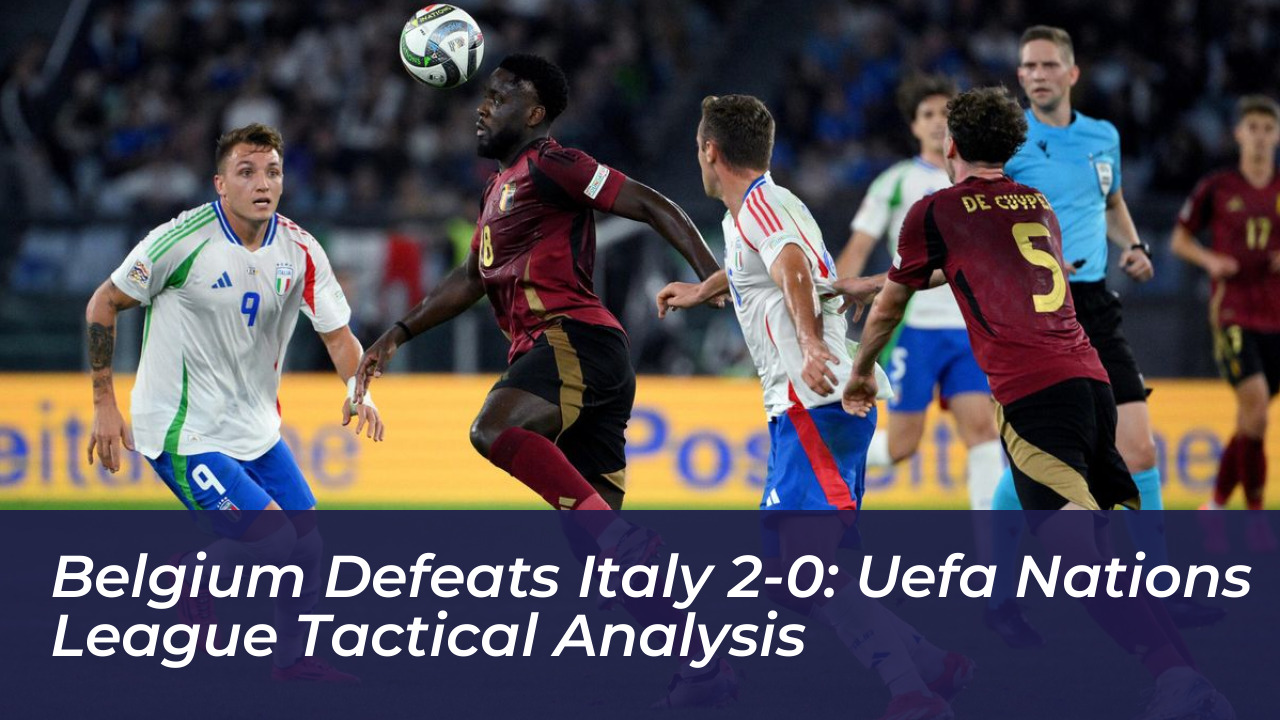
The Stadio Olimpico hosted a clash of contrasting fortunes as Belgium secured a clinical 2-0 victory over Italy in their opening fixture of the UEFA Nations League Group A1 campaign. This high-stakes encounter marked significant milestones for both national teams. Mark van Bommel made his managerial debut for the Belgian Red Devils following Rudi Garcia departure after the World Cup quarter-finals. Meanwhile, Roberto Mancini returned to the Italian dugout for his second spell as head coach, seeking to rebuild the Azzurri after consecutive play-off failures and the absence of a third straight World Cup appearance.
- Match Overview and Scoreline Breakdown
- Mark van Bommel Tactical Blueprint for Belgium
- Roberto Mancini Second Era Realities and Selection Choices
- Key Match Moments and Chronological Breakdown
- First Half: Opening Exchanges and Godts Breakthrough
- Second Half: Italian Pressure and Lukebakio Killer Blow
- Late Woodwork Frustration and Defensive Resilience
- Conclusion
Despite thousands of empty seats reflecting fan disillusionment, the atmosphere inside the Rome venue crackled with tension. Belgium executed a disciplined, counter-attacking masterclass. Goals from Mika Godts and substitute Dodi Lukebakio punished defensive lapses from the hosts. Italy dominated periods of possession and generated quality scoring chances. However, poor finishing, heroics from Belgian goalkeeper Senne Lammens, and tactical rigidity exposed deep structural flaws in the Mancini squad.
Match Overview and Scoreline Breakdown
The final scoreline of 2-0 accurately reflected Belgium defensive solidity and clinical execution against an Italian side that lacked a ruthless edge in the final third. The match unfolded in two distinct tactical phases. The first half saw Belgium weather early Italian pressure before capitalizing on a critical individual error. The second half featured an aggressive Italian onslaught that tested the Belgian rearguard, only for a devastating counter-attack to seal the three points.
Final Score: Italy 0 – 2 Belgium. Competition: UEFA Nations League, League A, Group 1, Matchday 1. Venue: Stadio Olimpico, Rome, Italy. Date: Friday, September 25, 2026. Goals: Mika Godts (20′), Dodi Lukebakio (69′). Referee: Daniel Siebert (Germany).
The statistical narrative highlights Italy inability to convert dominance into goals. While the Azzurri controlled large shares of territory and registered numerous attempts, Belgium maximized their transitional opportunities. Mark van Bommel set up his side in a pragmatic 4-2-3-1 formation that absorbed pressure and launched rapid vertical attacks through Kevin De Bruyne, Mika Godts, and Diego Moreira. Roberto Mancini deployed a familiar 4-3-3 system, incorporating inexperienced talents like Alessandro Romano and Nicolo Cambiaghi alongside seasoned veterans.
Mark van Bommel Tactical Blueprint for Belgium
Taking over the Belgian national team after a successful club coaching career, Mark van Bommel implemented an organized, high-intensity structure. Without several star players due to injuries, including Jeremy Doku, Leandro Trossard, and Thibaut Courtois, Van Bommel relied on a blend of experienced pillars and emerging prospects to deliver this statement win.
Midfield control formed the foundation of the team. Kevin De Bruyne dictated the tempo in advanced areas, supported by the industrious Youri Tielemans and Nicolas Raskin in the double pivot. Meanwhile, defensive discipline was maintained as center-backs Brandon Mechele and Nathan Ngoy held a low-to-medium block, restricting space between the lines for Italian attackers like Moise Kean and Pio Esposito.
Vertical transitions served as the primary weapon. Wingers Mika Godts and Diego Moreira exploited high Italian defensive lines with explosive pace and direct running. Behind them, goalkeeping heroics from Senne Lammens delivered a stellar performance, marshaling his area and denying Italy with crucial reflex saves.
Roberto Mancini Second Era Realities and Selection Choices
Roberto Mancini return to the Italy bench was meant to inject optimism into a demoralized football federation. Instead, the match laid bare the immense rebuilding task ahead. Mancini selected a hybrid starting XI that blended established names like Gianluigi Donnarumma, Giovanni Di Lorenzo, and Nicolo Barella with experimental selections.
Alessandro Romano, the 20-year-old playmaker recently switching allegiance from Switzerland, endured a difficult full debut, highlighted by the misplaced pass that led to Belgium opening goal. Alongside him, Nicolo Cambiaghi was deployed in the front three, creating decent service but lacking the clinical support required to break down the rigid Belgian block.
Defensive instability further plagued the hosts. Injuries to Alessandro Bastoni and Federico Dimarco forced a makeshift backline featuring Diego Coppola alongside Gianluca Mancini. Tactical adjustments in the second half brought on Davide Frattesi, Daniel Maldini, and debutants Momo Zoma and Issa Doumbia, yet structural attacking disconnects persisted throughout the ninety minutes.
Key Match Moments and Chronological Breakdown
The progression of the match swung on pivotal moments of individual brilliance and costly defensive errors. Belgium executed their game plan with ruthless efficiency, while Italy lamented missed chances.
First Half: Opening Exchanges and Godts Breakthrough
Italy started brightly as Charles De Ketelaere drew an early reaction save from Gianluigi Donnarumma in the seventh minute. Shortly after, Pio Esposito struck the post, though the assistant referee raised the offside flag to dampen home celebrations. Moise Kean also tested Senne Lammens from distance.
The defining moment of the first half arrived in the 20th minute. Alessandro Romano surrendered possession cheaply in midfield with a loose pass. Kevin De Bruyne instantly intercepted, slipping a perfectly weighted ball into the path of Mika Godts. The Paris Saint-Germain youngster drove into the penalty area, cut sharply past two Italian defenders, and fired a low, clinical shot past Donnarumma for his first international goal.
Donnarumma kept Italy afloat with a spectacular double save to deny De Ketelaere and Nicolas Raskin, followed by a one-handed reflex stop against another Godts effort. Despite a late chance where Moise Kean hit the side netting from a Cambiaghi cross, Belgium entered halftime nursing a deserved 1-0 lead, greeted by loud jeers from the Olimpico crowd.
Second Half: Italian Pressure and Lukebakio Killer Blow
Italy emerged from the interval with intense urgency. Within seconds of the restart, Moise Kean unleashed a powerful point-blank volley from a Cambiaghi cross, only for Lammens to produce a stunning foot-save. Lammens denied Esposito moments later at the near post as Italy pinned the visitors deep in their own half.
Just as Italy looked likely to equalize, Belgium struck on the counter-attack in the 69th minute. A swift transition caught the Italian defense stretched. Dodi Lukebakio, introduced from the bench, received possession in space, drove toward the edge of the box, and unleashed a sublime long-range strike into the top corner, leaving Donnarumma helpless.
Late Woodwork Frustration and Defensive Resilience
Trailing by two goals, Roberto Mancini turned to his bench, making desperate tactical changes and handing international debuts to Momo Zoma and Issa Doumbia. The changes injected fresh energy, but the finishing touch remained elusive for the Azzurri.
Riccardo Calafiori and Davide Frattesi both came close for the home side with headers from set pieces. The ultimate symbol of Italian frustration arrived late in the game when Giorgio Scalvini rose highest in a crowded box, hammering a header against the underside of the crossbar that bounced away to safety, epitomizing Italy lack of a clinical edge.

Conclusion
Belgium leaves Rome with three precious points, built on tactical discipline, clinical execution, and stubborn defensive resistance. Mark van Bommel begins his tenure on the ideal note, proving that the Red Devils can adapt and win even amidst a wave of high-profile injuries.
For Italy, the rebuilding process under Roberto Mancini demands urgent attention in the final third. The supporters at the Stadio Olimpico made their frustrations clear at the final whistle. The Azzurri coaching staff must quickly address defensive vulnerabilities and scoring inefficiencies before their next fixture if they hope to salvage this Nations League campaign.