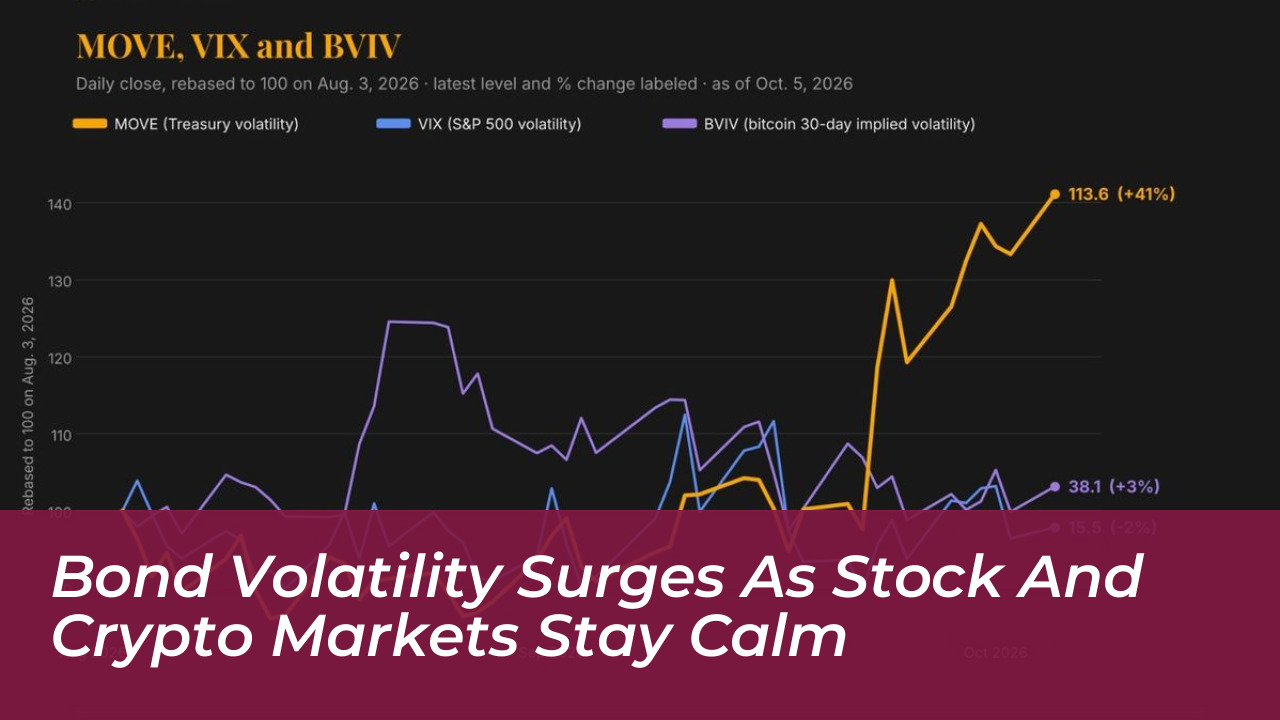


A growing divergence between surging bond market volatility and remarkably calm equity and cryptocurrency markets has macro observers warning of potential turbulence ahead, according to market data analyzed as of October 6, 2026. While core funding instruments register intense stress, risk assets continue to hover near low-volatility baselines.
The Mechanics of the MOVE Index Surge
The ICE BofA U.S. Bond Market Option Volatility Estimate, widely known as the MOVE Index, jumped 46% in June and reached roughly 116. This put it near its March high and marked its highest reading since April 2025. The index acts as the bond market’s equivalent to the equity VIX. It measures expected volatility in U.S. Treasuries using options on 2-, 5-, 10-, and 30-year notes, with the 10-year receiving the heaviest weight.
Kurt S. Altrichter, wealth manager and writer of the RiskSIGNAL Report, noted the historical precedent of these shifts. “The MOVE index is making higher lows while the VIX makes lower highs. The MOVE leads: it flashed turbulence before the VIX in 2022, in 2023, and at the start of the Iran war. Stocks are usually the last to get the message,” Altrichter stated.
Treasury notes underpin global finance and serve as primary collateral. Because of this, heightened volatility in these instruments can tighten financial conditions and increase borrowing costs across global markets. Corporate debt has already felt the immediate pressure. Cboe reported that investment-grade and high-yield bond volatilities climbed from bottom-tier levels to their 79th and 84th percentile highs respectively over a brief two-week period.
Equities and Bitcoin Remain Unmoved
In stark contrast to the turbulence in government debt, the S&P 500’s volatility index (VIX) and Bitcoin’s 30-day implied volatility gauge (BVIV) remain anchored near year-to-date lows. Volmex’s annualized 30-day bitcoin implied volatility index (BVIV) has stayed subdued around 37, closely tracking its year-to-date low of 35. Meanwhile, the Cboe VIX hovers near its yearly low at approximately 14.
This stability persists even as the U.S. 10-year Treasury yield briefly hit 5.2% before easing slightly to 5.163%. Global factors, including rising oil and diesel prices driven by tensions in the Middle East, have complicated the inflation outlook. These factors have forced traders to reevaluate the path of central bank monetary policy.
Asset performance correlations further highlight this disconnect. Over a recent 20-day window, the correlation between the MOVE Index and the equity VIX slipped to −0.06, turning slightly negative for the first time since April 2024. The correlation between the MOVE Index and Bitcoin’s BVIV dropped even further to −0.37. This illustrates a pronounced divergence where bond traders actively pay up for rate protection while crypto and stock markets ignore the warning signals.
Implications for Global Financial Conditions
Analysts emphasize that historical patterns suggest equity and crypto markets eventually price in sustained stress originating from core sovereign debt sectors. When the MOVE Index previously neared current levels in March, the S&P 500 stood near 6,350 before climbing roughly 21% to 7,704.

However, market participants tracking liquidity constraints note that sustained high bond market volatility increases risk premiums globally. Whether steady exchange-traded fund (ETF) inflows and supportive regulatory frameworks can continue to insulate cryptocurrencies and equities from broader funding squeezes remains the central question for portfolio managers heading into the final quarter of 2026.
Frequently Asked Questions
What is the MOVE Index?
The MOVE Index (ICE BofA U.S. Bond Market Option Volatility Estimate) measures expected volatility in the U.S. Treasury market over the next month using options on 2-, 5-, 10-, and 30-year government bonds.
Why are bond and stock volatilities moving in opposite directions?
Rising energy prices, climbing global yields, and inflation concerns have spiked hedging demand in the bond market. Meanwhile, equities and crypto have maintained low volatility due to strong inflows, positive earnings sentiment, and supportive digital asset regulations.
What does a rising MOVE Index mean for borrowing costs?
Because U.S. Treasuries serve as global financial collateral, higher volatility typically tightens financial conditions, increases risk premiums, and pushes up borrowing costs across corporate debt and consumer lending sectors.
How does Bitcoin volatility compare to Treasury volatility?
Bitcoin’s 30-day implied volatility index (BVIV) has stayed subdued near 37, close to its yearly low, showing virtually no correlation with the sharp upward spikes observed in the U.S. bond market.