- The Economic Reality: Why Talk Inside the Castle Is Cheap
- The Math of Deception and Cognitive Biases
- Classroom Experiments Demonstrate Traitor Dynamics
- How Celebrity Status Alters Strategic Play
- Key Factors Impacting the 2026 Contestants
- Frequently Asked Questions
- When does The Celebrity Traitors 2026 air?
- Why are castle discussions considered economically cheap?
- How many contestants are participating in the 2026 celebrity edition?
- What role do pre-existing relationships play in the game?
- How successful are humans at detecting lies?
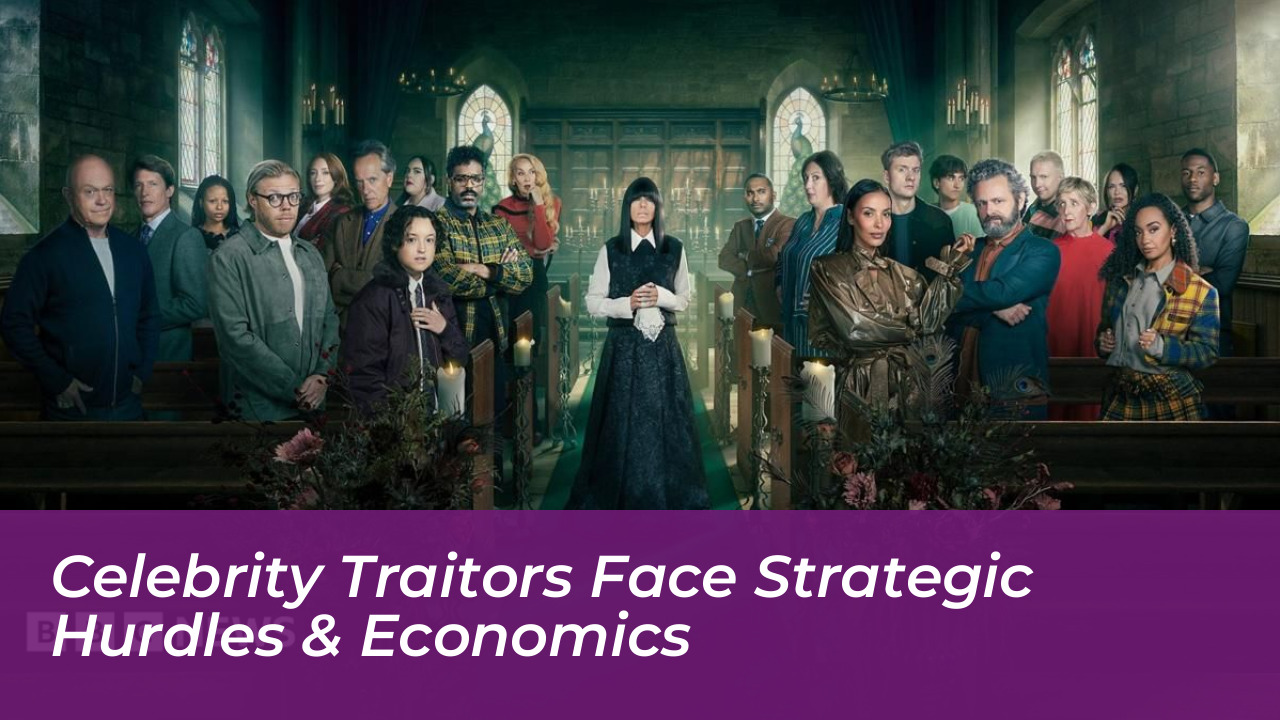
The 2026 edition of The Celebrity Traitors brings a high-profile cast to Ardross Castle in the Scottish Highlands. The cast features notable figures such as singer James Blunt, mathematician Hannah Fry, broadcaster Amol Rajan, and actors Bella Ramsey and Richard E. Grant. While viewers often assume tactical mastery is straightforward, psychological research and economic theory reveal severe, systemic strategic obstacles that render standard castle discussions virtually useless.
The Economic Reality: Why Talk Inside the Castle Is Cheap
The BBC reality game show pits a large group of faithful participants against a smaller, hidden contingent of traitors. They play for a shared charity jackpot hosted by Claudia Winkleman. However, economic principles dictate that conversation within the castle walls is fundamentally cheap. Because statements made by players cannot be legally enforced, independently verified, or checked against true intent, words carry no inherent value.
Any contestant can possess a motive to deceive, whether protecting a traitorous identity or deflecting suspicion as a faithful. Consequently, their verbal declarations become unreliable. Actions taken by traitors during round-table debates mirror the exact behaviors of innocent faithfuls. Traitors can pose clever questions, float complex theories, look visibly uneasy, or defend themselves with profound emotion. A faithful participant can execute every single one of these actions identically, rendering verbal listening and interrogation functionally futile.
The Math of Deception and Cognitive Biases
Statistical realities further compound the challenge for high-profile contestants. Across more than 200 psychological studies on deception, humans successfully identify liars only about 54% of the time, which is marginally better than a coin flip. At the start of the 2026 series, with an expanded field of 21 players and an estimated three traitors, any accusation carries a severe mathematical disadvantage.
Without hard evidence, human psychology tends to prioritize vivid behavioral descriptions over dry statistics. Psychological experiments demonstrate that colorful descriptions frequently overpower baseline probabilities. When contestants react to visible cues-such as appearing defensive, going quiet, or agreeing too quickly-they reach for noticeable anomalies rather than evaluating the cold mathematics of suspicion.
Classroom Experiments Demonstrate Traitor Dynamics
Academic simulations involving economics undergraduates provide clear insights into game behavior. In controlled trials where students received randomized, meaningless observations about peers, such as appearing calm before the game, early round discussions consistently targeted the most outspoken participants. Confidence was routinely misread as guilt.
Only in later rounds did participants successfully isolate and banish hidden players. This success happened when groups began reasoning from verifiable, unfakable evidence, specifically voting records showing who voted for whom. In the television version, where viewers possess omniscient knowledge of traitor statuses, these human errors, misdirected confidences, and paranoid theories create the core entertainment value of the program.
How Celebrity Status Alters Strategic Play
Beyond basic game theory, the celebrity dynamic introduces unique psychological variables absent in civilian series. Cast members enter the historic Scottish setting with pre-existing professional reputations and personal relationships. Broadcasters like Clare Balding and Kate Garraway share common ground, while real-life friends such as Paloma Faith and Alan Carr establish natural alliances through homophily. Homophily is the psychological tendency for similar individuals to flock together. Alan Carr notably triumphed in the previous celebrity spin-off.
However, star status also strips away anonymity. Civilian players can alter their presentation, accents, or backstories to project trustworthiness. Celebrities live under public spotlights where private and working lives are already heavily documented, making deceptive reinvention far more difficult.
Key Factors Impacting the 2026 Contestants
- Unverified Communication: Nothing spoken at the round table is binding or verifiable.
- Behavioral Overlap: Traitors and faithfuls utilize identical emotional defenses and questioning tactics.
- Statistical Odds: Early accusations rely on intuition rather than favorable probabilities.
- Pre-Existing Networks: Friendships and professional pairings drive natural alliances and potential betrayal trauma.
- Altruism vs. Glory: Playing for charity creates mixed motivational drivers compared to standard cash prizes.
As the 10-episode series unfolds on BBC One, the intersection of economic theory, psychological deception, and pre-existing fame will continue to test the contestants. Boffins like Hannah Fry and seasoned actors like Michael Sheen must attempt to overcome the brutal mathematical and strategic hurdles built into the format.
Frequently Asked Questions
When does The Celebrity Traitors 2026 air?
The second celebrity series premieres on Thursday, October 1, at 8:00 PM on BBC One with an extended 75-minute opening episode, airing twice weekly on Thursdays and Fridays.
Why are castle discussions considered economically cheap?
According to economic theory, talk is cheap because statements are non-binding and unverifiable. Because players can lie without immediate penalty, words cannot be relied upon to prove innocence or guilt.
How many contestants are participating in the 2026 celebrity edition?
The field has expanded to 21 high-profile contestants, up from 19 in the inaugural celebrity run, filmed at Ardross Castle in the Scottish Highlands.
What role do pre-existing relationships play in the game?
Contestants often enter knowing each other professionally or personally. This leads to natural alliances based on homophily, though these bonds can also cause deeper feelings of betrayal if broken.
How successful are humans at detecting lies?
Psychological research across more than 200 studies shows that humans successfully identify deception only about 54% of the time, making unverified accusations largely unreliable.