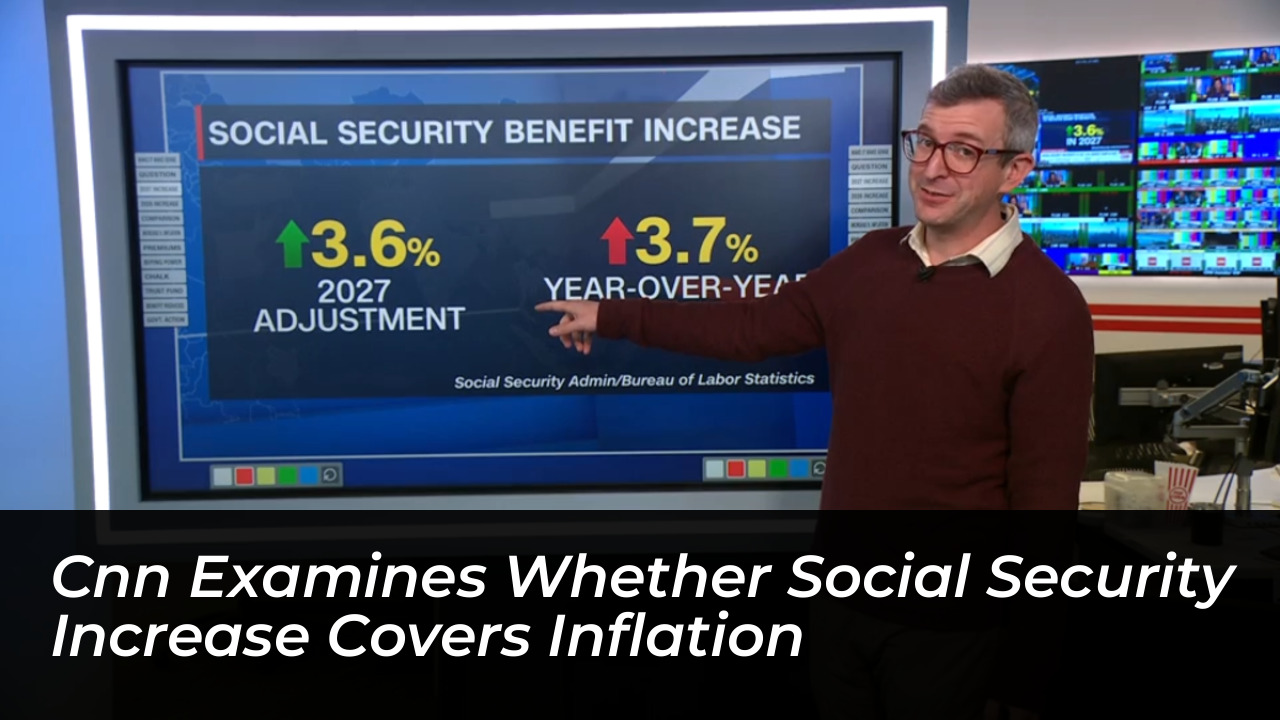

Millions of Social Security recipients face renewed questions about the true purchasing power of their benefits. A newly announced 3.6% cost-of-living increase fell slightly below the reported 3.7% inflation rate. This financial dilemma came under close scrutiny on October 19, 2026. CNN Business Executive Editor David Goldman appeared on CNN’s The Situation Room with anchor Pamela Brown to discuss whether the annual adjustment covers rising household expenses.
The core issue is a tight mathematical gap between government benefit adjustments and consumer price tracking indexes. The 3.6% adjustment raises Social Security payments for tens of millions of Americans. However, the 3.7% inflation figure highlights how rising prices continue to affect everyday necessities like groceries, utilities, and healthcare.
Breaking Down the Numbers: COLA Versus Inflation
The Social Security Administration announced the 3.6% cost-of-living adjustment (COLA). This is the largest increase to retirement benefits since 2023, when recipients received an 8.7% boost during severe post-pandemic inflation. For the average retiree, the 3.6% bump adds an extra $75 per month starting in January, according to federal agency data. Around 76 million Americans rely on these adjustments for financial stability.
During their discussion on The Situation Room, Goldman and Brown evaluated whether a 0.1 percentage point difference leaves older adults falling behind. Independent policy analysts and advocacy groups note that standard COLA calculations often fail to mirror the spending patterns of seniors. Seniors typically spend larger portions of their fixed incomes on medical care and essential goods.
The Impact of Medicare Premiums and Rising Costs
Gross benefit increases do not land entirely in retirees’ pockets. Deductions for Medicare premiums frequently reduce annual COLA raises. Standard monthly premiums for Medicare Part B are projected to rise to $209.50, directly impacting the net amounts available to seniors.
About 40% of beneficiaries aged 65 and older depend on Social Security for at least half of their income. For these retirees, even minor gaps between inflation and benefit bumps force difficult budgeting choices. Many older Americans have depleted emergency savings, accumulated credit card debt for routine groceries, or cut back on home heating during colder months.
Legislative Alternatives and Future Outlook
The mismatch between annual benefit increases and cost-of-living realities has reignited discussions on Capitol Hill about how inflation is measured for seniors. Lawmakers and think tanks have proposed switching the tracking index. They want to move from the Consumer Price Index for Urban Wage Earners and Clerical Workers (CPI-W) to alternatives like the Consumer Price Index for the Elderly (CPI-E), which theoretically better captures senior spending habits.
Financial experts emphasize that monitoring the balance between government-calculated adjustments and actual market inflation remains critical for household financial security. CNN’s coverage highlights that until structural adjustments match consumer realities, millions of older Americans will continue to feel the squeeze of rising expenses.