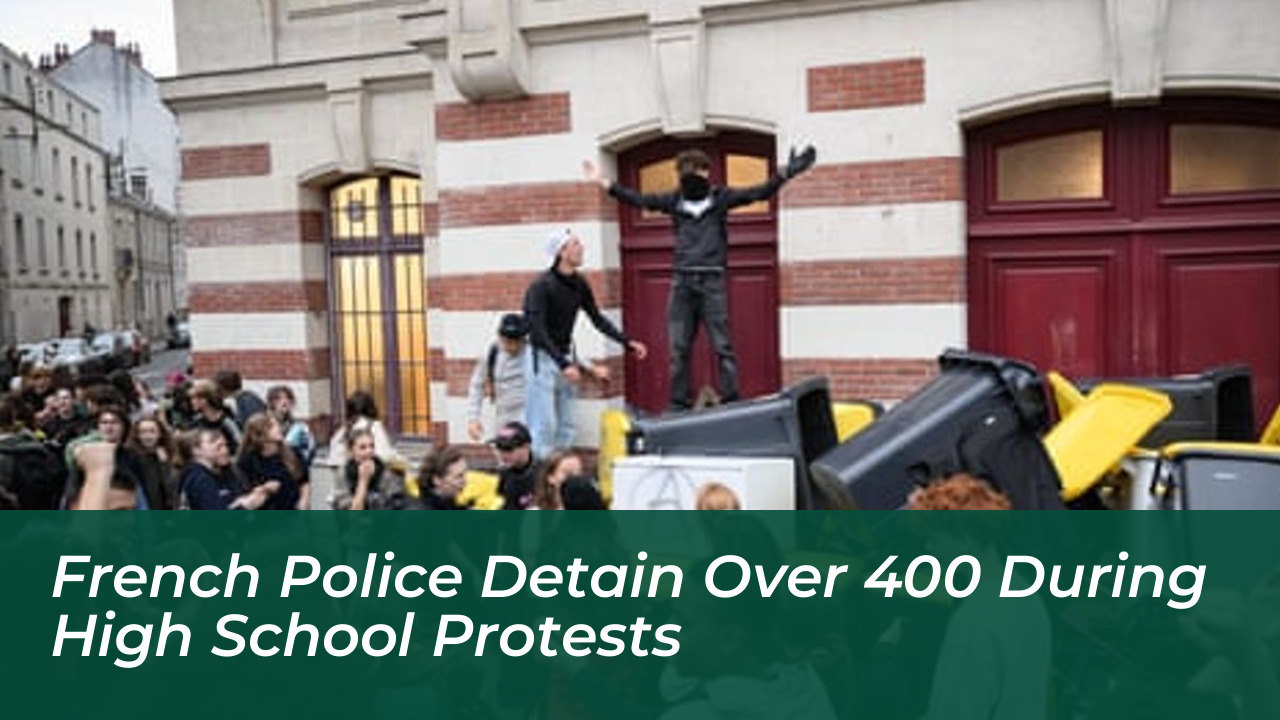
French police detained more than 400 people on Tuesday, September 29, 2026. The vast majority of those detained were minors. The arrests occurred as nationwide high school demonstrations over overcrowded classrooms and staff shortages turned violent. According to officials, the unrest disrupted at least 400 educational facilities out of roughly 3,700 nationwide.
- Scale of the Disruption and Injuries
- Political Repercussions and Public Sector Strikes
- Core Grievances of the Student Movement
- Frequently Asked Questions
- Why did French high school students start protesting?
- How many people were detained during the protests?
- Which cities were most affected by the unrest?
- Were there any injuries reported during the clashes?
- Did other groups join the demonstrations?
The protests began the previous week in the Île-Défense region around Paris. They quickly spread to major urban centers including Lille, Bordeaux, Rennes, Nantes, and Marseille. Demonstrators blockaded entrances, set fire to trash bins, vandalized bus stops, and hurled projectiles such as paving stones, glass bottles, and, in several instances, hydrochloric acid at law enforcement officers.
Scale of the Disruption and Injuries
The French Education Ministry reported that approximately 400 high schools experienced disruptions, with dozens facing full blockades. Interior Minister Laurent Nuñez stated on BFMTV that 440 individuals had been detained across the national territory. He noted that roughly two-thirds of those detentions resulted in formal police custody.
The violent clashes left 48 law enforcement officers injured, alongside ten teachers and several students. Teachers at several institutions attempted to form protective human chains around protesting teenagers to shield them from escalating police interventions involving batons and tear gas.
Political Repercussions and Public Sector Strikes
The high school demonstrations coincided with broad nationwide walkouts by public sector unions. These unions were protesting government spending cuts and proposed budget measures under Prime Minister Sébastien Lecornu. While standard union marches involving teachers, civil servants, and hospital staff largely proceeded without major incidents, the student blockades drew sharp rebukes from government officials.
Prime Minister Lecornu labeled any escalation of the student movement as irresponsible, pointing to fires and fireworks near schools. Concurrently, political tensions mounted after hard-left figures like Jean-Luc Mélenchon accused the government of institutionalized repression against harmless youth. Ministers swiftly denounced this claim as an unwarranted partisan escalation.
Core Grievances of the Student Movement
Student unions, including the Union Syndicale Lycéenne, defended the demonstrations as a legitimate response to a broken education system. Protesters cited unsustainable conditions. These included classes packed with up to 34 students, severe teacher shortages, and exhausting daily schedules running from early morning to evening.
Education Minister Édouard Geffray acknowledged the fundamental right to demonstrate. However, he condemned the property damage and violence as indefensible. He emphasized that blockading schools ultimately endangers the safety of both students and educational personnel.
Frequently Asked Questions
Why did French high school students start protesting?
Students initiated the protests to demand better conditions. They cited overcrowded classrooms with up to 34 students, severe teacher shortages, exhausting daily timetables, and uncomfortably hot facilities.
How many people were detained during the protests?
Interior Minister Laurent Nuñez confirmed that over 400 people, mostly minors, were detained across France on Tuesday, September 29, 2026. About two-thirds of them were placed in police custody.
Which cities were most affected by the unrest?
While the movement originated in Paris, violent clashes and blockades also spread to Lille, Bordeaux, Rennes, Nantes, and Marseille.
Were there any injuries reported during the clashes?
Yes. Officials reported that 48 law enforcement officers, ten teachers, and multiple students sustained injuries during the demonstrations.
Did other groups join the demonstrations?
The student blockades coincided with nationwide strikes and marches by public sector unions, including teachers and civil servants, protesting government budget cuts and working conditions.