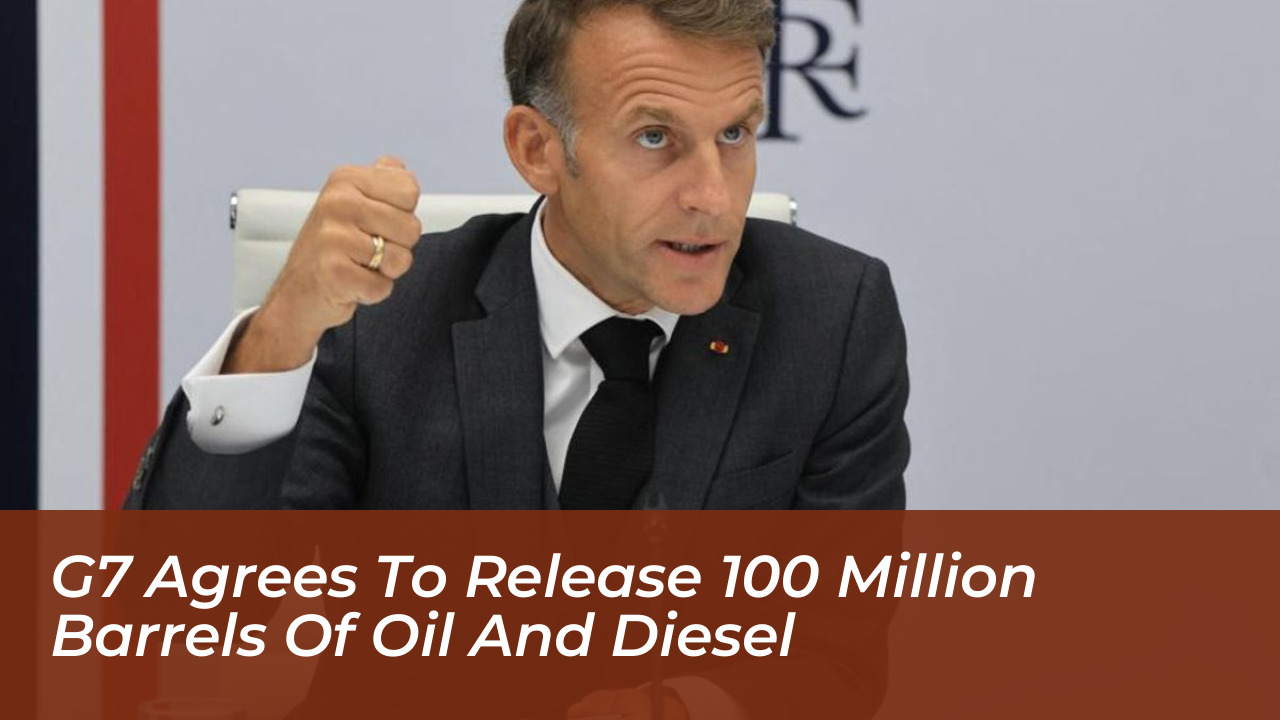
Leaders from the G7 bloc of advanced economies agreed on Friday to release up to 100 million barrels of crude oil and diesel from strategic reserves. The coordinated international action aims to ease severe global supply bottlenecks, stabilize surging consumer energy prices, and avert potential supply disruptions caused by ongoing conflicts in the Middle East.
Coordinated Release and Timeline
The joint decision follows a virtual meeting of G7 leaders presided over by French President Emmanuel Macron, whose country currently holds the rotating presidency of the group. According to the official joint statement, the 100 million barrels will be released under the coordination of the International Energy Agency (IEA) over a four-month period.
Crucially, the release features a frontloaded component. Member nations committed to a substantial deployment of diesel within the first 20 days to immediately target soaring fuel costs that have heavily impacted logistics, agriculture, and everyday consumers.
Averting U.S. Export Restrictions
The breakthrough agreement successfully averted a potential trade crisis triggered by U.S. President Donald Trump. Facing mounting pressure ahead of the November midterm elections and lagging approval ratings regarding the economy, President Trump had threatened to ban domestic diesel exports to force lower prices for American consumers.
While an American export ban would have brought short-term relief to U.S. drivers, experts warned it would have choked off vital supplies to import-reliant nations like the United Kingdom, Canada, and various European countries, driving international prices even higher. In response to the G7 pact, which included commitments from the U.S., UK, Canada, Japan, Germany, Italy, and France alongside European Union representation, President Trump posted on social media:
Europe has just agreed to release a massive amount of their heavily stocked Diesel Oil. The process will begin immediately. Thank you for your attention to this matter!
As part of the diplomatic resolution, G7 members formally committed to refraining from mutual energy export restrictions. The joint statement called on all global producers to avoid implementing bans that could further exacerbate market tensions.
Impact on Global Markets and Local Pump Prices
Global energy markets have experienced unprecedented volatility due to the ongoing U.S.-led war with Iran and choked shipping lanes through the vital Strait of Hormuz. These geopolitical disruptions caused international crude oil benchmarks to climb above $100 a barrel, subsequently pushing retail fuel costs to historic highs.
In the United Kingdom, motoring groups reported that average diesel prices breached the psychological threshold of £2 per litre for the first time. Similar pain was felt across North America, where Canadian diesel prices surged past $2.63 per litre in regions like Vancouver, placing immense financial strain on transport truck drivers, farmers, and delivery networks.
International Energy Agency (IEA) Chief Fatih Birol noted that prices began reacting positively to the announcement. Energy analysts and officials, including UK Foreign Secretary Ed Miliband and European Commission President Ursula von der Leyen, welcomed the intervention, emphasizing that the coordinated release will build supply chain resilience and shield households and businesses from further price shocks.
Frequently Asked Questions
Why did the G7 agree to release oil and diesel reserves?
The G7 nations acted to combat unprecedented volatility in global energy markets, skyrocketing consumer fuel prices, and supply chain bottlenecks driven largely by the conflict in the Middle East and transportation disruptions through the Strait of Hormuz.
How much oil and diesel is being released?
Member countries will release a combined total of up to 100 million barrels of crude oil and petroleum products over a four-month period, which includes a frontloaded, substantial deployment of diesel within the first 20 days.
Who oversees the release of these strategic reserves?
The coordinated release is managed and implemented through the framework of the International Energy Agency (IEA) and its 32 member countries.
Did President Trump go through with the U.S. diesel export ban?
No. After European nations and G7 partners agreed to step up and release substantial domestic reserves onto the market, the threat of a U.S. export ban was averted. G7 members also agreed in writing to refrain from imposing energy export restrictions on each other.
How does this impact everyday consumers?
The injection of 100 million barrels into the global market is designed to calm market nerves, increase supply availability, and lower soaring retail prices for diesel and petrol at the pump, ultimately reducing operational costs for haulage, agriculture, and public transport.