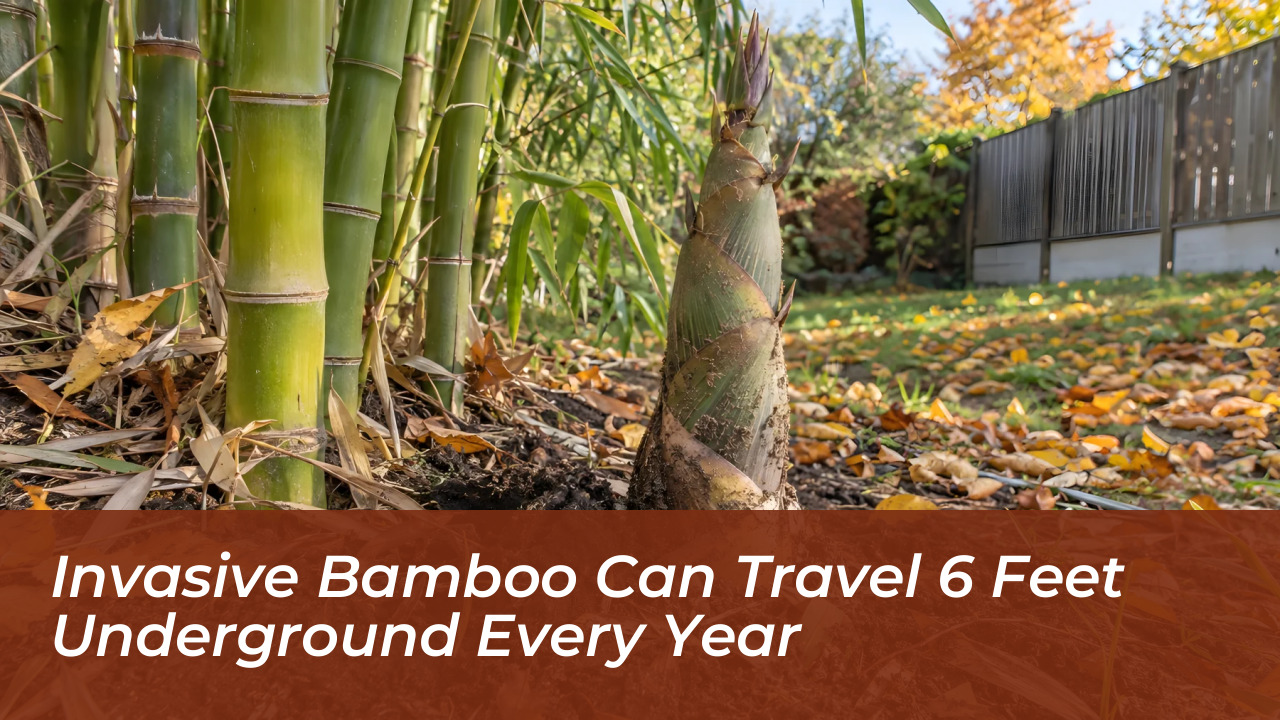
Aggressive running bamboo species send underground rhizomes traveling between 1 and 2 meters (roughly 3 to 6.5 feet) every single year. They push straight beneath standard privacy fences and surface deep inside neighboring yards. In extreme conditions, these underground runners can sprint up to 15 to 20 meters. This turns a quick privacy screen into an expensive structural nightmare that cracks patios and sparks severe property line disputes.
Homeowners often plant running varieties like Phyllostachys in the fall to establish a tall, dense living wall against adjoining lots. While the leafy culms provide immediate visual seclusion above ground, the plant wages an unseen expansion below the surface. Without a specialized physical deflector installed before planting, normal wire or wooden fences offer zero resistance to subterranean shoots searching for open soil.
How Running Bamboo Breaches Property Boundaries
Unlike clump-forming varieties, running bamboo relies on horizontal root-like stems called rhizomes that colonize every pocket of loose soil they encounter. These underground stems spread indiscriminately into neighboring lawns, flowerbeds, paving joints, and the edges of concrete patios. Within just three growing seasons, a colony can expand multiple yards past the boundary line.
When spring arrives, new shoots do not emerge politely along the fence line. They erupt straight through turf and hardscaping several feet into adjoining properties. Standard garden borders and shallow gravel trenches cannot redirect this horizontal force. Underground rhizomes navigate freely below standard boundary fences, forcing shoots upward through paving slabs, decorative borders, and manicured lawns yards away from the parent grove.
The High-Density Polyethylene Defense
Halting this creeping root system requires a specialized, heavy-duty barrier rather than ordinary landscaping fabric. The standard mechanical defense is a continuous sheet of high-density polyethylene (HDPE) engineered specifically to block persistent root structures:
- Material thickness: The barrier must measure at least 2 millimeters (mm) thick to prevent sharp rhizome tips from piercing the wall.
- Trench depth: The sheet must be buried 60 to 80 centimeters (approximately 24 to 32 inches) deep, with 60 to 70 centimeters serving as the standard baseline.
- Surface lip: Crucially, 5 centimeters (about 2 inches) of the barrier must remain exposed above ground level to prevent runners from creeping over the top.
- Seam security: Joint connections must be tightly clamped, as loose overlapping seams allow rhizomes to slip right through.
Bamboo Management: Running vs. Clumping Varieties
Selecting the wrong species is the primary reason backyards turn into expensive excavation sites. Understanding the botanical difference between types determines whether a garden requires intensive containment or zero structural reinforcement.
| Feature | Running Bamboo (Phyllostachys) | Clumping Bamboo (Fargesia) |
|---|---|---|
| Spread Habit | Spreads 1 to 2 meters yearly via aggressive underground runners. | Grows in tight, non-invasive clusters without running rhizomes. |
| Containment Needs | Requires heavy-duty 2mm HDPE barriers buried 60-80 cm deep. | Minimal containment required; naturally stays close to the clump center. |
Common Misconceptions About Property Distance Rules
A widespread myth among property owners is that honoring standard setback distances protects them from legal claims or root spread. Under statutory rules such as Article 671 of the French Civil Code-frequently referenced in European boundary litigation-tall vegetation exceeding 2 meters in height must stand at least 2 meters back from the boundary line, while smaller plants require a 50-centimeter buffer.
Following setback measurements does nothing to halt root systems. Because bamboo can easily travel multiple meters subterraneanly within a few seasons, planting a specimen at the legally mandated distance will not stop its runners from crossing into neighboring land. Physical barriers installed prior to planting remain the only real safeguard.
Legal Liability and Property Nuisance
When subterranean shoots breach a boundary, property law categorizes the resulting damage as an abnormal neighborhood nuisance. The party who owns the land where the bamboo originates bears legal and financial responsibility for the intrusion, even if they purchased the home after the grove was already established.
Judges handling these disputes have the authority to mandate complete grove extraction, order professional HDPE barrier installation, and award damages for property restoration. In severe disputes documented in civil court records, responsible owners have been forced to fully finance the demolition of ruined outdoor patios alongside deep root extraction. Severing encroaching rhizomes at the boundary line provides immediate relief, but each severed root will continuously regenerate from the original parent stand unless physically blocked.
Practical Steps to Resolve Bamboo Encroachment
Addressing an active bamboo invasion requires steady documentation before taking irreversible steps or heading to court:
- Document the damage: Photograph every shoot emerging through turf, garden beds, or masonry, establishing a clear timeline of the invasion.
- Exercise boundary trimming rights: Statutory rules (such as Article 673) grant property owners the right to sever encroaching roots and runners precisely at the boundary line without a strict expiration or prescription deadline.
- Send a formal demand: Mail a dated, formal notice with contractor quotes for barrier installation and lawn restoration to demonstrate documented property damage.
- Retrofit a containment trench: If the grove is already mature, dig a continuous trench between the planting and the boundary line, insert a 2 mm HDPE barrier, and thoroughly excavate all runners that crossed prior to installation.
Check your fence line this spring to identify rogue runners before subterranean rhizomes break through expensive paving or lawn turf.
Frequently Asked Questions
How far can running bamboo travel underground in a year?
Running bamboo rhizomes typically travel between 1 and 2 meters (3 to 6.5 feet) every single year under normal conditions. In loose, nutrient-rich soils with ample moisture, extreme runners can sprint up to 15 to 20 meters.
Do standard wooden privacy fences stop bamboo roots?
No. Standard wire or wooden boundary fences offer zero resistance to subterranean bamboo shoots. Without a specialized physical deflector, rhizomes easily push right underneath fence posts into neighboring properties.
What specifications are required for an effective bamboo barrier?
An effective root barrier must be made of high-density polyethylene (HDPE) measuring at least 2 mm thick. It needs to be buried 60 to 80 centimeters deep while leaving 5 centimeters exposed above the soil line to prevent runners from jumping over the top.
Who is legally responsible when bamboo crosses a property line?
The property owner on whose land the bamboo originates is legally and financially responsible for damage caused by encroaching roots, regardless of whether they planted the original grove.
Can I kill running bamboo simply by cutting the stalks?
No. Cutting down visible above-ground canes does not kill the plant. The underground rhizome network remains fully intact and will continue to generate fresh shoots unless completely excavated or chemically treated.