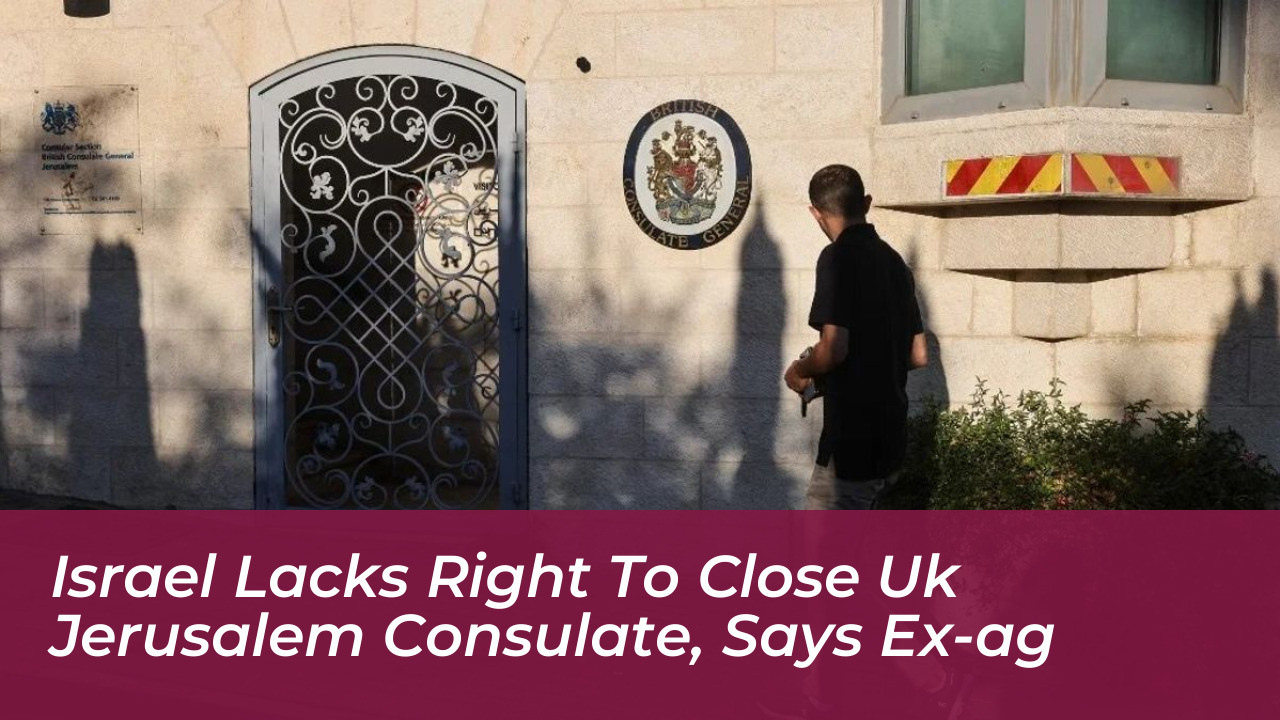
Former UK Attorney General Dominic Grieve has advised the British Foreign Office that Israel lacks the legal authority under international law to force the closure of the British Consulate General in occupied East Jerusalem. The legal opinion comes after Israeli Foreign Minister Gideon Sa’ar ordered the mission to shut down by October 8, 2026, in retaliation for trade restrictions introduced by the UK government.
In an advisory paper commissioned by the British Palestine Project, Grieve argued that because East Jerusalem is recognized by the United Nations and the United Kingdom as occupied Palestinian territory, Israel’s authority is limited strictly to that of an occupying power. Consequently, Israel does not possess the sovereign right to unilaterally terminate diplomatic premises situated outside its recognized borders.

Legal Arguments Against the Closure
Grieve, who served as the UK’s chief legal adviser between 2010 and 2014, stated that challenging Israel’s order is necessary to uphold international law and preserve the diplomatic status quo of the city.
Key points outlined in the legal advisory include:
- Occupying Power Limits: Israel cannot exercise sovereign rights to expel foreign missions operating in occupied territory.
- Preservation of City Status: Maintaining a distinct consulate in East Jerusalem preserves the UK’s position that the final status of Jerusalem remains to be determined through negotiations.
- Compliance with ICJ Ruling: The UK government formally accepted the July 2024 advisory opinion of the International Court of Justice (ICJ), which deemed Israel’s presence in occupied Palestinian territory unlawful and required states not to recognize actions asserting Israeli sovereignty over those areas.
Grieve warned that accepting the closure would implicitly concede Israeli sovereign control over East Jerusalem, setting a precedent that contradicts established international legal frameworks.
Historical Context and Diplomatic Scope
The British diplomatic presence in Jerusalem long predates the establishment of the State of Israel. The UK mission was established in 1838 during the Ottoman era and operates independently from the British Embassy in Tel Aviv, which handles bilateral relations with Israel.
Located in the Sheikh Jarrah neighborhood of East Jerusalem, the consulate general reports directly to the UK Foreign, Commonwealth and Development Office (FCDO). It serves as the primary diplomatic link to the Palestinian Authority and oversees British aid, development projects, and humanitarian reporting across Jerusalem, the West Bank, and the Gaza Strip.
Legal experts note that shutting down the mission would primarily affect Palestinians by disrupting aid distribution, monitoring of local conditions, and administrative services.
Escalating Row Over Settlement Trade Restrictions
The order to close the consulate followed a decision by UK Foreign Secretary Ed Miliband to implement a sweeping trade ban on goods produced in illegal Israeli settlements across the West Bank. The UK stance also explicitly designated the broader occupation of Palestinian territories as unlawful.
In response, Israeli Foreign Minister Gideon Sa’ar announced retaliatory measures against the UK, including:
- Ordering the shutdown of the British Consulate General in East Jerusalem.
- Imposing entry bans on several British parliamentarians, including Jeremy Corbyn, Diane Abbott, Naz Shah, Zarah Sultana, John McDonnell, and Green Party co-leader Carla Denyer.
- Terminating long-standing UK involvement in training Palestinian security forces in the West Bank.
- Excluding Britain from the US-led Gaza coordination mission based in Israel.
Sa’ar characterized the UK trade ban as unwarranted interference in internal affairs. Israel simultaneously revoked the diplomatic credentials of Dutch envoys after the Netherlands introduced similar import restrictions on settlement products.
Diplomatic Precedents and Court Challenges
In Parliament, Foreign Office Minister Lord Wood acknowledged concerns regarding the legality of Israel’s actions, noting the risk that Israeli authorities could make the consulate de facto inoperable despite the legal invalidity of the closure order.
Grieve has urged the British government to mount a formal legal challenge. Similar measures taken by Israel against European missions have previously disrupted diplomatic operations; in 2024, Israel revoked the accreditation of Norwegian diplomats working with the Palestinian Authority, forcing Norway to handle diplomatic relations through its embassy in Jordan.
The UK government is currently assessing its formal legal and diplomatic steps ahead of the October deadline set by Israeli authorities.