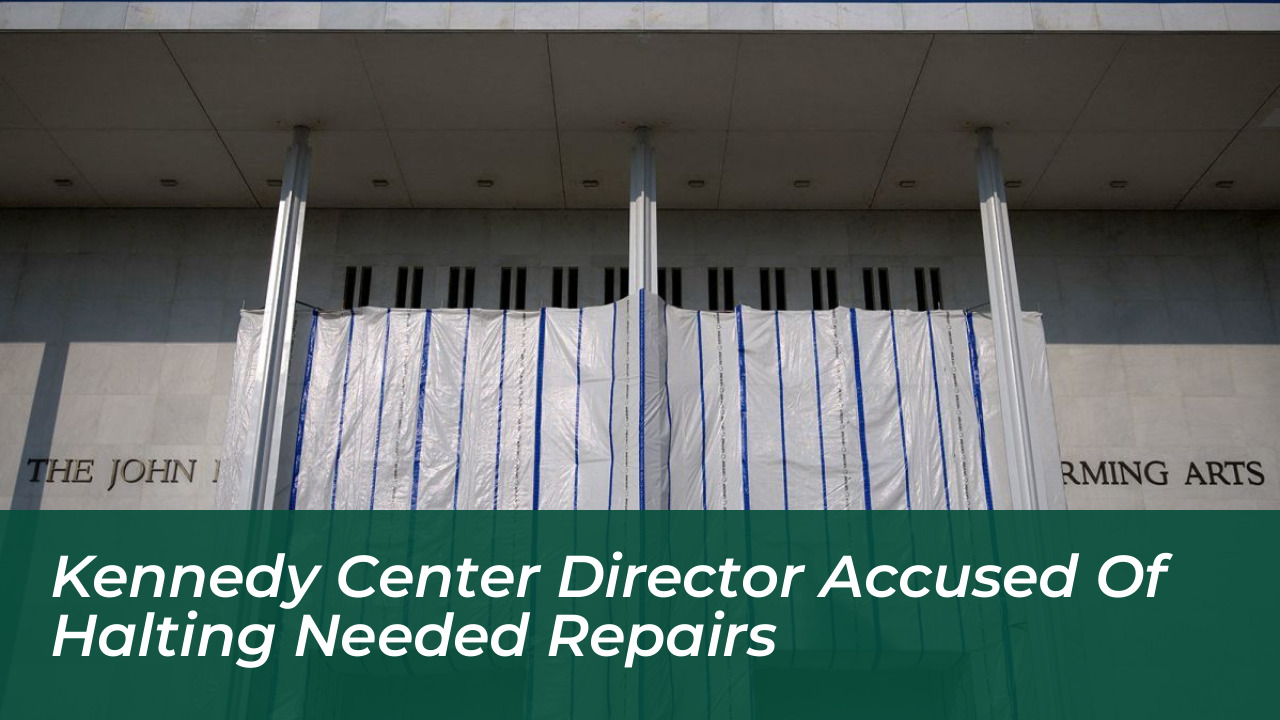
Whistleblowers have submitted a formal complaint to Congress alleging that leadership at the John F. Kennedy Center for the Performing Arts intentionally halted planned roof repairs earlier this year, only to later cite the resulting water damage as an urgent safety risk justifying the institution’s closure.
The complaint was detailed in a letter sent on Thursday, September 24, 2026, by attorney David Seide, who represents several anonymous former employees of the Washington, D.C. institution. The allegations directly target Executive Director and Chief Operating Officer Matt Floca, who oversaw facility operations before stepping into executive leadership.
Allegations of Mismanaged Repair Funds
According to the whistleblower filing, Congress allocated $9.3 million to the Kennedy Center last year as part of President Donald Trump’s domestic spending legislation, known as the One Big Beautiful Bill Act. The funds were specifically designated to repair and replace leaking roof overhangs that had troubled the building for years.
The letter states that Floca initially approved $295,000 for design plans to fix the leaks. However, in April 2026, Floca reportedly ordered the remediation work to stop, despite having the federal funding in hand. Whistleblowers further allege that center officials diverted $1.4 million previously earmarked for waterproofing to help cover a $4.4 million project painting the center’s exterior columns white, which was designated as a high-priority cosmetic change.
Months after the repair work was stopped, the center abruptly closed its doors to the public. Officials pointed to falling plaster, water damage, and structural concerns as acute safety hazards that forced the shutdown.
Kennedy Center Leadership Responds

Kennedy Center Director Matt Floca and center representatives strongly denied the whistleblowers’ claims, stating that public safety remains the institution’s top concern.
In a written statement responding to the allegations, Floca clarified that the roof repairs were not canceled due to neglect, but because initial contractor bids came in at nearly three times the expected cost. As a result, leadership chose to fold the roof work into a broader $250 million overhaul plan submitted in June, which covers structural fixes alongside updates to electrical systems, elevators, and theaters.
Floca added that subsequent inspections conducted over the summer revealed that internal water damage was far more extensive than previously understood, creating immediate safety risks that required closing the facility to protect patrons, artists, and staff.
Congressional Scrutiny and Ongoing Battles
The whistleblower allegations have drawn sharp criticism from lawmakers overseeing federal cultural institutions. Senator Sheldon Whitehouse of Rhode Island, the top Democrat on the Senate Environment and Public Works Committee, stated that documents provided by the whistleblowers indicate leadership “hoarded” taxpayer dollars meant for vital maintenance while blaming previous administrations for the building’s decline.
The controversy surrounding the repairs comes amid broader legal and political friction over the performing arts venue:
- Name Rights Dispute: U.S. District Judge Christopher Cooper previously blocked attempts by the center’s board to display President Trump’s name on the building, ruling the addition illegal and ordering the lettering removed.
- Court Mandates: Judge Cooper ordered the Kennedy Center to give a 30-day advance notice before taking any major physical actions, including potential demolition.
- Legal Injunctions: Democratic Representative Joyce Beatty has filed ongoing legal challenges seeking to stop the center’s prolonged closure and preserve the historic structure.
Kennedy Center officials are expected to file an updated status report with the federal court detailing the ongoing emergency repairs and safety inspections.