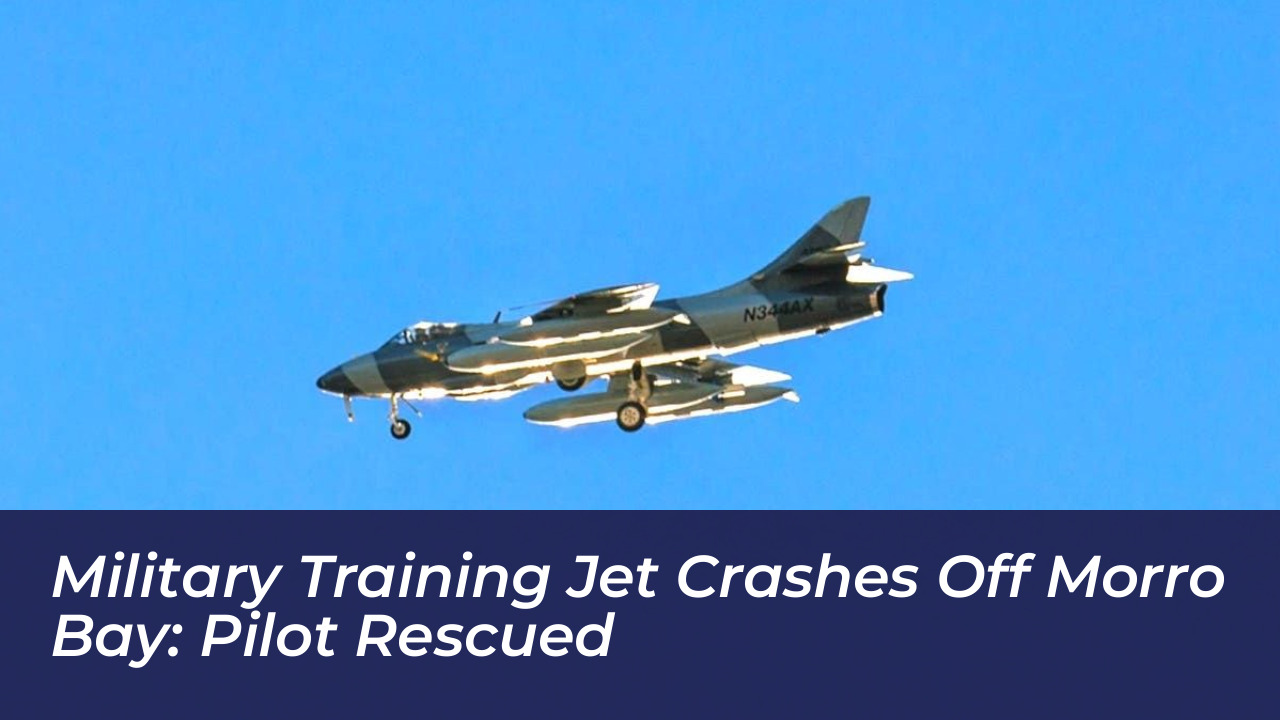
A military training jet crashed into the Pacific Ocean roughly six miles northwest of Morro Bay, California, on Tuesday evening, September 22, 2026. The single-seat MK-58 Hawker Hunter suffered a total loss of engine power during a tactical exercise off the Central Coast, forcing the pilot to execute a successful ejection before the aircraft impacted the water at approximately 6:50 p.m. This high-stakes incident triggered a rapid, multi-agency search and rescue operation that ultimately saved the aviator’s life and prompted immediate reviews of outsourced adversary training protocols.
- Overview of the Morro Bay Training Jet Crash
- Incident Summary and Immediate Response
- Key Agencies Involved
- Flight Timeline and Distress Communications
- Departure from Naval Base Ventura County
- Catastrophic Engine Failure and Mayday Call
- Successful Ejection Protocol
- Search and Rescue Operation Details
- U.S. Navy and Coast Guard Coordination
- Pilot Recovery and Environmental Impact
- Aircraft Profile: The MK-58 Hawker Hunter
- Cold War Origins and Swiss Air Force Heritage
- Operational Limitations in Modern Training
- The Role of Private Defense Contractors in Military Training
- Simulating Enemy Tactics for U.S. Armed Forces
- Fleet Safety and Maintenance Standards
- Historical Precedents and Safety Records
- Previous Incidents off Big Sur and North Carolina
- Ongoing Fleet-Wide Investigations
- Frequently Asked Questions
- What caused the military training jet to crash off Morro Bay?
- How did the pilot survive the Pacific Ocean crash?
- Who owns the downed Hawker Hunter aircraft?
Overview of the Morro Bay Training Jet Crash
The aircraft plunged into the ocean during a routine evening training flight. The military training jet crash off Morro Bay involved a vintage fighter operated by Airborne Tactical Advantage Company, a leading private defense contractor. Coordinated rescue efforts by the U.S. Coast Guard and Naval Air Forces mobilized within minutes of the distress call to locate the downed pilot in the darkening Pacific waters.
Incident Summary and Immediate Response
- Timing and coordinates of the crash six miles northwest of Morro Bay.
- Coordinated rescue operations involving the U.S. Coast Guard and Naval Air Forces.
- Current medical status of the pilot transported to Community Regional Medical Center in Fresno.
Key Agencies Involved
- Federal Aviation Administration (FAA) oversight and initial jurisdiction.
- National Transportation Safety Board (NTSB) investigation protocols.
- U.S. Navy temporary operational pause on related contractor flights.
Flight Timeline and Distress Communications
The fateful mission began earlier in the afternoon when the Hawker Hunter, bearing registration N345AX and the call sign Snake4, departed from Naval Base Ventura County at Point Mugu. The jet integrated into a formation of multiple aircraft designed to simulate adversary tactics for military readiness training. Flight tracking data shows the formation cruising smoothly over the Pacific before mechanical trouble struck the aircraft.
Without warning, the single-engine fighter suffered a catastrophic loss of thrust at high altitude, prompting a rapid descent exceeding 10,000 feet per minute. The pilot broadcasted an urgent mayday call over emergency frequencies. Air traffic controllers attempted to vector the distressed jet toward Paso Robles Municipal Airport, but the rapid loss of altitude made reaching a runway impossible.
Departure from Naval Base Ventura County
- Initial takeoff from Point Mugu under the call sign Snake4.
- Integration into a formation of multiple aircraft for routine adversary tactical exercises.
Catastrophic Engine Failure and Mayday Call
- Sudden loss of thrust at high altitude and rapid descent exceeding 10,000 feet per minute.
- Emergency radio transmissions and attempts by air controllers to vector the jet to Paso Robles Municipal Airport.
Successful Ejection Protocol
- Activation of the Martin-Baker ejection seat at 3,425 feet above sea level.
- Pilot safety parameters and factors contributing to survival in cold ocean water.
Search and Rescue Operation Details
The rescue mission unfolded rapidly as military and civilian responders pooled resources in gathering darkness. Naval Air Station Lemoore dispatched a UH-60 Blackhawk helicopter equipped with night-vision equipment and thermal imaging to sweep the freezing ocean surface. The flight crew spotted the pilot floating in his life raft near the Morro Bay impact zone.
A rescue swimmer descended via hoist, secured the aviator, and brought him safely aboard the helicopter. Medical evaluations confirmed that the pilot sustained non-life-threatening injuries and recovered under stable conditions at Community Regional Medical Center in Fresno. Meanwhile, surface vessels monitored the crash site for environmental hazards, as the aircraft carried between 400 and 1,000 gallons of jet fuel.
U.S. Navy and Coast Guard Coordination
- Dispatch of a UH-60 Blackhawk helicopter from Naval Air Station Lemoore.
- Utilization of night-vision equipment and thermal imaging to spot the life raft.
Pilot Recovery and Environmental Impact
- Rescue swimmer hoist operation and immediate medical evaluation.
- Assessment of jet fuel volume ranging from 400 to 1,000 gallons in the impact zone.
- Navigational warnings issued to local mariners by U.S. Coast Guard Sector Los Angeles-Long Beach.
Aircraft Profile: The MK-58 Hawker Hunter
The aircraft involved in the incident carries a rich aviation heritage dating back to the early Cold War era. Designed and manufactured in the United Kingdom by Hawker Aircraft, the Hunter served as a premier fighter jet for the Royal Air Force and later the Swiss Air Force. Private defense contractors acquired surplus Swiss airframes and refurbished them to serve as high-performance tactical adversaries.
Despite their exceptional handling characteristics and transonic speeds, these vintage platforms present unique operational limitations in modern military training. The single-engine architecture relies entirely on a Rolls-Royce Avon turbojet, leaving pilots with minimal glide range if power fails. , the advanced age of the airframes requires rigorous maintenance and strict adherence to safety margins.
Cold War Origins and Swiss Air Force Heritage
- Manufacturing history by Hawker Aircraft in the United Kingdom.
- Refurbishment of Swiss Air Force surplus airframes for tactical adversary training.
Operational Limitations in Modern Training
- Single-engine architecture relying on the Rolls-Royce Avon turbojet.
- Age of airframes and unique safety margins associated with vintage platforms.
The Role of Private Defense Contractors in Military Training
Airborne Tactical Advantage Company operates as a premier civilian provider of outsourced tactical flight training for the United States Armed Forces. Military branches utilize private contractors to simulate enemy fighter tactics, electronic warfare, and missile profiles. This practice preserves the flight hours and structural life of frontline military jets like the F-35 Lightning II and F/A-18 Super Hornet.
Private military aviation contracts operate in demanding, high-stress environments. The rigorous performance demands of tactical adversary simulation push vintage airframes to their limits. Contractors enforce strict pre-flight turnaround inspections under U.S. Navy flight clearance guidelines, yet mechanical failures remain an inherent risk in high-performance aviation.
Simulating Enemy Tactics for U.S. Armed Forces
- Providing “Red Air” support to preserve flight hours on frontline jets like the F-35 and F/A-18.
- High-stress operational environments and rigorous performance demands.
Fleet Safety and Maintenance Standards
- Pre-flight turnaround inspections under U.S. Navy flight clearance guidelines.
- Fleet-wide review of fuel pump assemblies and telemetry data.
Historical Precedents and Safety Records
Tuesday’s crash off Morro Bay joins a small number of historical incidents involving ATAC Hawker Hunter operations. Previous mishaps, including an engine failure off the coast of Big Sur and metallurgical issues identified during historical investigations, highlight the continuous challenges of maintaining vintage military hardware.
In response to the Morro Bay incident, the U.S. Navy initiated a temporary operational pause on related contractor flights. Engineering assessments and fleet-wide maintenance reviews remain underway to examine high-pressure fuel pump assemblies, ensuring that future adversary training flights meet the highest possible safety standards.
Previous Incidents off Big Sur and North Carolina
- October Big Sur engine failure and sinking airframe.
- 2002 Wilmington metallurgical analysis revealing high-pressure fuel pump bearing failure.
Ongoing Fleet-Wide Investigations
- Maintenance reviews and engineering assessments following the temporary operational pause.
Frequently Asked Questions
What caused the military training jet to crash off Morro Bay?
Preliminary reports indicate a sudden and total loss of engine power during a tactical exercise, though formal investigations by the NTSB, FAA, and U.S. Navy are ongoing.
How did the pilot survive the Pacific Ocean crash?
The pilot successfully activated his Martin-Baker ejection seat at 3,425 feet above sea level, cleared the cockpit, and deployed his life raft before being rescued by a Navy helicopter.
Who owns the downed Hawker Hunter aircraft?
The aircraft was owned and operated by Airborne Tactical Advantage Company (ATAC), a private defense contractor providing adversary air training for the U.S. military.