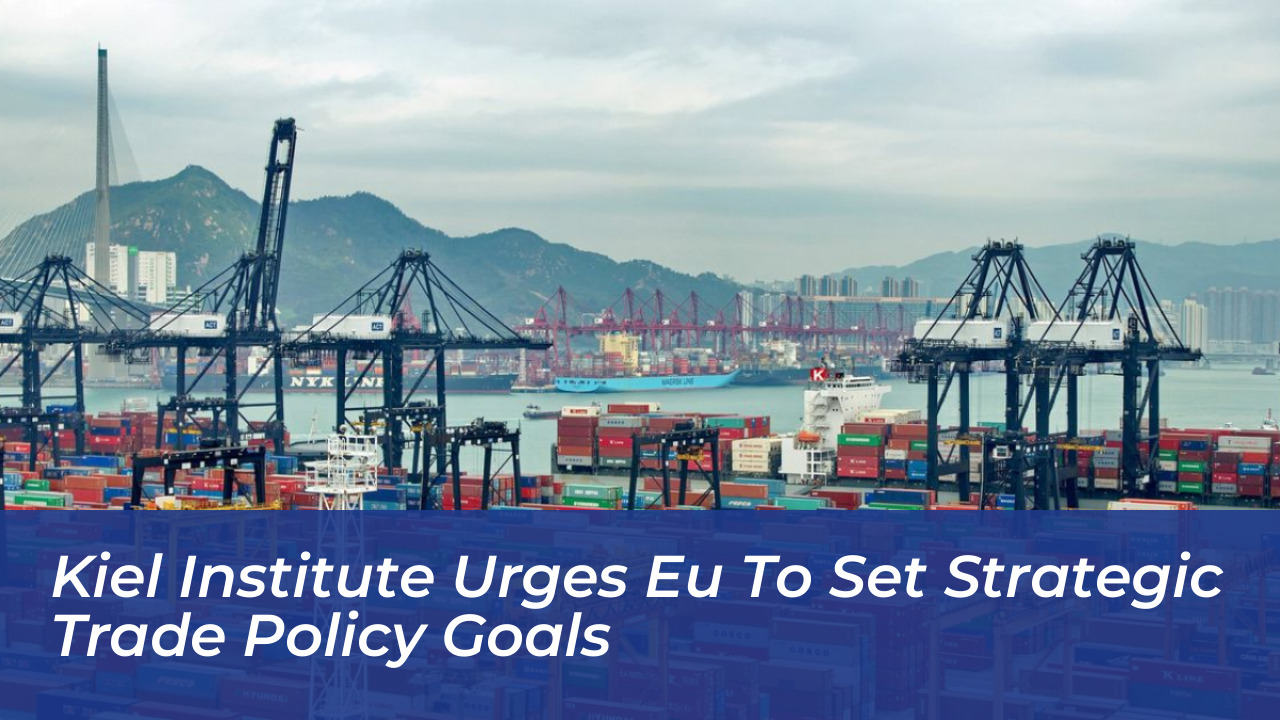

Europe needs a clearer economic security strategy to address growing Chinese competition and strengthen its industrial capabilities, according to a policy brief published by the Kiel Institute for the World Economy. Ahead of European Council meetings in Brussels, policymakers from Paris, Berlin, and the European Union have explored faster trade defenses, European purchasing preferences, and new diversification measures. However, the Kiel Institute argues that these proposals lack defined strategic objectives.
The policy brief highlights that China now competes directly with the euro area in nearly 40 percent of the sectors where Europe historically holds a comparative advantage. This figure marks a significant jump from about 25 percent in the early 2000s. Germany faces intense pressure as its automotive, machinery, and chemical industries experience declining export opportunities within China, alongside aggressive Chinese competition in domestic and third-country markets.
The Limitation of Reactive Measures
Julian Hinz, head of the Trade Policy Research Group at the Kiel Institute and a co-author of the brief, emphasized that the European Union has failed to develop an effective mechanism to utilize access to its single market as a strategic economic tool. Researchers note that Europe possesses a major geoeconomic asset-access to its prosperous consumer market-without a viable framework to wield it purposefully.
“Europe is sitting on its biggest geoeconomic asset, access to its own market, and has no way to use it,” said Julian Hinz. “China built its car industry by making market access conditional on local production. The EU cannot do the same, even if it wanted to. All of its instruments act on prices and the border, none on where production takes place.”
The researchers evaluated existing tools, including countervailing duties, safeguard measures, subsidy conditions, public procurement, local-content rules, the Anti-Coercion Instrument, and general sanctions. While these instruments provide a sufficient framework for conventional trade defense, they fail to establish a cohesive strategy for proactive industrial development.
Addressing the China Shock 2.0 and Institutional Gaps
A joint Franco-German non-paper introduced response options that relied heavily on expanding traditional, reactive trade defenses. Hinz warned that accumulating defensive measures fails to tackle the underlying systemic problem, stating that defensive measures do not create a coherent strategy and risk inviting domestic lobbying and retaliation from major international trading partners.
To illustrate the discrepancy between defensive tariffs and strategic goals, the policy brief points to battery manufacturing. Battery cells serve as critical foundational inputs for drones, autonomous systems, and advanced military applications. Because defense demand alone cannot finance a competitive industrial cell sector, a large-scale electric vehicle (EV) market is required to provide commercial scale. Consequently, localizing EV manufacturing acts as a direct path to building domestic battery capabilities.
The authors identify a deep institutional divide as the primary roadblock: trade policy falls under exclusive EU authority, while national security remains the responsibility of individual member states. This leaves the bloc without a clear legal foundation to translate unified European security assessments into direct commercial action.
Proposed Solutions and Recommendations
To overcome these systemic constraints, the researchers propose implementing an economic security instrument modeled after United States Section 232. They suggest utilizing existing EU legal powers in the short term while building an explicit Union competence for economic security over the long run. This mechanism would remain country-agnostic, applying equally to established trade partners, including the United States.
Prof. Christoph Herrmann of the University of Passau noted that European institutions possess significant legal flexibility. Pointing to the Council’s ability to adjust external tariffs through qualified majority voting during past steel measures, Herrmann confirmed that the legal room for maneuver is substantial.
- Establish Clear Objectives: Define precise industrial sectors for long-term capability building before enacting defensive trade measures.
- Bridge Institutional Divides: Create a dedicated European-level security competence to align trade policy with strategic geopolitical assessments.
- Close Policy Loopholes: Investigate whether existing EU duties on electric vehicles should be immediately extended to hybrid vehicles to prevent market evasion.
As European leaders navigate global trade shifts, the Kiel Institute’s recommendations underscore that sustainable industrial strength requires more than defensive safeguards-it demands a unified, forward-looking strategic vision.