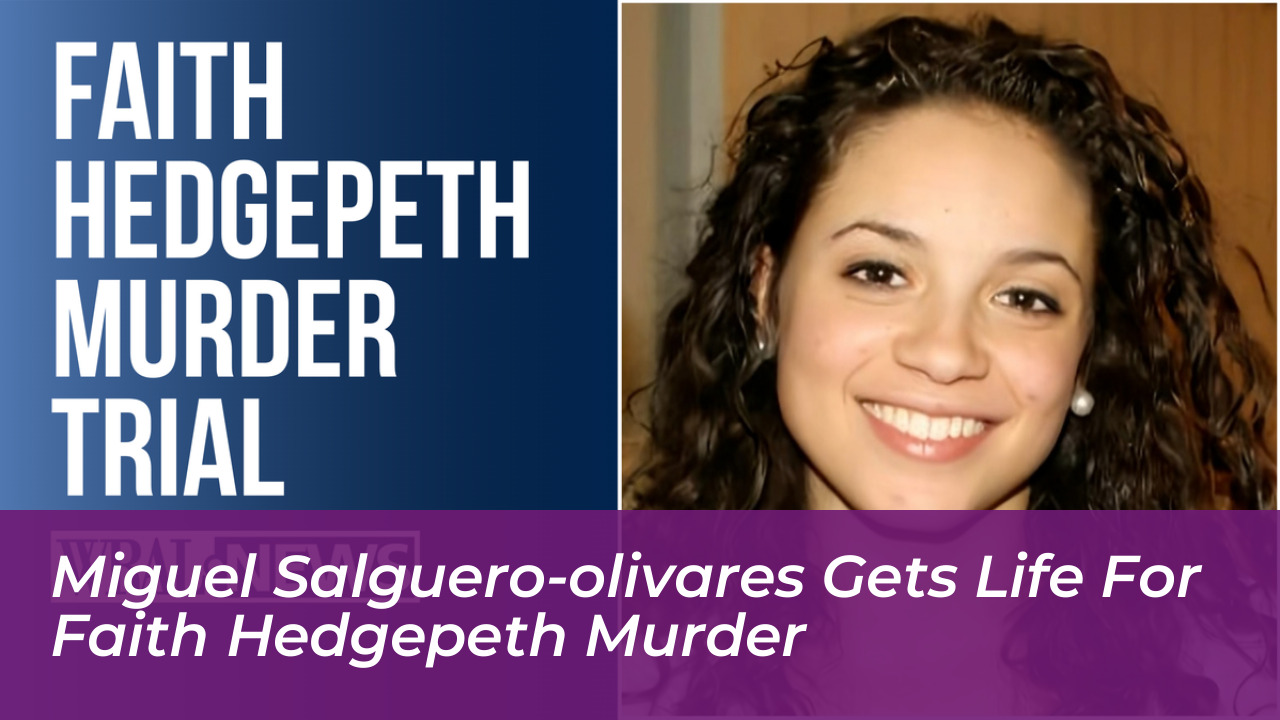

A North Carolina jury convicted Miguel Salguero-Olivares of first-degree murder, first-degree kidnapping, s*xual offense, and burglary on Friday, October 23, 2026, in the 2012 killing of Faith Hedgepeth. Hedgepeth, a 19-year-old University of North Carolina at Chapel Hill student, was found dead in her off-campus apartment more than 14 years ago. The verdict was delivered in a Durham County courtroom after jurors deliberated for six hours over two days.
Judge Keith Gregory sentenced Salguero-Olivares to life in prison without the possibility of parole for the murder conviction. Additionally, the judge handed down consecutive sentences of 240 to 348 months for first-degree kidnapping, 240 to 348 months for first-degree s*xual offense, and 64 to 89 months for first-degree burglary. As the verdict was read, Salguero-Olivares could be heard protesting the outcome, saying, “It’s not fair,” while his defense team noted that he is appealing his convictions and sentences.
The 2012 Investigation and Breakthrough
Faith Hedgepeth was a 19-year-old junior majoring in biology at UNC-Chapel Hill and a member of the Haliwa-Saponi tribe in Warren County. On September 7, 2012, her roommate, Karena Rosario, returned to their apartment at Hawthorne at the View Apartments on Old Chapel Hill Road to find Hedgepeth’s body. An autopsy revealed that Hedgepeth suffered extensive skull fractures, cuts to her face and head, and severe blunt force trauma to her arms and legs.
The case remained unsolved for years, with more than 25 State Bureau of Investigation (SBI) agents working on the file and over 400 DNA samples collected. The major breakthrough came on September 16, 2021, when Salguero-Olivares was arrested after providing a DNA sample during a drunk-driving traffic stop the month before.
Key Forensic Evidence at Trial
Throughout the 19-day trial, prosecutors presented extensive forensic evidence tying Salguero-Olivares to the crime scene. Special prosecutor Lisa Coltrane told jurors that the defendant left his DNA “like confetti all over that room.” Forensic scientist Erin Ermish testified that DNA swabbed from Hedgepeth’s body was 170 septillion times more likely to be a mixture of DNA from Hedgepeth and Salguero-Olivares than from Hedgepeth and an unknown individual.
During the trial, experts testified that Salguero-Olivares’ fingerprints and palm print were discovered on a wine bottle at the scene. His DNA was also identified on a note written on a fast-food bag and on a blood-covered rum bottle that investigators determined was used as the weapon in the attack. Prosecutors argued that Salguero-Olivares was a stranger who returned to the apartment angry and attacked the victim after an unsuccessful encounter earlier in the evening.
The defense rested its case on Wednesday without calling any witnesses. Defense attorneys questioned the thoroughness of the initial police investigation, pointed out missed areas, and suggested that potential blood evidence had been lost. They argued that prosecutors failed to build a foolproof case, but the jury ultimately sided with the state’s overwhelming forensic findings.
Family Reaction and Closure
Following the sentencing, members of Hedgepeth’s family delivered emotional victim impact statements. Connie Hedgepeth, the victim’s mother, expressed a sense of relief after more than 14 years of waiting. “Here we have been waiting a long time, over 14 years. And I am just glad we have the closure we need, we have peace,” she said, adding that she had forgiven what happened.
Faith’s father, Roland Hedgepeth, detailed the exact passage of time since his daughter’s death, noting that it had been 14 years, six weeks, and four days-or 5,158 days-before justice was finally served. Judge Keith Gregory commended the family for their endurance and embraced both parents before the proceedings concluded.