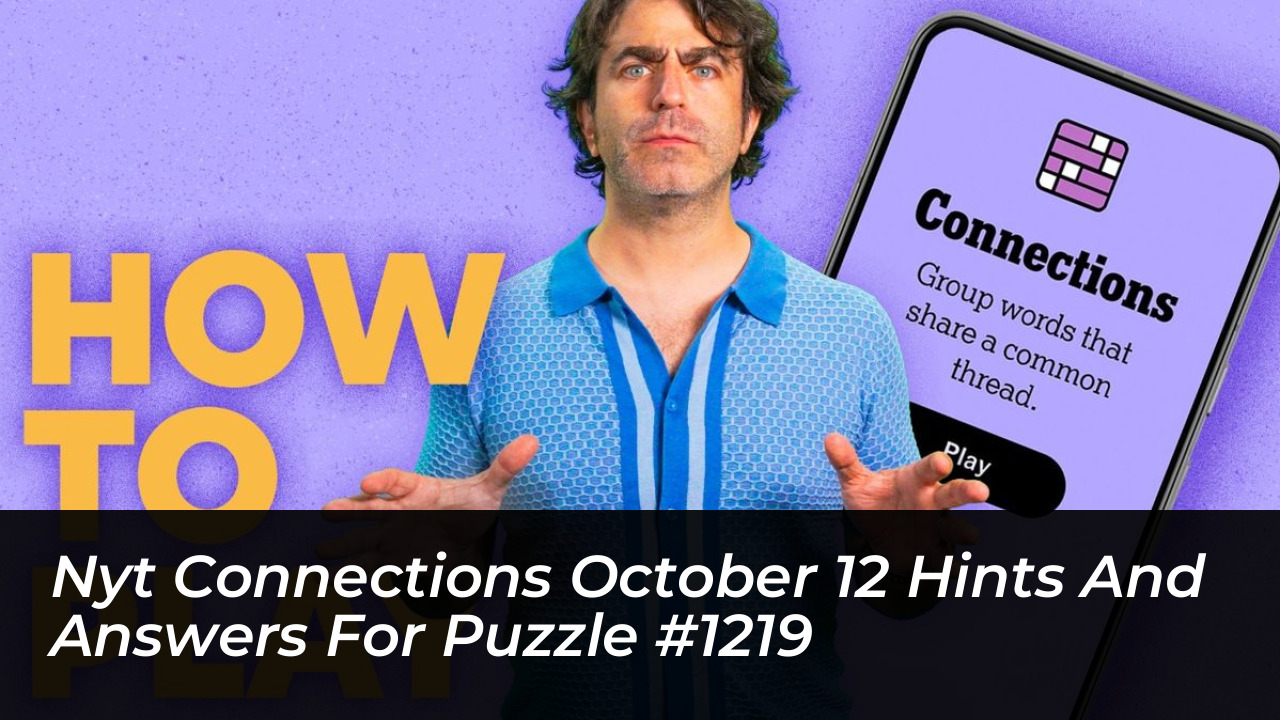

The New York Times Connections puzzle for Monday, October 12, 2026, challenged players to organize 16 words into four distinct groups based on shared meanings, linguistic patterns, and wordplay. Puzzle No. 1219 featured categories involving condition status, verbs of tolerance, language shortenings, and words constructed entirely out of consecutive U.S. postal state abbreviations.
The daily web-based puzzle, created by NYT crossword editor Wyna Liu, features four difficulty-coded categories progressing from yellow (the easiest) to purple (the most difficult). The testing team rated the October 12 puzzle 2.5 out of 5 for difficulty, making it a moderately tricky exercise that required careful attention to overlapping decoy definitions.
Today’s NYT Connections Categories and Hints
Before diving into the full spoiler answers for Connections #1219, reviewing these theme descriptions can help nudge your brain in the right direction without completely giving away the board:
- 🟨 Yellow Category: Manner of being or standing. Think about condition words rather than weather reports.
- 🟩 Green Category: Verbs used when putting up with something difficult or annoying.
- 🟦 Blue Category: Different ways language gets shortened, ranging from clipped names to dropped sounds.
- 🟪 Purple Category: Ordinary-looking English words that can be carved into consecutive U.S. state postal codes.
Complete Answers for NYT Connections #1219 (October 12, 2026)
If you have exhausted your four allowed mistakes or simply want to check your final groupings against the official New York Times record, here are all four categories and their corresponding 16 words:
🟨 Status (Yellow)
Words: CONDITION, SHAPE, SITUATION, STATE
Explanation: These four terms share a common meaning of position, rank, or how things stand. In this context, “shape” refers to a condition (as in being “in bad shape”), and “state” denotes status rather than a geographical location.
🟩 Tolerate (Green)
Words: BEAR, HANDLE, STAND, WEATHER
Explanation: Each of these words functions here as a verb meaning to endure or put up with strain. A primary trap for solvers is reading these terms as concrete nouns or physical objects-such as an animal, a door handle, a stadium stand, or a meteorological forecast-rather than active verbs.
🟦 Word Shortenings, Often (Blue)
Words: ABBREVIATION, CONTRACTION, ELISION, NICKNAME
Explanation: This category groups together various linguistic methods used to shorten language. An elision drops a sound inside a word (such as turning “over” into “o’er”), a contraction joins words with missing letters, a nickname clips a personal name, and abbreviation covers the broader shortening habit.
🟪 Words Made Using U.S. Postal Abbreviations (Purple)
Words: ALKYLAMIDE, CALAMARI, MANDARIN, MELAMINE
Explanation: Considered the hardest group in puzzle #1219, the purple category requires breaking down each word into consecutive two-letter U.S. state postal codes with no leftover letters. For example, CALAMARI breaks down into CA (California), LA (Louisiana), MA (Massachusetts), and RI (Rhode Island).
Strategic Tips for Winning NYT Connections Daily
Sustaining a winning streak in Connections relies heavily on identifying decoy traps before hitting the submit button. Game designers frequently deploy overlapping categories to bait incorrect guesses. For instance, words like STATE or WEATHER can easily trick players into looking for geographic or climate-related themes when they actually belong to status or tolerance groups.
When stuck on a challenging board, look closely at outlier words that do not seem to fit any obvious patterns. Cross-referencing those remaining tiles often reveals hidden wordplay, such as embedded acronyms, suffixes, or state postal codes, helping you clear the grid successfully before running out of attempts.