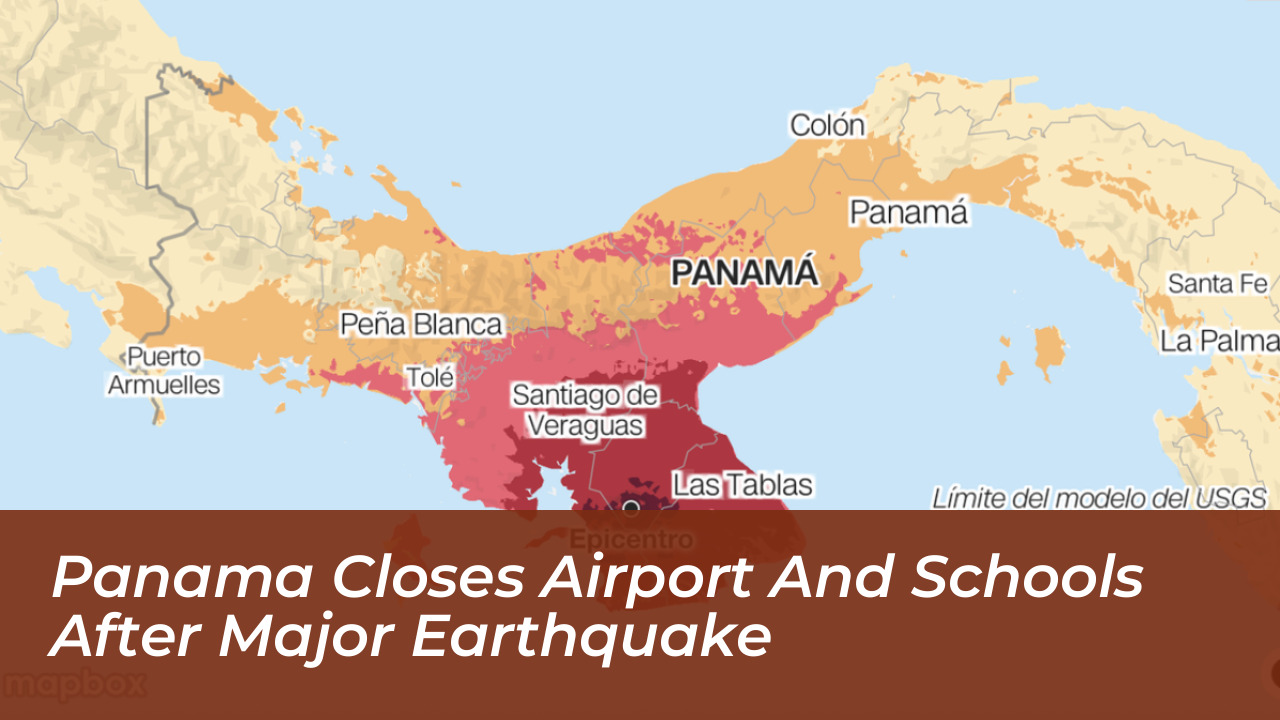

Emergency precautions disrupted air travel, education, and coastal safety measures after a powerful magnitude 7.7 earthquake struck southeastern Panama on Friday, October 9, 2026. The major seismic event occurred at 12:56 p.m. local time, according to the US Geological Survey (USGS), prompting immediate airport evacuations, afternoon class cancellations, and tsunami warnings across parts of the wider Pacific region.
The USGS reported that the earthquake originated at a shallow depth of 10 to 12 kilometers near Pitaloza Arriba and Tonosí in southern Panama, approximately 239 kilometers from the capital. Because of this shallow depth, moderate to severe shaking was felt by roughly 4.6 million people, sending residents fleeing into the streets of Panama City and neighboring Costa Rica.
Tocumen International Airport and Metro Suspended
Tocumen International Airport temporarily suspended all commercial operations to thoroughly assess infrastructure integrity and verify safety conditions following the tremors. Airport authorities confirmed that passengers and administrative personnel were safely evacuated as a strict preventative measure.
In Panama City, services on two lines of the Panama City Metro were temporarily halted for safety evaluations. Nationwide, the Ministry of Education ordered the immediate closure of schools to protect students and allow structural assessments to take place across educational facilities.
Infrastructure Damage and Regional Tsunami Alerts
Local media and social media footage revealed structural damage in several areas near the epicenter. In Penonomé, videos showed the tower of a historic building and several balconies collapsing. Power company Naturgy reported electricity supply disruptions affecting customers across six Panamanian provinces.
The US Tsunami Warning System initially issued warnings over the risk of potentially dangerous waves reaching coastal areas of Central America, Colombia, Ecuador, Peru, Nicaragua, Guatemala, El Salvador, and Mexico within three hours of the quake. However, subsequent updates indicated that the immediate widespread threat had passed without major tsunami impacts reported on land.
Response and Preparedness
Omar Smith, head of Panama’s civil protection agency (Sinaproc), confirmed that impacts were registered in Chitré, the capital of Herrera province, and along the coast of Los Santos. Authorities advised residents to stay away from damaged structures and unstable infrastructure.
Notably, the disaster struck just three days before Panama was scheduled to hold a national evacuation drill to test the nation’s emergency response capabilities. Meanwhile, the Panama Canal Authority confirmed that the vital trade waterway continued operating normally without interruption after engineering teams completed initial safety inspections.