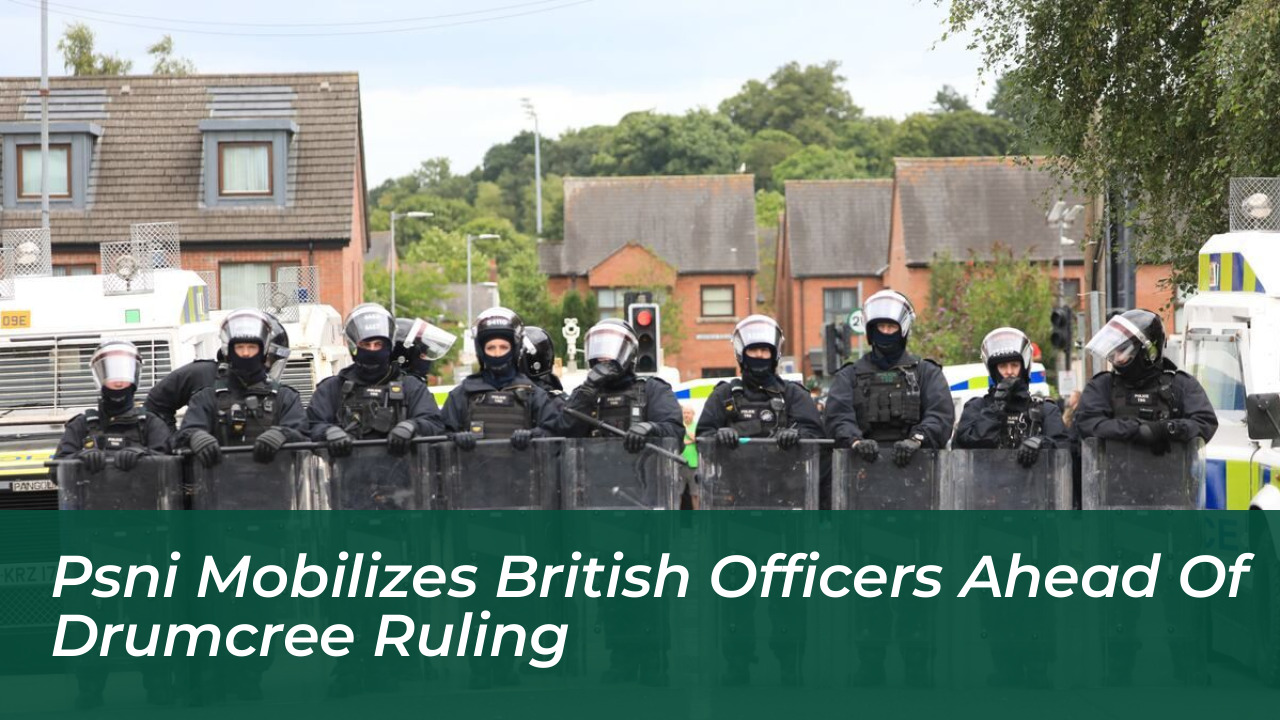
As tensions rise ahead of a landmark decision, the PSNI mobilizes British officers to reinforce local security forces ahead of the contentious Drumcree parade ruling. Roughly 100 officers from Scottish and English police forces are arriving in Northern Ireland to support the Police Service of Northern Ireland (PSNI). This rapid mobilization centers on the long-standing dispute over the Orange Order’s requested procession down the predominantly nationalist Garvaghy Road in Portadown, scheduled for Sunday, September 27, 2026. With memories of historical stand-offs still looming, authorities are taking no chances in managing public order.
- The Security Mobilization and PSNI Operational Pressures
- Mutual Aid Deployment from Great Britain
- Stretched Resources Within the PSNI
- The Parades Commission Ruling and Legal Fallout
- Administrative Origins of the Crisis
- Strict Conditions Imposed on the Orange Order
- Community Responses and Political Polarization
- Outrage from Nationalist Residents and Sinn Féin
- Welcoming Statements from Unionist Leadership
- Broader Implications and Changing Dynamics
- Precedent for Contentious Parades Across Northern Ireland
- Generational Shifts in Portadown
- Frequently Asked Questions
- Why are police officers from Great Britain being deployed to Northern Ireland?
- What are the exact conditions set by the Parades Commission for the Drumcree march?
- How are local nationalist residents responding to the ruling?
- What historical significance does the Drumcree conflict hold?
The Drumcree dispute carries deep historical resonance in Northern Ireland. Between 1996 and 1999, annual stand-offs over the parading route sparked widespread civil unrest, claiming 21 lives. The most tragic event occurred in 1998, when a sectarian arson attack by loyalist paramilitaries in Ballymoney killed three young Catholic brothers, Richard, Mark, and Jason Quinn. Given this history, security agencies are treating the upcoming determination with extreme care, deploying extensive cross-jurisdictional resources to maintain peace.
The Security Mobilization and PSNI Operational Pressures
Mutual Aid Deployment from Great Britain
The arrival of approximately 100 officers from England and Scotland marks a significant escalation in regional public order preparations. These officers are moving under long-established mutual aid arrangements governed by the UK Police Act, which allows cross-jurisdictional assistance during severe operational demands. External officers provide specialized riot support, tactical crowd management, and frontline relief to local divisions anticipating localized unrest.
While mutual aid solves immediate staffing shortages, it introduces complex logistical and economic challenges. Transporting, housing, and feeding hundreds of visiting officers requires significant financial management. Cross-border deployments also guarantee specialized hazard and away-from-home allowances for Scottish and English personnel. These operational costs fall directly on the already constrained Northern Ireland justice budget, forcing police management to divert funding from routine community policing projects.
Stretched Resources Within the PSNI
The decision to request external aid highlights severe internal staffing deficits facing Northern Ireland’s domestic force. The PSNI carries an official paper headcount of roughly 6,444 officers. However, real operational capacity sits closer to 4,000 active, deployable personnel when accounting for long-term sick leave, accrued holiday time, and officers restricted to modified administrative duties.
This operational gap makes managing large-scale security events exceptionally risky without external assistance. Police Federation chair Liam Kelly characterized the arrival of mutual aid officers as a prudent and necessary precautionary measure. Kelly emphasized that relying on cross-border support protects local officers from total exhaustion while ensuring everyday emergency calls across Northern Ireland remain answered during a high-risk security operation.
The Parades Commission Ruling and Legal Fallout
Administrative Origins of the Crisis
The current legal and political standoff emerged not from fresh community clashes, but from a major procedural flaw within the administrative system. A previous Parades Commission determination restricting the annual Drumcree parade was quashed in the High Court after the commission conceded a critical administrative error. The document had been issued without obtaining formal sign-offs from all sitting commissioners, rendering the restriction legally invalid.
This failure triggered an immediate internal crisis. Parades Commissioner Billy Gamble resigned shortly after the High Court ruling, prompting Northern Ireland Secretary Sir Chris Bryant to order an independent review into the commission’s governance led by Sir John O’Hara KC. The incident highlighted the administrative fragility of the Parades Commission, demonstrating how procedural errors can instantly reignite dormant political controversies.
Strict Conditions Imposed on the Orange Order
In a dramatic shift from its long-held stance established in 1998, the Parades Commission issued a revised determination permitting members of the Portadown District Orange Lodge to walk down the Garvaghy Road. However, to control safety risks, the commission attached severe restrictions to the parade:
- Strict Participant Limit: The procession is capped at a maximum of 35 participants, cutting down the 60 marchers requested by Portadown District.
- Tight Time Window: Marchers must depart Drumcree Church precisely at 08:00 BST and fully disperse from Carleton Street Orange Hall by 09:30 BST.
- Total Band Ban: No musical bands or drum corps are permitted to play or participate along any segment of the route.
- Singular Display: Participants may only carry the official banner of the Portadown Orange Lodge; no local or paramilitary flags are permitted.
- No Spectators: Public supporters, onlookers, and secondary crowds are prohibited from assembling along the Garvaghy Road or adjacent residential side streets.
Community Responses and Political Polarization
Outrage from Nationalist Residents and Sinn Féin
The determination sparked immediate anger among nationalist residents along the Garvaghy Road. Breandán Mac Cionnaith, spokesperson for the Garvaghy Road Residents’ Coalition, condemned the decision as a dangerous step backward that ignores decades of community sensitivity. Resident groups quickly gathered outside the Belfast High Court to launch emergency judicial review proceedings aimed at stopping the march before Sunday morning.
Political leaders echoed these community concerns. Sinn Féin leader Mary Lou McDonald labeled the decision reckless, arguing that forcing any parade down the Garvaghy Road without local consent undermines community relations and threatens the principles of the Good Friday Agreement. Nationalist representatives maintain that bypassing localized dialogue sets a damaging precedent for public order decisions across Northern Ireland.
Welcoming Statements from Unionist Leadership
In contrast, political representatives from unionist parties welcomed the Parades Commission decision as a overdue vindication of civil rights. Democratic Unionist Party (DUP) figures Gavin Robinson and Carla Lockhart defended the determination, describing it as a balanced and fair compromise. Unionist leaders pointed out that 35 silent men walking quietly along a public road for a brief morning window poses no legitimate physical threat to surrounding neighborhoods.
| Operational Metric | Historical Peak (1996-1999) | Current Situation (September 2026) |
|---|---|---|
| Security Personnel Deployed | Over 1,000 police and 1,000 military troops | Local PSNI units with ~100 mutual aid officers |
| Casualties and Fatalities | 21 fatal deaths, thousands injured | Zero fatalities; high political tension and court challenges |
| Parades Commission Status | Newly established, heavily contested authority | Under independent review following procedural quashing |
| Parade Parameters | Thousands of marchers, multiple bands, full day routes | Capped at 35 marchers, zero bands, 90-minute early morning window |
Broader Implications and Changing Dynamics
Precedent for Contentious Parades Across Northern Ireland
The decision to allow the Drumcree march despite opposition from local residents creates broader legal implications. Community leaders across towns like Derry, Belfast, and regions of Tyrone worry that overriding local objections will break fragile agreements negotiated over the past two decades. In many areas, nationalist residents and loyal orders built custom agreements that keep seasonal parades peaceful.
If central rulings bypass these hard-won local accommodations, community leaders fear groups on both sides may abandon direct dialogue. Without trust in local compromise, parading disputes could revert back to formal legal battles and heavy security operations, reversing years of progress in local peacebuilding.

Generational Shifts in Portadown
Despite rising political debate, Portadown itself has changed significantly over the 28 years since the stand-offs of the late 1990s. An entire generation has grown up without the militarized barricades, steel walls, and armored vehicles that once defined local summers. Modern business owners, civic organizers, and younger residents have worked hard to build commercial and social ties across traditional community lines.
This generational evolution presents a real test for the area. While political figures maintain firm stances, everyday civic life in Portadown is far more integrated than it was thirty years ago. The coming days will show whether modern community relations can absorb high-profile political events without disrupting daily peace.
Frequently Asked Questions
Why are police officers from Great Britain being deployed to Northern Ireland?
The PSNI requested mutual aid reinforcement to manage active personnel shortages ahead of the high-risk Drumcree parade decision. With roughly 2,400 local officers unavailable due to sick leave, holiday, or light duties, roughly 100 officers from Scottish and English forces were deployed under the UK Police Act to maintain public order and cover frontline duties.
What are the exact conditions set by the Parades Commission for the Drumcree march?
The Parades Commission capped the procession at 35 marchers from the Portadown District Orange Lodge. The parade must leave Drumcree Church by 08:00 BST and finish at Carleton Street Orange Hall by 09:30 BST. No musical bands or extra supporters are allowed along the route, and only one official lodge banner may be displayed.
How are local nationalist residents responding to the ruling?
Local nationalist residents and the Garvaghy Road Residents’ Coalition reacted with strong opposition. Represented by community spokespersons and backed by political figures from Sinn Féin, resident groups filed urgent judicial review applications at the Belfast High Court to challenge the legality of the determination.
What historical significance does the Drumcree conflict hold?
The Drumcree parade dispute in Portadown was one of the most volatile friction points of Northern Ireland’s Troubles during the late 1990s. Between 1996 and 1999, annual stand-offs over the Garvaghy Road route led to massive civil disruptions, thousands of public order incidents, and 21 deaths, making it a pivotal chapter in modern regional history.