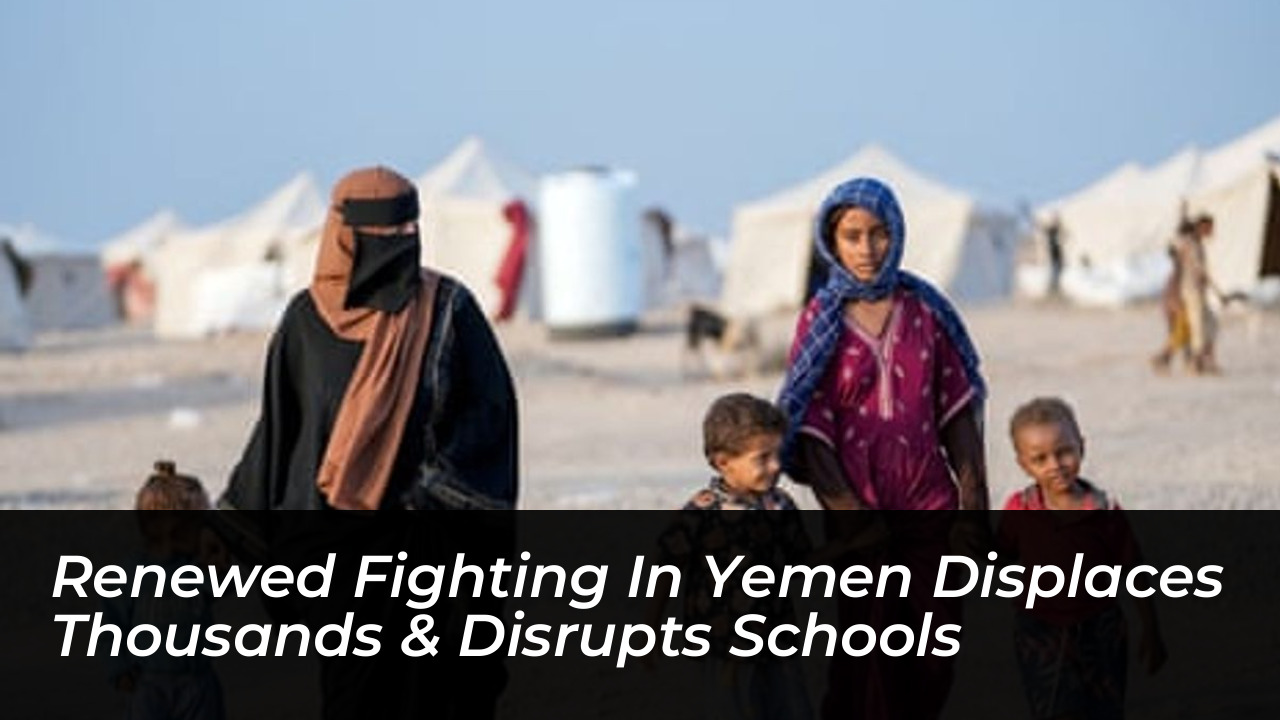
Renewed military escalation between Iran-aligned Houthi forces and Saudi-backed Yemeni government troops has displaced more than 130,000 people. This surge has severely disrupted daily life, healthcare, and education across southwestern Yemen, abruptly ending four years of relative calm that followed a 2022 UN-mediated ceasefire and plunging millions back into severe vulnerability.
The conflict escalated sharply in September when Houthi forces launched a rapid military campaign, pushing government forces back and seizing strategic towns along the Red Sea coast. This offensive has triggered widespread displacement across several governorates, including Taiz, Hudaydah, Marib, and Abyan.
Impact on Children and Education
The humanitarian toll has fallen heavily on children. According to the UN Children’s Fund (UNICEF), more than 57,000 children have been displaced in just two weeks of fighting. At least nine children have been reported killed and 12 injured, with three others missing following an attack on the main road connecting Yemen’s western coast to Aden.
Educational infrastructure has suffered devastating blows. Across the affected regions, 243 schools have been forced to close or suspend classes, interrupting the studies of more than 137,000 students. For many children, the classroom has been replaced by informal displacement camps.
Thirteen-year-old Muneer Farie, a resident of al-Wazeyah district in Taiz, had dreamed of becoming the first teacher in his farming family. However, as artillery fire approached his village, he and his family were forced to flee overnight with only their livestock and basic belongings.
“Studying is important, but not in a situation like this where we are struggling to get enough food, water and other necessities,” Muneer said. “For now, I will keep working until the war ends.”
Now living in a crowded tent in a displacement camp in al-Shimayateen, Muneer and his brother spend their days selling socks and cheap goods in nearby markets to help their parents scrape together money for survival.
School Closures and Psychological Trauma
Schools that attempted to stay open have ultimately succumbed to the violence. Abdulwasea Abdu, principal of the Musaab Ibn Umayr school in Taiz, kept doors open to maintain a sense of normalcy until a missile struck nearby.
“On the day the missile struck, we witnessed severe panic among them, with crying and screaming due to the explosions,” Abdu said. The resulting psychological trauma and ongoing danger forced the school to shut down, depriving more than 600 pupils of their education and raising deep concerns over a potential surge in child labor.
Disrupted Supply Lines and Regional Spillover
The fighting has also severed vital transport links, notably the main road between the Houthi-controlled port city of Mocha and government-controlled Taiz. The blockade of this crucial artery for heavy trucks and buses has restricted the flow of goods, driving up the prices of food and basic commodities.
Beyond Yemen’s borders, the violence has forced thousands to undertake dangerous maritime journeys across the Bab el-Mandeb Strait. More than 3,000 people have sought refuge in neighboring Djibouti, testing the resources of host communities in locations such as Obock and Khor Angar.
Emergency Humanitarian Response
International aid organizations are racing to address the expanding crisis, though resources remain critically constrained. UNICEF, the International Organization for Migration (IOM), the UN refugee agency (UNHCR), and the World Health Organization (WHO) are scaling up emergency operations.
Relief teams are deploying mobile health and nutrition clinics, distributing hygiene kits and water tanks, and repairing damaged water sanitation systems. Child protection units are actively providing psychosocial support and raising awareness about the lethal dangers posed by unexploded ordnance left behind by active combat.
Despite these efforts, aid agencies warn that ongoing bureaucratic hurdles, fuel shortages, and depleted stockpiles threaten to overwhelm current response capacities as displacement numbers continue to rise daily.