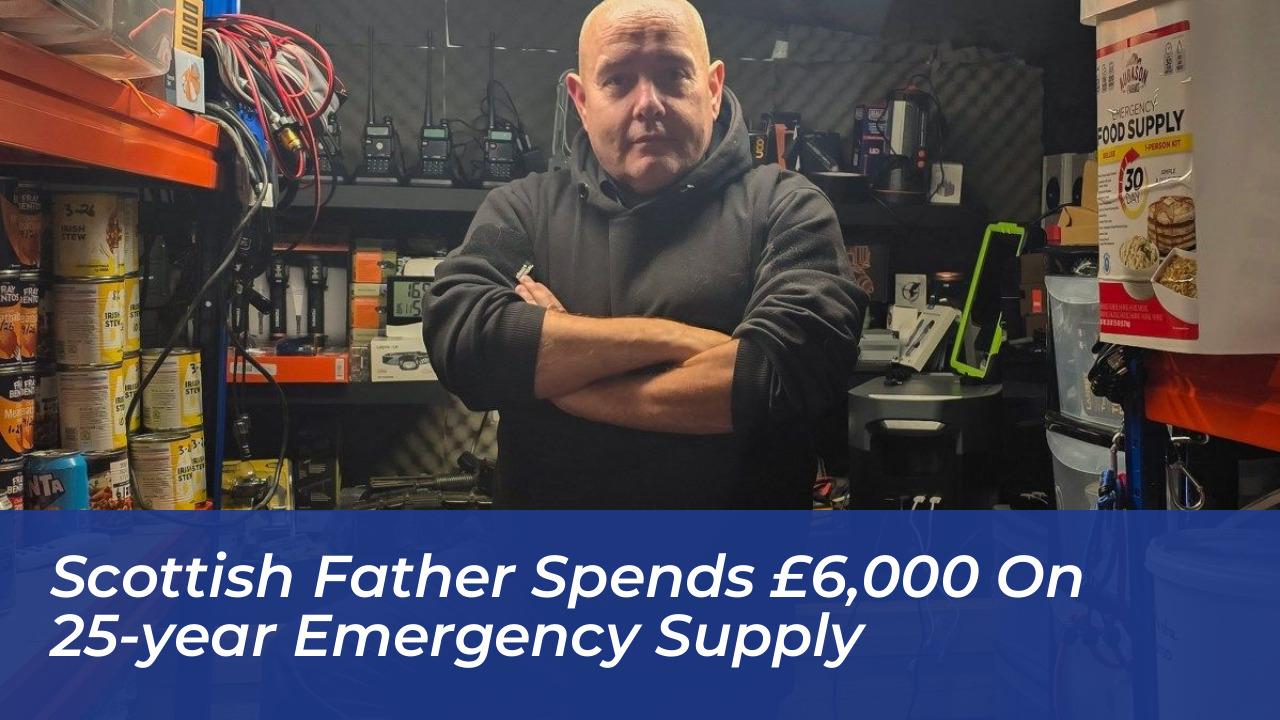

A Scottish engineer has invested £6,000 in emergency supplies, filling two family shelters with food, power banks, and survival equipment designed to sustain his household for up to 25 years. Brian Forbes, 52, began his journey into disaster preparedness after a severe winter storm in 2010 severely disrupted local transport and deliveries, leaving his family struggling to secure basic groceries.
Living with his family between Glasgow and Stirling, Forbes has dedicated years to refining his home-based setup. According to reports, his expenditures this year include approximately £2,500 on freeze-dried food, £2,000 on power banks, and £500 on a new generator. His shelters are also stocked with hundreds of canned goods, military rations, night vision goggles, walkie-talkies, battery-operated radios, and headlamps.
From Winter Storms to Global Risks
Forbes, who works as an engineer surveyor and analyzes risk for his profession, first started prepping following the chaotic winter weather of 2010. Gridlocked roads and empty supermarket shelves left a lasting impression on the father-of-three.
"The roads were gridlocked up here, people were sleeping in cars overnight, they had to be rescued by police," Forbes recalled. "I had to walk a mile to the local supermarket, and most of the staff hadn’t turned up. There was one person at the till, and queues down all three aisles. I felt bad that my kids didn’t have a lot in the house. I decided from then it would be a good idea to stock up for unplanned emergencies."
By adding to his inventory little and often, Forbes and his family built up a three-month food buffer by the time the COVID-19 pandemic arrived. This allowed them to bypass early panic-buying and supermarket queues.
Inside the £6,000 Backyard Shelters
Last year, Forbes invested around £5,000 to construct two specialized garden sheds to function as his emergency stores. The primary structure measures 14 feet by 12 feet and operates independently with its own solar panels, air conditioning systems, and isolated power supplies.
The shelters contain a vast assortment of provisions designed for long-term storage:
- Freeze-dried foods, rice, pasta, and flour with shelf lives reaching up to 25 years
- Military-grade 24-hour meal ration packs
- 12 high-capacity power banks and a modern generator
- Eight walkie-talkies, high-frequency radios, wind-up radios, and FM receivers
- Lanterns, headtorches, and night vision goggles intended for unlit power outages
"It's not a bunker. I wish I had bunker money," Forbes noted. "The goggles aren't for hunting people, obviously. They're just for power cuts in general. It means you don't have to walk around with a torch."
Family Dynamics and Community Realities
While his wife, Donna, 51, initially displayed skepticism toward his hobby, she has since embraced the lifestyle and splits the prepping expenses with him. However, their three children-aged 15, 27, and 29-remain entirely unconvinced.
"They think dad's nuts, dad's crazy, he's lost his marbles," Forbes said. "They go to great lengths to tell me why I'm wrong-I may well be wrong, but it's ultimately my money and time. I do no harm to anyone else. I only need to be right once. Whether they think I'm right or wrong, I have a responsibility to care for them and I take that pretty seriously."
Forbes also pointed out that his increased spending in recent months stems from escalating concerns over infrastructure vulnerabilities. These include a potentially crumbling national power grid burdened by electric vehicles and heat pumps, as well as recurring water supply disruptions.
Despite facing online criticism and occasional hostile messages regarding his prepping lifestyle, Forbes remains unfazed. He advises others interested in emergency preparedness to avoid breaking the bank, emphasizing that beginners can easily start small on a modest budget.