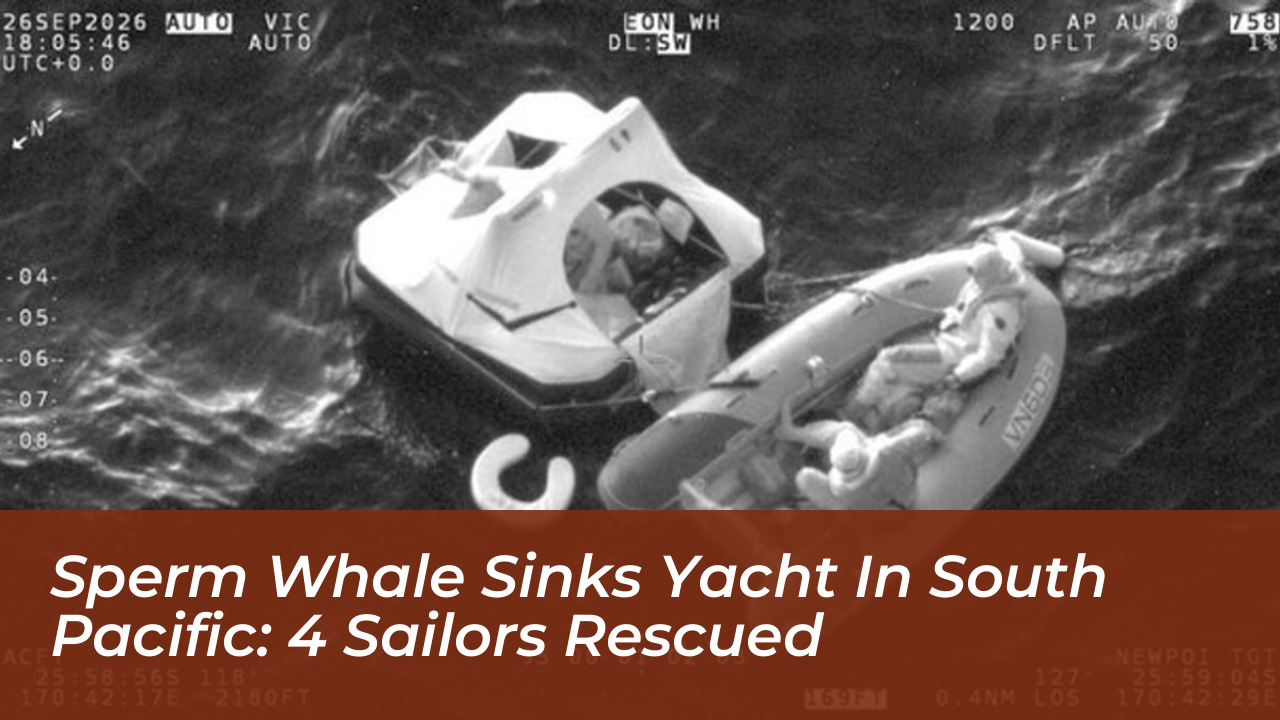
Four sailors faced a harrowing 18-hour fight for survival on the high seas after a pod of sperm whales collided with and sank their yacht in the remote South Pacific. The incident involved the 52-foot vessel Tai Tam (identified in some reports as a Beneteau Oceanis 51.1), which was sailing approximately 250 nautical miles north of Norfolk Island on a Saturday afternoon when the catastrophic strike occurred.
The Sudden Collision and Impact
The crew members were caught completely off guard as the marine mammals made contact with the hull. Australian sailor Jemma Cooper described the terrifying moment the vessel was struck while she was near the steering wheel.
“There was sort of a loud thud. The whole boat was pushed sideways,” said Jemma Cooper, recounting the sudden blow.
After being thrown by the force, she noticed a brown discoloration in the water and spotted a pod of six to eight sperm whales alongside the port side of the vessel. Below deck, her husband, Jeremy Cooper, was awakened by the violent impact.
“It was pretty immediately evident it was very serious,” Jeremy Cooper said. “All the steering gear was smashed on the starboard side, and there was a significant amount of water coming in.”
Emergency Response and Bailing Efforts
Recognizing the severity of the structural damage, the crew acted quickly. The group comprised Australian, New Zealand, and French nationals. At 1 p.m. New Zealand time on Saturday, roughly 30 minutes after the collision, they activated their Emergency Position-Indicating Radio Beacon (EPIRB).
“We declared a full mayday,” said New Zealand crew member Terry Hetherington. The sailors spent the next several hours manually bailing out incoming water and trying to prevent the engine from becoming clogged.
French crew member Martin Jaffre inspected the damage below the boat. He found that the collision had cracked the fiberglass structure, left several gashes in the hull, and entirely disabled the steering mechanism. Jaffre attempted to slow the flooding using expansion foam and whatever materials were available.
The Royal New Zealand Air Force deployed a P-8A Poseidon patrol plane to the area to establish radio contact and coordinate rescue operations with maritime authorities.
Abandoning Ship and Rescue by Container Ship
As water continued to overwhelm the vessel, the crew stayed aboard as long as safely possible. Late at night, under a full moon and in calm two-meter seas, they abandoned the sinking yacht and transferred into a life raft.
In the early hours of Sunday morning, the sailors cut the tether connecting their life raft to the Tai Tam. They feared that the sinking boat would drag them down with it. Shortly after, the yacht slipped completely beneath the waves.
At approximately 6 a.m. on Sunday-roughly 18 hours after the whale encounter-a 470-foot container ship named the MV Sofrana Surville arrived on the scene and rescued the stranded sailors. Although the towering size of the commercial freighter made the initial approach to the tiny life raft intimidating, all four crew members successfully climbed the ladder to safety within half an hour.
Rescue Coordination Centre Operations Manager Mike Clulow commended the preparedness of the crew and the execution of the mission.
“This was a well-coordinated and executed rescue,” Clulow said. “The crew of the yacht did all the right things, and it was unfortunate to have struck a whale in open water. They were well prepared and the early activation of their EPIRB was key to helping get them to safety.”
Broader Context of Whale Collisions at Sea
Marine experts note that adult male sperm whales typically measure between 50 and 60 feet in length. Classified as a vulnerable species by the International Union for Conservation of Nature, sperm whales face numerous threats in modern oceans, including noise pollution, plastic ingestion, and ship strikes.
Accidental collisions between vessels and large marine mammals, including sperm whales, humpbacks, and orcas, remain an ongoing concern for offshore sailors and commercial shipping lanes worldwide. While rare, such incidents underscore the inherent unpredictability of open-water navigation and the vital importance of carrying functional emergency distress equipment.