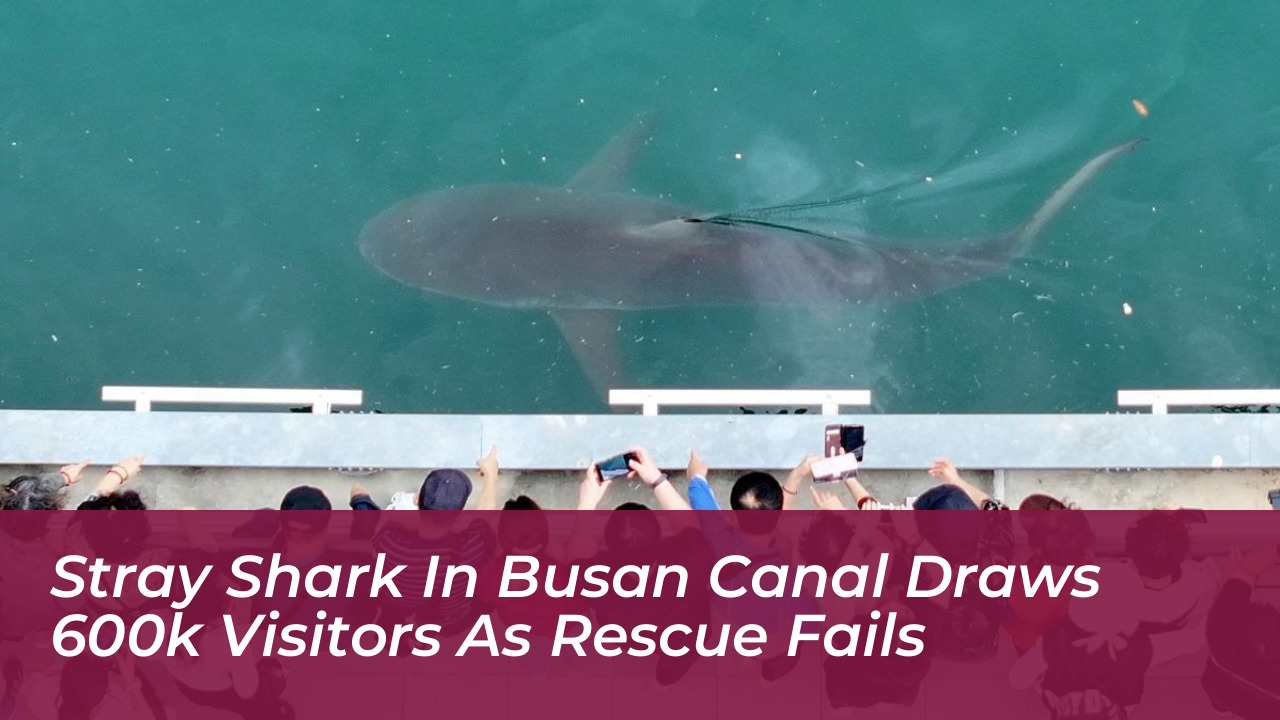
A 3.5-meter shark trapped in an artificial canal at Busan’s North Port Waterfront Park has drawn more than 600,000 visitors since September 18, 2026. This massive public interest has forced South Korean authorities to suspend multiple rescue operations aimed at guiding the animal back to the open sea.

The marine predator, believed to be a bronze whaler or dusky shark, became trapped after following prey from the open sea into the narrow, shallow waterway. The canal stretches approximately 1.5 kilometers and ranges from 30 to 60 meters wide, with depths fluctuating between 2.5 and 4 meters.
Failed Rescue Operations by Coast Guard
The Busan Coast Guard and local rescue teams initiated a herding operation on Tuesday morning, September 29, 2026. Coastguard and fire department vessels deployed water pumps to spray high-pressure jets, generating localized noise, vibrations, and foam behind the shark.
Officials modeled this technique after a successful 2004 rescue of a great white shark trapped in shallow waters off Massachusetts. However, the animal repeatedly slipped past the five deployed vessels, bypassed the water streams, and retreated deeper into the canal. By Tuesday afternoon, authorities suspended the operation for the second time after concluding that the current tactics were ineffective.
Health Concerns and Rising Shark Encounters
The National Institute of Fisheries Science confirmed that the shark remains in stable physical condition. Locals have affectionately nicknamed the animal “Bukang-i” after the Korean name for Busan North Port. However, scientists have warned that prolonged confinement in the shallow waterway restricts its movement and prevents normal feeding activities. This could weaken the animal over time.
Ji Hwan-sung, a researcher at the National Institute of Fisheries Science, noted that dusky and bronze whaler sharks typically hunt in waters as deep as 100 meters. This makes a confined urban channel unsuitable for long-term survival. Maritime authorities announced plans for a subsequent rescue attempt utilizing a custom-built net designed to partition the canal section by section.
The incident coincides with a broader regional trend. The fisheries institute recorded 46 large sharks off South Korea’s east coast in the first half of 2026. This figure is nearly four times the amount recorded during the same period the previous year. Experts attribute this shift to warming ocean temperatures and higher concentrations of migrating prey species.
Tourism Surge and Honorary Ambassadorship
The shark’s appearance unexpectedly coincided with preparations for Chuseok, the major Korean harvest festival that drives extensive domestic travel. Between September 19 and September 28, the North Port Waterfront Park recorded 607,000 visits. This represents a dramatic surge compared to its normal baseline of about 2,000 visitors per day during holidays.
Capitalizing on the massive public interest, the Busan municipal government held an Instagram poll. In this poll, 91% of approximately 8,200 respondents backed a proposal to name the animal an honorary public relations ambassador. City officials officially conferred the title “Shafluencer” upon the shark, with the city’s mascot, Boogi, designated to accept the certificate on its behalf.
Authorities have scheduled a fresh rescue attempt using specialized netting to guide Bukang-i safely out of the canal and back into coastal waters.