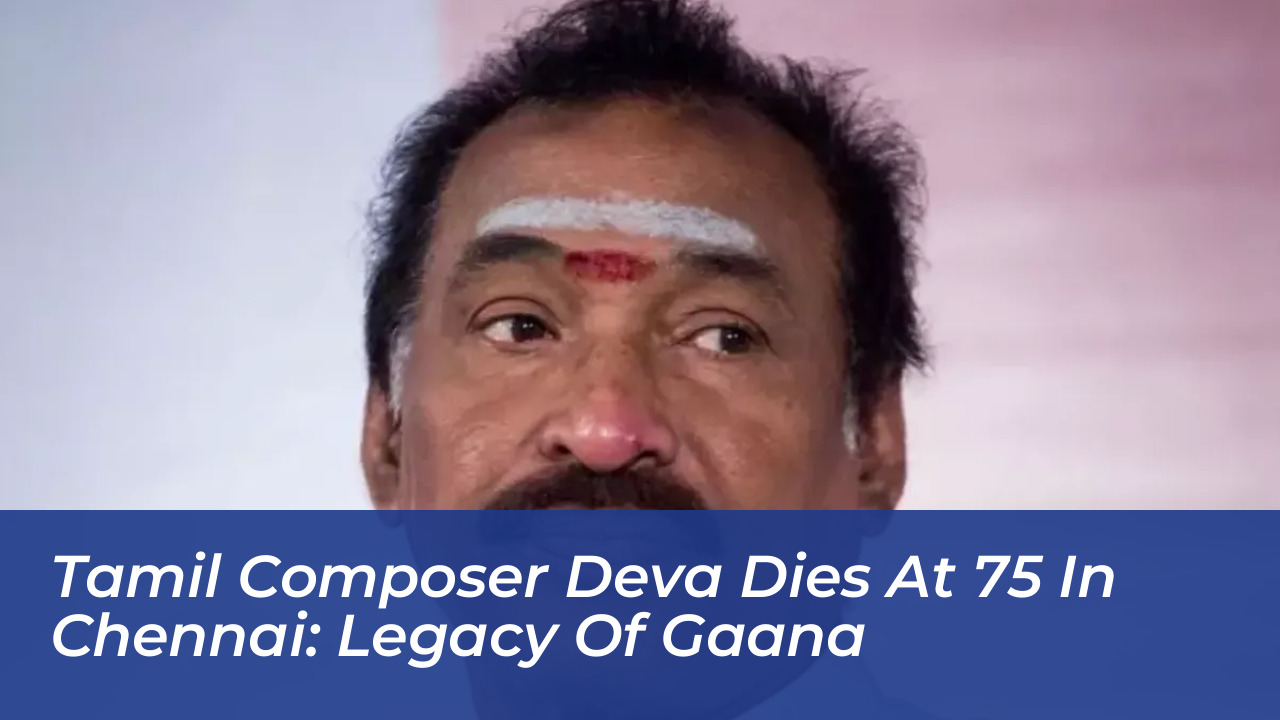

Veteran Tamil film music composer and singer Deva, widely celebrated as ‘Thenisai Thendral’, passed away at Surya Hospital in Chennai on Saturday, October 17, at the age of 75. According to reports from The Times of India and DT Next, the legendary musician experienced a sudden health emergency involving chest pain and cardiac arrest early that morning.
Despite immediate efforts by doctors to resuscitate him at the hospital in Kodambakkam, he could not be revived. His death marks the end of an era for South Indian cinema, robbing the industry of one of its most prolific and culturally significant music directors.
A Storied Career Spanning Over Four Decades
Born Devanesan Chokkalingam on November 20, 1950, Deva carved a monumental path in regional cinema. Over a career spanning more than 30 years, he composed songs and background scores for over 400 films across Tamil, Telugu, Kannada, and Malayalam industries. His journey in music began with rigorous training. He studied piano under Dhanraj Master-who also mentored the iconic Ilaiyaraaja-and learned Indian classical music on the harmonium from J.B. Krishna.
After working with Doordarshan Podhigai composing tracks for the program Vayalum Vaazhvum, and spending years crafting hundreds of devotional albums in the 1980s, Deva made his full-fledged feature film debut with Mattukkara Mannaru in 1986. Though that initial venture had a modest box-office run, his distinct musical sensibilities soon captured the attention of filmmakers.
His big breakthrough came with projects like Manasukketha Maharasa (1989) and Vaigasi Poranthachu (1990). The latter earned him his first Tamil Nadu State Film Award for Best Music Director. From there, he became the heartbeat of 1990s commercial cinema.
The Pioneer Who Brought Gaana to Mainstream Cinema
Perhaps Deva’s most enduring legacy is his bold integration of Gaana-a folk music tradition deeply rooted in Chennai’s working-class neighborhoods-into mainstream Tamil cinema. At a time when the musical landscape was overwhelmingly dominated by giants like Ilaiyaraaja and A.R. Rahman, Deva sought an unmistakable signature identity.
Reflecting on this creative choice shortly before his passing, Deva explained how he differentiated his style by lifting the rhythms, everyday language, and raw emotion of local Chennai streets onto the silver screen. Songs like ‘Kaavalaipadaathey Sagothara’ from Kadhal Kottai proved that folk-infused street tracks could anchor major cinematic moments, forever changing how directors utilized background scores and situational tracks.
The Voice Behind Superstar Rajinikanth’s Stardom
Deva’s discography reads like a checklist of blockbusters from Tamil cinema’s golden commercial era. He is universally remembered for crafting the musical identities of Superstar Rajinikanth’s biggest hits, including Annamalai (1992), Baashha (1995), and Arunachalam (1997). Notably, Deva composed the iconic theme music for Rajinikanth’s official title card, a triumphant fanfare that has announced the superstar’s cinematic entries for decades, including recent projects.
His extensive hit list also features unforgettable soundtracks for other top stars:
- Vijay: Deva (1995), Nerrukku Ner (1997), and Kushi (2000)
- Ajith Kumar: Kadhal Kottai (1996), Aasai (1995), Vaalee (1999), and Priyamudan (1998)
- Malayalam Cinema: The Prince (1996) starring Mohanlal, and Phantom (2002) featuring Mammootty
- Kannada Cinema: Amrutha Varshini (1997), which won him the Filmfare Award for Best Music Director in Kannada
Honours, Family Legacy, and Final Rites
In recognition of his immense contributions to the arts, the Tamil Nadu government honored Deva with the prestigious Kalaimamani Award. He also served as the chairman of the Tamil Nadu Eyal Isai Nadaka Mandram and added his name to the Guinness World Records for his involvement in the rapid production film Sivappu Mazhai (2010).
Music remains deeply embedded in his family lineage. His son, Srikanth Deva, followed in his footsteps to become an established film composer in Kollywood, while his nephew Jai works as a recognized film actor. Deva’s brothers, Sabesh and Murali, also carved out successful careers in the industry as musicians and composers.
Following his passing at Surya Hospital, his mortal remains were brought to his residence in Vadapalani, Chennai, allowing grieving fans, political leaders, and members of the South Indian film fraternity to pay their final respects.
Frequently Asked Questions About Composer Deva
When did Tamil composer Deva pass away?
Deva passed away on Saturday, October 17, at the age of 75 following a sudden heart-related medical emergency at Surya Hospital in Chennai.
What was Deva’s real name and popular title?
His birth name was Devanesan Chokkalingam. He was affectionately known as ‘Thenisai Thendral’, a title bestowed upon him by veteran composer M.S. Viswanathan meaning “a breeze of sweet music.”
Which music genre is Deva most famous for popularizing?
Deva is credited with bringing Gaana music-a traditional folk genre originating from Chennai’s working-class neighborhoods-into mainstream Tamil cinema.
How many films did Deva compose music for?
Over a career spanning nearly four decades, Deva composed songs and background scores for more than 400 films across Tamil, Telugu, Kannada, and Malayalam cinema.
Which iconic Rajinikanth films featured music by Deva?
Some of Rajinikanth’s biggest blockbusters scored by Deva include Annamalai (1992), Baashha (1995), and Arunachalam (1997). He also composed the legendary ‘Superstar’ title card theme music.