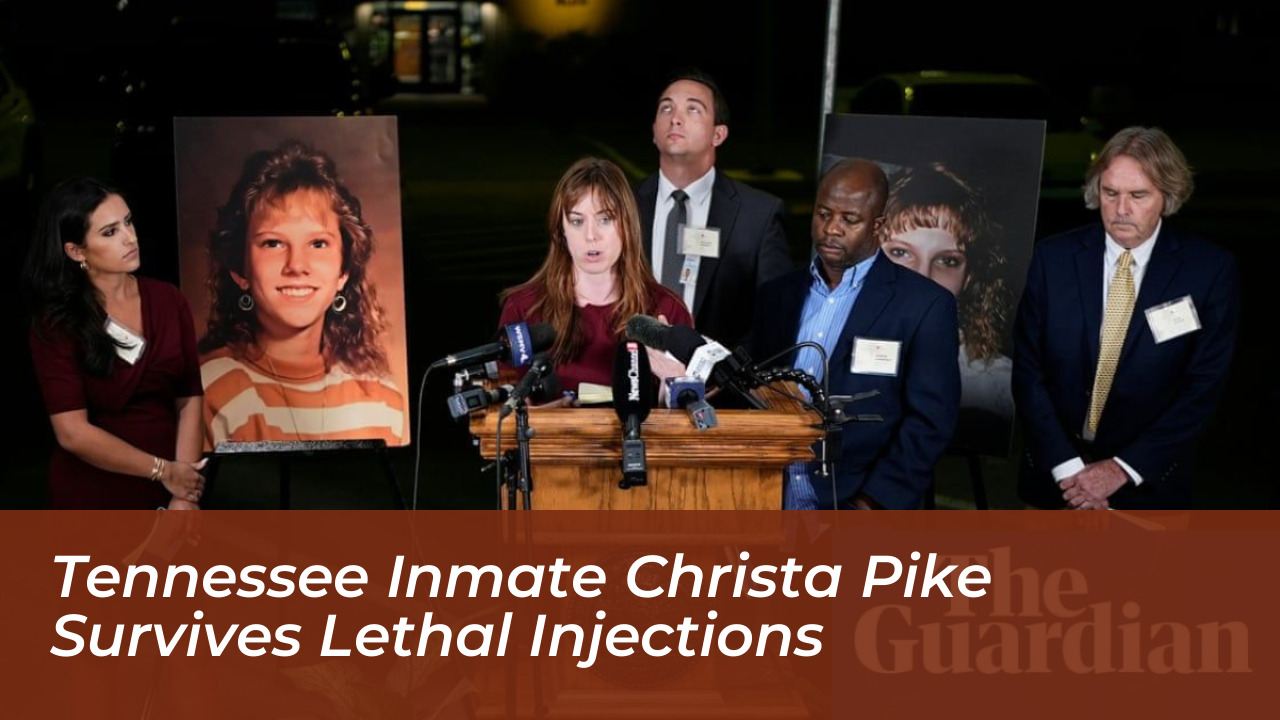
Death row inmate Christa Pike survived an unprecedented attempt by Tennessee prison officials to execute her using two separate lethal injection doses at the Riverbend Maximum Security Institution in Nashville. Pike, 50, was convicted three decades ago for the 1995 murder of her 19-year-old Job Corps classmate, Colleen Slemmer. The botched procedure marked Tennessee’s first execution effort involving a female inmate in over two centuries.
The execution procedure was preceded by a dramatic sequence of legal challenges. An appeals court issued a temporary stay of execution just an hour before it was scheduled to begin at 10:00 a.m. CDT on Wednesday, following arguments regarding unconsidered childhood trauma and abuse. However, the U.S. Supreme Court later voted 6-3 to lift the stay, allowing the lethal injection process to proceed later that evening.
Eyewitness Accounts and Severe Physical Distress
Media witnesses, including WKRN news anchor Tori Gessner and Associated Press reporter Kim Chandler, observed officials raising the execution chamber curtains at approximately 7:27 p.m. Strapped to a gurney, Pike addressed witnesses before the administration of drugs.
"I'm going to leave this world the way I spent most of my life, and that is in love," Pike said, adding that she felt at peace and ready to be free.
Shortly after the initial injection of pentobarbital, Pike remained conscious. Witnesses reported that she raised her head and complained about severe pain in her arm, stating, "My arm feels like it’s about to bust. One spot is really throbbing." Following a five-minute waiting period and a second set of drug syringes administered around 8:30 p.m., Pike continued to breathe audibly and snore behind the closed curtains until the facility cut off the room’s microphone at 8:53 p.m. and escorted witnesses out.
Legal Fallout and Government Response
Pike’s defense attorneys immediately filed emergency motions with federal and state courts, arguing that she was subjected to unnecessary agony in violation of constitutional protections against cruel and unusual punishment. Her legal team stated that the incident validated long-standing concerns regarding difficult vein access, blown veins, degraded pentobarbital, and a lack of immediate emergency medical intervention.
Dr. Joel Zivot, an Emory University medical expert retained by the defense, noted that Pike likely failed to achieve sufficient blood concentration levels of the drug to trigger apnea and cardiovascular collapse. This raised concerns about potential long-term brain injuries resulting from delayed resuscitation efforts. Following the botched procedure, Pike was transferred to an off-site medical facility where lawyers stated she received life-saving measures.
In response to the chaos, Tennessee Governor Bill Lee ordered a comprehensive, independent third-party review to investigate the events inside the execution chamber. Gov. Lee also announced that the state's remaining scheduled execution for the year would be put on hold.
"Carrying out a lawfully imposed sentence is among the state's most serious responsibilities, and the people of Tennessee expect it to be done in a manner that is not only legal and constitutional, but is effective," Gov. Lee said in a public statement.
The Tennessee Department of Correction maintained that prison staff adhered strictly to the state's established and approved lethal injection protocols. Spokesperson Dorinda Carter confirmed that Pike was transported to an off-site medical facility after the standard protocol procedures failed to cause death.
Background of the Case and Prior Incidents
Christa Pike was sentenced to death in 1996 for first-degree murder after she, along with co-defendant Tadaryl Shipp and accomplice Shadolla Peterson, lured Colleen Slemmer to an isolated area of the University of Tennessee’s agricultural campus. Investigators established that the victim was brutally tortured, beaten with a meat cleaver, and slashed before Pike ultimately killed her by striking her head with a large chunk of asphalt.
The high-profile crime shocked the local community, particularly after investigators discovered an inverted pentagram carved into the victim’s chest and learned that Pike retained a fragment of Slemmer’s skull as a souvenir. While Shipp received a life sentence due to being a juvenile at the time of the offense, Pike remained the sole woman on Tennessee’s death row.
The failed execution marks another troubling milestone for capital punishment protocols in Tennessee. In April 2022, Gov. Lee paused the execution of Oscar Smith just minutes before it was set to begin after discovering drug-testing oversights. Additionally, the planned execution of Tony Carruthers in May 2026 was abandoned after staff failed to secure intravenous vein access. Legal experts and advocacy groups continue to scrutinize the systemic issues surrounding lethal injection protocols nationwide.