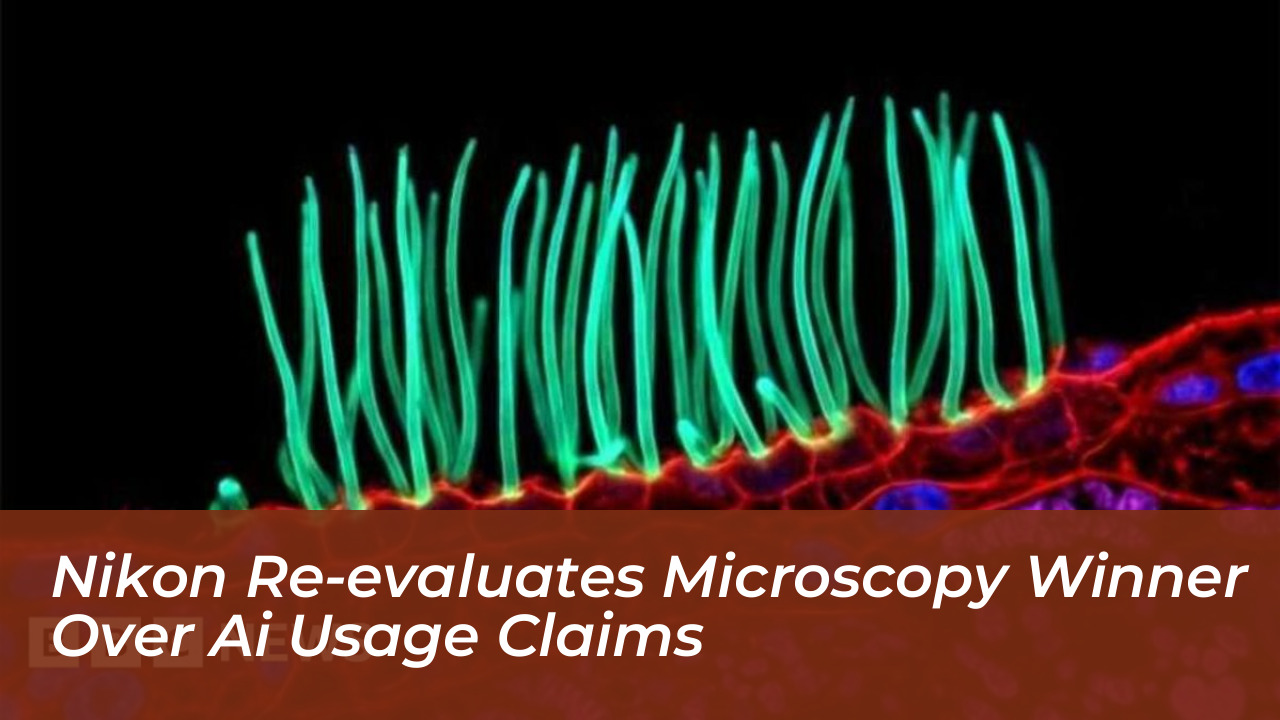
Nikon is actively re-evaluating the winning entry of its 15th annual Small World In Motion contest. Members of the scientific community raised serious concerns that the video submission relied heavily on artificial intelligence. The annual international competition celebrates videos and photographs captured through advanced laboratory microscopes, blending scientific research with visual artistry.
- Scientific Backlash Over Biological Accuracy
- AI Post-Processing Versus Image Generation
- Broader Implications for Scientific Visualization
- Nikon’s Ongoing Investigation
- Frequently Asked Questions
- What is the Nikon Small World In Motion competition?
- Who won the disputed 2026 competition entry?
- Why did scientists object to the winning video?
- Did Dr. Xu admit to using artificial intelligence?
- How is Nikon responding to the controversy?
The disputed first-place entry was submitted by Dr. Ning Xu, an optical engineer affiliated with Tsinghua University in China. The short video purports to demonstrate microscopic, hair-like structures known as cilia moving inside the airways of a child. Specifically, the biological sample was sourced from a patient diagnosed with primary ciliary dyskinesia (PCD), a rare genetic disorder that impacts respiratory function by impairing normal mucus clearance.
Scientific Backlash Over Biological Accuracy
Shortly after Nikon announced the winning entry on September 15, independent researchers and microscopy experts took to social media to question the video’s anatomical validity. Critics pointed out unusual structural features, incorrect cell scaling, and bizarre movements that contradict established biology.
Edward Phelps, a bioengineering researcher at the University of Florida in Gainesville, publicly highlighted anomalies on LinkedIn. He noted that the video displayed distinct purple sub-epithelial structures resembling mitochondria. He pointed out that such extracellular configurations matching the size of cell nuclei do not occur naturally in human biology.
Robert Hirst, a lead diagnostic scientist at Leicester University who uses microscopy to study PCD, remarked that the film immediately set off alarm bells. According to Hirst, the visualization incorrectly suggests there is only a single cilium per cell rather than the normal count of roughly 200. This creates an inaccurate impression for patients and researchers alike.
“What worries me most of all is that PCD patients will see this video and think, ‘My cilia look like this, and my cells look like this,’ and they just don’t, unfortunately,” Hirst noted.
AI Post-Processing Versus Image Generation
As scrutiny intensified, Nikon updated its contest blog post on September 22 to disclose that Dr. Xu utilized an unsupervised neural network to assist with post-processing. Additionally, Ian Donovan, an MD/PhD student at UT Southwestern Medical Center, reportedly ran the video through Google Gemini and discovered an invisible Google SynthID watermark. This indicated portions of the media file interacted with AI systems.
Dr. Xu has defended his submission online, maintaining that he did not violate the established rules of the competition. He clarified that AI was not used to generate the experimental movie, the biological cilia, or their movement from scratch. Instead, he argued that an algorithm was applied afterward to reconstructed grayscale data to help distinguish and color structures featuring similar morphology.
“There is an important difference between using AI to create something that was never in the experiment and using AI to process or visualize real experimental data,” Dr. Xu explained. He added that his team wanted to make the presentation visually engaging for a contest celebrating microscopy artistry.
Broader Implications for Scientific Visualization
The controversy has sparked a wider conversation across the scientific community regarding the ethical boundaries of artificial intelligence in research visualization. Experts emphasize that microscopic imagery serves as foundational data rather than mere decorative illustration.
“Scientific images are not just illustrations,” said Melanie White, a developmental biologist at the University of Queensland in Brisbane, Australia. “They are data, and we need to be able to trust that what we are seeing is grounded in the underlying measurement.”
Markus Sauer, a super-resolution microscopy expert at the University of Würzburg in Germany, noted that leveraging computational tools for visualization is not inherently problematic. However, he cautioned that ethical concerns arise the moment AI tools misrepresent, exaggerate, or fundamentally alter experimental findings.
Nikon’s Ongoing Investigation
Nikon Instruments Inc. stated that Dr. Xu is cooperating fully with the inquiry and has provided comprehensive technical documentation outlining his equipment, imaging methods, and processing workflows. While initial reviews suggested the technical methodology aligned with standard microscopy practices, organizers have committed to a thorough re-evaluation of the entry.
“At this time, we don’t see that any rules were violated, but we are reinvestigating and re-evaluating the entry,” a Nikon spokesperson reported. The spokesperson confirmed that the company is actively reviewing its overarching AI policies for future competitions.
Frequently Asked Questions
What is the Nikon Small World In Motion competition?
The Nikon Small World In Motion contest is an annual international event that has run for 15 years. It celebrates short films and videos captured through light microscopes that showcase the beauty and complexity of the microscopic world.
Who won the disputed 2026 competition entry?
The contest initially awarded first place to Dr. Ning Xu, an optical engineer and researcher, for a video purportedly showing cilia moving inside a child’s airways.
Why did scientists object to the winning video?
Researchers raised concerns over biological plausibility. They pointed out that structures like mitochondria and cellular scales depicted in the video did not match real human biology or natural cell behavior.
Did Dr. Xu admit to using artificial intelligence?
Yes. Dr. Xu and Nikon confirmed that an unsupervised neural network or AI model was utilized during the post-processing phase to enhance grayscale data visualization and colorization. However, Xu insisted no generative AI was used to fabricate the underlying physical movie.
How is Nikon responding to the controversy?
Nikon updated the winning entry’s documentation to reflect the use of AI post-processing tools, gathered technical records from the entrant, and launched a formal re-evaluation of the winning video while reviewing its competition guidelines.