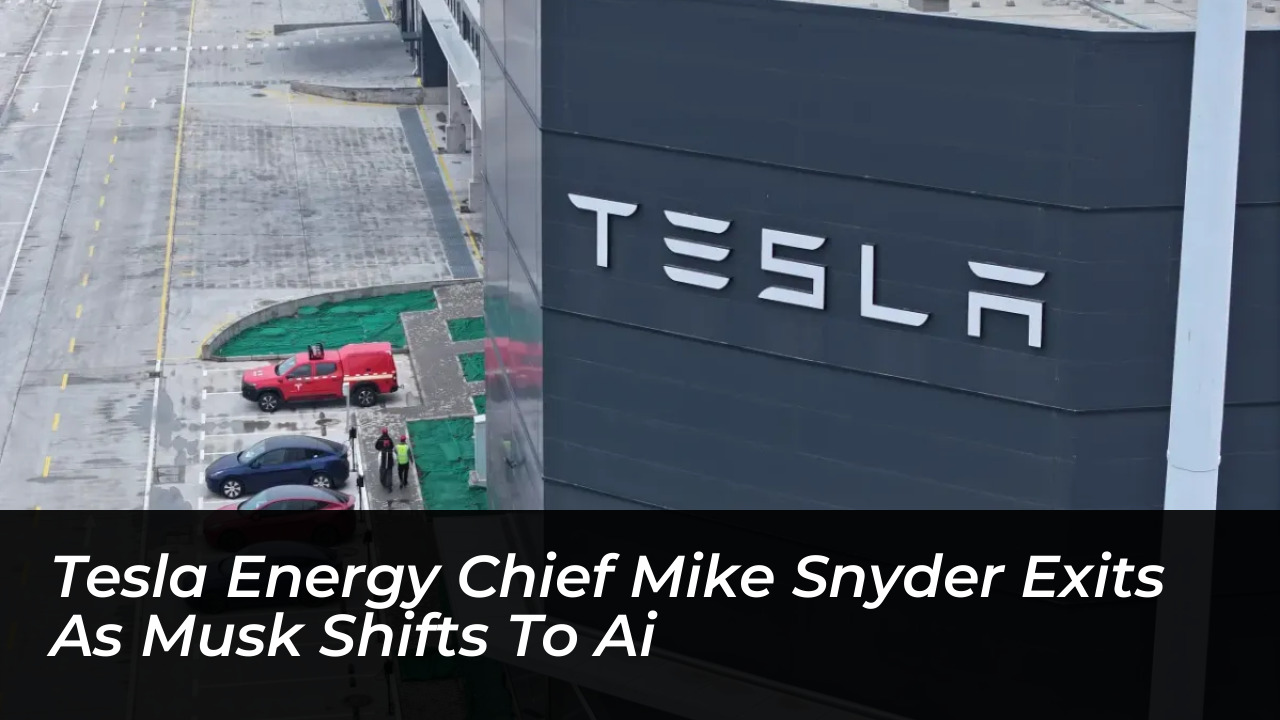

Tesla’s energy division is facing a major leadership transition following the departure of Mike Snyder, Vice President of Energy and Charging. According to a report published Thursday, October 15, 2026, by the Wall Street Journal, Snyder has left the company as CEO Elon Musk shifts corporate strategic priorities toward artificial intelligence and robotics.
People familiar with the matter stated that AJ Booth, Tesla’s senior director of energy products engineering, will step in to replace Snyder. Snyder has not publicly commented on his departure, and the report did not disclose specific circumstances surrounding his exit.
Snyder’s Rise Through Tesla’s Ranks
Snyder has a long tenure with the electric vehicle and clean energy giant. According to his LinkedIn profile, he joined Tesla in 2014 as a staff electrical engineer. Over the next decade, he advanced steadily through various technical and leadership roles.
He assumed the top energy and charging post in October 2024, succeeding former executive Drew Baglino. Following his own exit from Tesla, Baglino transitioned to founding two clean energy startups: Heron Power and Sadi Thermal Machines.
A Strategic Pivot Toward AI and Robotics
Snyder’s exit coincides with a broader corporate pivot by Elon Musk. While Tesla’s automotive and energy segments remain foundational to its business model, Musk has increasingly directed resources, engineering focus, and public attention toward autonomous driving, artificial intelligence, and humanoid robotics.
Despite this shift in corporate emphasis, Tesla’s energy storage business continues to function as a vital and growing source of revenue. The segment originated from Tesla’s $2.6 billion acquisition of SolarCity in 2016, which consolidated the company’s in-house battery storage initiatives.
Growth and Performance of Tesla Energy
The energy division has scaled significantly over the years, anchored by two primary hardware offerings: the Powerwall for residential energy storage and the commercial-scale Megapack utility system.
- Financial Contribution: In 2025, Tesla reported energy generation and storage revenue of $12.77 billion, accounting for approximately 13.5% of the company’s overall revenue.
- Manufacturing Expansion: Tesla operates dedicated Megapack megafactories in Lathrop, California, and Shanghai, China, with a new production facility commencing operations in Texas.
- Project Crystal Sun: The company is also reportedly planning a major solar manufacturing facility codenamed Project Crystal Sun in Texas.
- Deployment Metrics: Tesla recently reported deploying 13.7 GWh of energy storage products, representing a 10% increase compared to the 12.5 GWh deployed during the same period in 2025.
As AJ Booth takes over leadership of the energy products engineering and charging ecosystem, market watchers and retail investors continue to monitor how Tesla will balance its rapidly scaling energy infrastructure business alongside Musk’s ambitious bets on next-generation artificial intelligence and robotics.