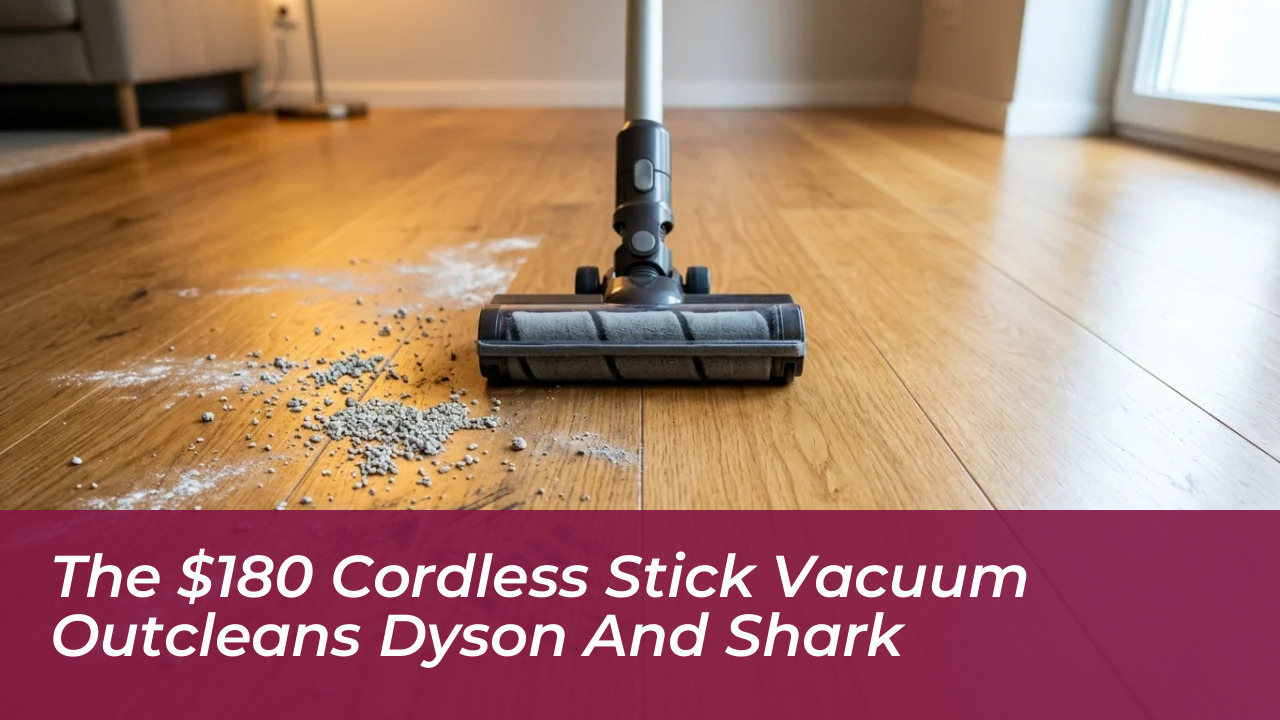

When shopping for a cordless stick vacuum, many consumers assume that reliable performance and strong suction require spending upwards of $400 or $500 on premium brand names like Dyson and Shark. However, hands-on performance evaluations reveal that budget-friendly alternatives can match or even exceed the cleaning capabilities of pricier market leaders, particularly on delicate surfaces. At a list price of $180-and frequently discounted to $160 at select retailers-the Eureka ReactiSense 440 delivers impressive suction and floorhead engineering that rivals heavy-hitting competitors like the Dyson V8 Cyclone.
While many budget stick vacuums under $200 struggle with weak airflow, poor battery longevity, and clumsy designs that scatter debris across polished floors, the ReactiSense 440 approaches hardwood floor care with sophisticated engineering designed to capture light debris and pet messes safely on the first pass.
The Engineering Behind Safe Hardwood Cleaning
Hardwood surfaces require a delicate balance of airflow dynamics and floorhead mechanics. Standard vacuum designs often rely on stiff plastic bristles and high-speed brush rolls built primarily to agitate deep carpet fibers. On bare wood, however, these rigid rollers can fling hard particles across the room, kick debris backward, or leave permanent scuffs and micro-scratches.
An effective bare-floor cleaner head must maintain low clearance to maximize direct suction without allowing hard plastic parts to scrape against delicate timber, laminate, or peel-and-stick tiles. High-end vacuums typically solve this challenge by incorporating soft-bristled rolls, rubberized contact points, and motorized brush shut-off controls-features rarely bundled into machines priced under $200.
The Eureka ReactiSense 440 bridges this gap by pairing soft bristles with thin strips of rubberized material designed to scoop up dirt rather than deflect it. To protect polished surfaces, the cleaner head utilizes a four-wheel suspension system featuring two larger rear wheels, two miniature front rollers, and a center strip of soft padding. This configuration elevates the plastic housing securely away from the floor surface, preventing scratches while maintaining optimal airflow.
Performance Breakdown: Eureka ReactiSense vs. Premium Competitors
In multi-surface cleaning evaluations, the Eureka ReactiSense 440 held its ground against models costing more than double its retail price. During controlled testing using cat litter and fine flour on hardwood, the unit demonstrated immediate debris pickup on the initial forward push, significantly reducing the dirt kickback commonly observed with several popular Shark vacuums and Dyson releases.
Beyond bare timber, the vacuum transitions smoothly over short-pile rugs and high-pile carpets without bogging down the motor or sacrificing suction power. Weighing in at 6.4 pounds, the machine remains manageable during overhead cleaning or multi-room sessions. It comes in slightly lighter than several 7-pound Shark models while closely trailing the 5.74-pound Dyson V8 Cyclone and the 6.25-pound Shark BU3626 PowerLite.
Key Specifications Comparison
- Eureka ReactiSense 440: $180 list price; 6.4 lbs; 4 rubber-covered wheels; auto-sensing suction.
- Dyson V8 Cyclone: 5.74 lbs; higher price point; premium filtration and bare-floor pickup.
- Shark BU3626 PowerLite: 6.25 lbs; cordless stick vacuum form factor optimized for daily chores.
- Eureka FlexReach Plus: $180 upright alternative; corded design; continuous multi-surface power.
- TP-Link Tapo RV30 Max Plus: $230 sale price ($330 list); 5,300 Pa suction; automated robot mop with dock.
Evaluating Real-World Trade-Offs
Despite its top-tier floorhead performance, robust build quality, and gentle touch on hardwood, the ReactiSense 440 reveals its budget roots in total run time. The manufacturer rates the battery for up to 60 minutes of cleaning on a single charge under optimal laboratory conditions. However, real-world testing paints a different picture.
When operating on its automatic sensing setting, the battery routinely drains in less than 40 minutes. This necessitates more frequent recharging between daily whole-home touch-ups compared to higher-capacity alternatives like the Dyson V8 Cyclone or the JELLYPIG X100.
Alternative Floor-Care Options Under $250
Homeowners seeking alternative cleaning configurations within a modest budget have several capable options across different form factors:
- Corded Upright Utility: The Eureka FlexReach Plus ($180) trades cordless freedom for continuous power, providing deep suction for high-pile carpets and bare hardwood via a long extension cord.
- Hands-Free Automation: The TP-Link Tapo RV30 Max Plus ($230 on sale from $330) delivers 5,300 Pa of suction, offering an automated robotic vacuum and mopping system complete with an auto-empty dock for effortless daily maintenance.
For shoppers focusing on agility, bare-floor preservation, and fast cleanups, an optimized cordless stick vacuum remains the most practical tool for high-traffic homes. Finding genuine performance under $200 requires looking closely at brush head mechanics and wheel clearance rather than marketing claims alone. Always test cleaner heads on incons**cuous flooring sections before tackling open hardwood rooms to verify wheel clearance and protect your investment.