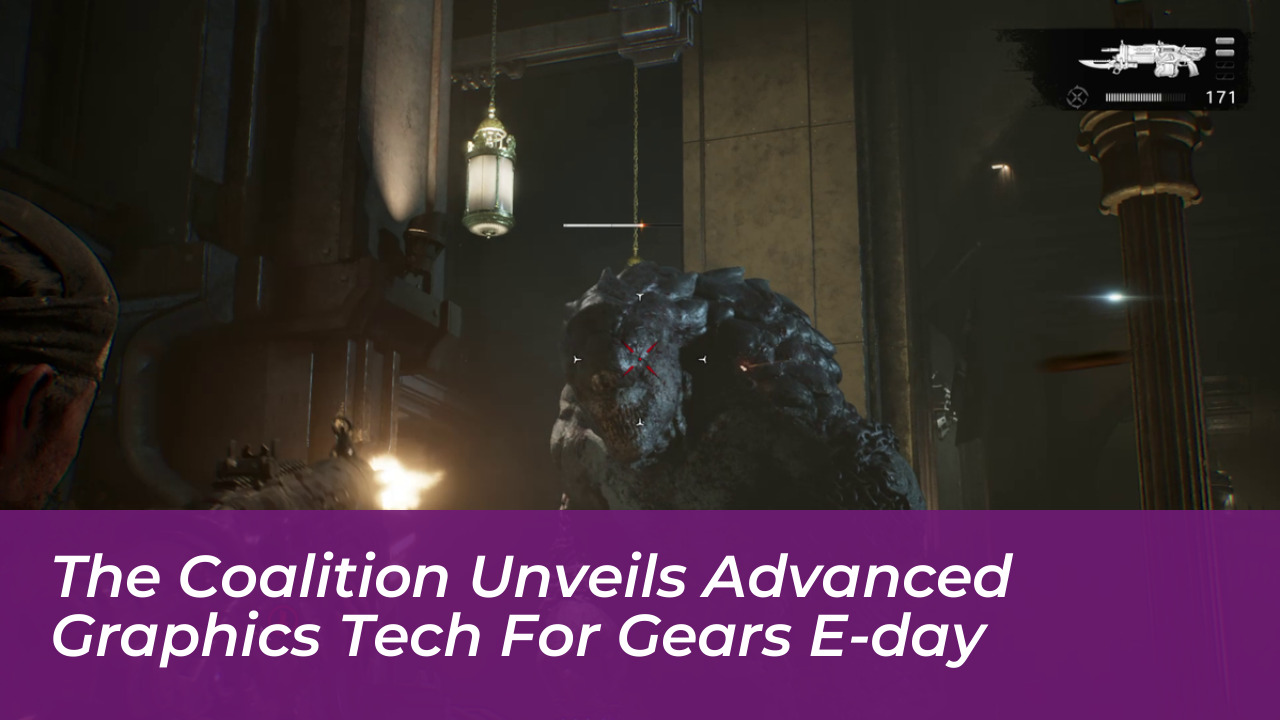
Developer The Coalition has integrated advanced Unreal Engine 5 rendering features to boost console performance and visual fidelity in Gears of War: E-Day. This follows a technical showcase at the studio’s Vancouver office. Serving as a technical showcase for newly developed engine capabilities co-created with Epic Games, the upcoming third-person shooter prequel implements several brand-new rendering solutions. These solutions optimize lighting, character detail, and environmental destruction ahead of its October 6 launch.
Pioneering Direct Lighting with MegaLights
A headline feature implemented in Gears of War: E-Day is MegaLights, which is Unreal Engine 5’s advanced ray-traced direct lighting technology. MegaLights functions as a stochastic direct lighting system. It effectively replaces traditional Virtual Shadow Maps (VSMs) for most light sources. By utilizing a fixed sample budget per pixel, the technology stochastically samples the most significant light sources. This allows it to render thousands of dynamic, shadow-casting lights simultaneously without severely impacting system performance.
To achieve a target frame rate of 60 frames per second on modern consoles, developers doubled the execution speed of MegaLights compared to its initial 2024 demonstration. According to Rendering Lead Mike Perzel, the partnership with Microsoft and technical collaborators focuses on balancing visceral cinematic storytelling with demanding visual fidelity.
Advanced Hardware Capabilities and RTX Mega Geometry
High-end PC platforms leveraging Nvidia hardware additionally utilize RTX Mega Geometry. This feature performs ray tracing against full-detail Nanite meshes. Operating within the DXR 2.0 framework, Mega Geometry constructs Clustered Bottom-Level Acceleration Structures (CBLAS) directly from Nanite clusters. This process eliminates the visual disconnect between high-detail Nanite rasterization and lower-detail ray-traced proxy meshes. As a result, it preserves sub-millimeter contact shadows and intricate environmental silhouettes.
Additional PC and console performance integrations include:
- Advanced Shader Delivery (ASD): Developed in tandem with Microsoft’s DirectX team, ASD circumvents lengthy upfront shader compilation screens and runtime traversal hitching. It achieves this by fetching pre-compiled Pipeline State Objects directly from the cloud.
- Upscaling and Frame Generation: The game features full support for DLSS 4.5 with Dynamic Multi Frame Generation, FSR 4, Intel XeSS, and Unreal Engine TSR. This is coupled with latency-reducing Nvidia Reflex integration.
- Scalability Presets: Canonical performance presets range from low, medium, high, and ultra-which map directly to Xbox Series S and Series X targets-up to an uncapped ‘ludicrous’ preset designed for enthusiast GPUs like the RTX 5090.
Optimized Performance and Future Releases
The game’s aggressive optimization for lower-spec console hardware inherently benefits alternative form factors such as PC handhelds. This is supported by low-level code optimizations like ray-tracing rotation for angled bounding boxes. Fans can experience the technical execution firsthand during the early access open beta beginning August 6, ahead of the global launch on October 6.