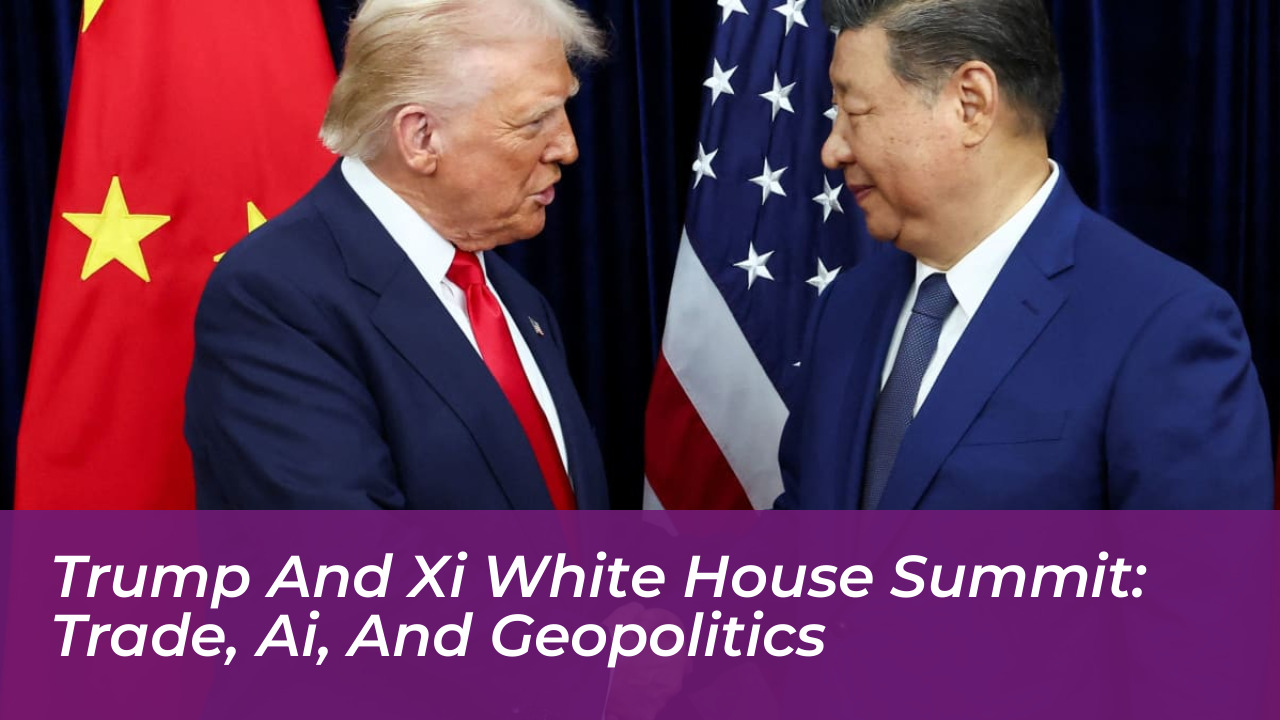
U.S. President Donald Trump and Chinese Leader Xi Jinping convened at the White House for a high-stakes diplomatic summit. The meeting marked the first formal state visit by a Chinese leader to Washington in eleven years. Both administrations tackled international trade relations, artificial intelligence governance, and regional security concerns involving Iran. The engagement balanced rigorous closed-door negotiations with grand ceremonial traditions, setting a new tone for bilateral engagement.
- Trade Truce Extended: Key Economic Outcomes
- Prolonging the Bilateral Trade Truce
- Preserving Critical Supply Chains
- Expanding Agricultural Access
- Artificial Intelligence Governance and Super Intelligence Strategy
- Defining Super Intelligence and Competitiveness
- Shared Responsibilities and Human Control
- Navigating Divergent Regulatory Philosophies
- Geopolitical Pressures: The Iran Conflict and Regional Security
- Addressing Regional Security Behind Closed Doors
- Balancing Enforcement and Economic Realities
- Intelligence Gathering and Pragmatic Assessments
- Pomp, Circumstance, and State Traditions
- Unprecedented Tarmac Greetings
- White House Ceremonial Welcomes
- State Dinner and Corporate Titans
- Panda Diplomacy Returns to Atlanta
- Unreported Industrial Dynamics and Strategic Gaps
- Critical Mineral Supply Chain Vulnerability
- Asymmetric Corporate Delegations
- Frequently Asked Questions
- What was the primary purpose of the Trump-Xi summit at the White House?
- How long was the bilateral trade truce extended?
- What specific agreements were made regarding artificial intelligence?
- Who attended the White House state dinner?
- What is panda diplomacy, and what was announced during the visit?
Trade Truce Extended: Key Economic Outcomes
Prolonging the Bilateral Trade Truce
Negotiations yielded an immediate procedural delay regarding tariff escalations. U.S. Treasury Secretary Scott Bessent confirmed that both nations agreed to prolong their temporary bilateral trade truce. The agreement received a two-month extension through January 10, pushing past its original mid-November expiration date.
Preserving Critical Supply Chains
This extension maintains current tariff reductions and preserves suspended export controls on rare earth elements and critical minerals. Economists view this pause as a strategic buffer to prevent sudden supply chain disruptions while officials negotiate long-term structural reforms.
Global manufacturers rely heavily on predictable material flows, making this short-term stability essential for industrial planning. Without this extension, factories across multiple continents faced immediate cost spikes on specialized metals.
Supply chain managers now utilize this extra window to source secondary suppliers across Latin America and Southeast Asia. Diversifying procurement routes remains a top corporate priority to insulate enterprises from future geopolitical shocks.
Expanding Agricultural Access
President Trump noted that both administrations are actively working toward a more balanced trading relationship. Discussions highlighted expanded market access for American agricultural producers and livestock ranchers.
Artificial Intelligence Governance and Super Intelligence Strategy
Defining Super Intelligence and Competitiveness
Artificial intelligence governance emerged as a primary agenda item during the bilateral talks. President Trump referred to the sector under the re-branded term Super Intelligence. He emphasized that the United States must maintain its competitive edge without overburdening the industry with excessive federal regulations.
Shared Responsibilities and Human Control
Chinese Leader Xi Jinping addressed the technology sector by highlighting the shared responsibility of both nations in managing advanced systems. Xi stressed that artificial intelligence development must remain under strict human control and serve public well-being.
Navigating Divergent Regulatory Philosophies
Despite differing regulatory philosophies, both leaders acknowledged the necessity of open communication channels. Dialogue focused heavily on algorithmic safety and national security applications.
Bridging these operational gaps requires continuous technical exchanges between engineering teams from both nations. Establishing baseline safety protocols prevents accidental escalations in autonomous digital environments.
Geopolitical Pressures: The Iran Conflict and Regional Security
Addressing Regional Security Behind Closed Doors
Regional security concerns, particularly the ongoing conflict involving Iran and its proxies, formed a critical component of closed-door discussions. The Trump administration recently launched Operation Economic Outcast, an initiative targeting the financial enablers of Tehran through aggressive secondary sanctions.
Balancing Enforcement and Economic Realities
Because China remains a primary trading partner and major importer of Iranian petroleum, Washington faced intense scrutiny regarding its enforcement approach. While the White House maintained that no nation is exempt from secondary sanctions, President Trump avoided direct public reprimands of Beijing during arrival ceremonies.
Intelligence Gathering and Pragmatic Assessments
Intelligence reports alleging that Chinese entities provided satellite surveillance data to Iranian forces were met with pragmatic assessments. U.S. leadership addressed these concerns within the framework of global intelligence-gathering norms.
Pomp, Circumstance, and State Traditions
Unprecedented Tarmac Greetings
The summit featured elaborate diplomatic fanfare designed to underscore the gravity of the relationship. President Trump took the unusual step of greeting Xi Jinping directly on the tarmac at Joint Base Andrews, mirroring historic gestures not seen since the 1960s.
White House Ceremonial Welcomes
The welcoming ceremony at the South Portico of the White House included a military review, a flyover by B-1 bombers, and an Air Force band performance. First Lady Melania Trump hosted Madame Peng Liyuan for cultural events.
State Dinner and Corporate Titans
The summit culminated in a lavish state dinner in the East Room attended by prominent American technology executives and corporate leaders. The guest list featured Amazon founder Jeff Bezos, Tesla and SpaceX leader Elon Musk, Meta CEO Mark Zuckerberg, Google chief Sundar Pichai, Nvidia CEO Jensen Huang, and OpenAI head Sam Altman.
Panda Diplomacy Returns to Atlanta
Continuing a long-standing tradition of bilateral goodwill, Chinese leadership announced a renewed installment of panda diplomacy. Xi Jinping revealed that two giant pandas, named Ping-Ping and Fu Shuang, will travel to Zoo Atlanta very soon.
Unreported Industrial Dynamics and Strategic Gaps
Critical Mineral Supply Chain Vulnerability
The extension of the trade truce to January 10 directly correlates with the multi-year timeline required for Western mining companies to develop domestic processing facilities for heavy rare earths. China retains leverage over permanent magnet manufacturing, meaning the temporary truce merely defers a structural bottleneck rather than resolving it.
Asymmetric Corporate Delegations
While American media highlighted the attendance of U.S. tech billionaires at the state dinner, independent reports confirm a separate development. A concurrent, unpublicized delegation of Chinese industrial automation and electric vehicle supply chain executives arrived to scout secondary partnership opportunities outside official state channels.
Frequently Asked Questions
What was the primary purpose of the Trump-Xi summit at the White House?
The summit aimed to address critical bilateral friction points, including international trade tariffs, artificial intelligence governance, and regional security concerns related to Iran.
How long was the bilateral trade truce extended?
U.S. Treasury Secretary Scott Bessent confirmed that the temporary trade truce was extended by two months, pushing the new expiration date from mid-November to January 10.
What specific agreements were made regarding artificial intelligence?
While both leaders agreed on the importance of keeping artificial intelligence under human control, they maintained distinct regulatory stances. President Trump emphasized avoiding heavy restrictions to maintain national competitiveness, while Xi Jinping stressed cooperative governance and safety management.
Who attended the White House state dinner?
The guest list featured numerous high-profile American technology executives, including Elon Musk, Jeff Bezos, Mark Zuckerberg, Sundar Pichai, Jensen Huang, Sam Altman, and Tim Cook.
What is panda diplomacy, and what was announced during the visit?
Panda diplomacy involves leasing giant pandas as a gesture of goodwill. Xi Jinping announced that two pandas, Ping-Ping and Fu Shuang, will soon arrive at Zoo Atlanta.