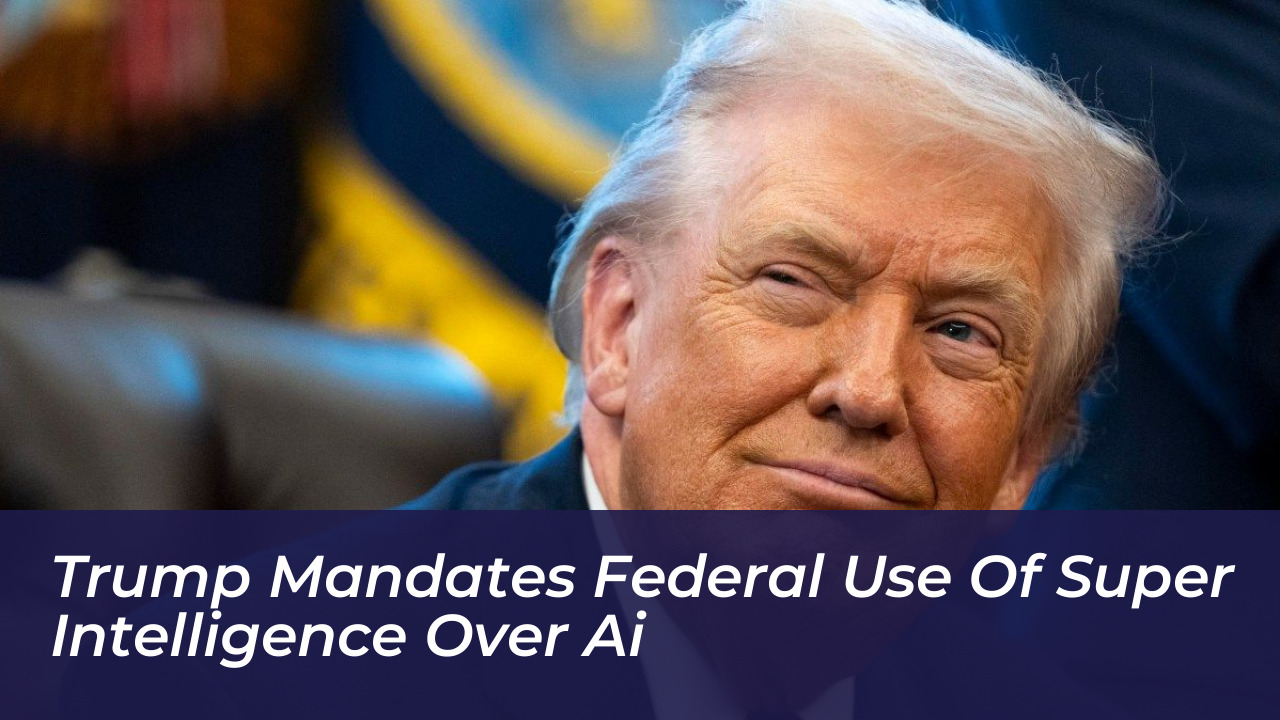
U.S. President Donald Trump signed an executive order on September 29, 2026. The order mandates that the federal executive branch rename artificial intelligence to “Super Intelligence” across all official policy documents, websites, and press releases. This policy directive targets future government terminology and statutory definitions without requiring retroactive edits to existing agency regulations. Trump announced the directive at the White House following a luncheon with major technology executives, including Nvidia CEO Jensen Huang, Meta CEO Mark Zuckerberg, and Tesla CEO Elon Musk.
- Details of the Executive Order and Rebranding
- The White House Accord on Super Intelligence
- Industry Reactions and Expert Response
- Frequently Asked Questions
- What did Donald Trump’s executive order on AI change?
- Who signed the White House Accord on Super Intelligence?
- When was the executive order signed?
- What are the main components of the White House Accord?
- How do tech experts view the term “Super Intelligence”?
“The word super is the best word of all, and it’s the simplest,” Trump said, addressing reporters outside the West Wing. The administration’s new directive aims to reflect the continuous advancement of the technological frontier. It also seeks to move away from the implication that machines merely imitate human cognition.
Details of the Executive Order and Rebranding
Titled “Inaugurating The Era Of Super Intelligence,” the executive order directs all federal departments and agencies to exclusively use the terms “Super Intelligence” and “SI” in official correspondence, public communications, policy documents, and non-statutory papers. The order instructs the Assistant to the President for Science and Technology to propose a formal federal definition of the new terminology that aligns with current capabilities.
The White House stated that the United States has led the world in developing the field for over 70 years. According to the administration, the updated naming convention conveys true technological capabilities. It unlocks new forms of human creativity rather than simply automating human intelligence. Prior to finalizing the choice, Trump crowdsourced options on his Truth Social platform, where followers voted between “SUPER INTELLIGENCE” and “SUPERIOR INTELLIGENCE.”
The White House Accord on Super Intelligence
Alongside the executive order, tech industry leaders signed a separate, two-page document titled the “White House Accord on Super Intelligence” with the subtitle “Joint Commitment on Frontier Responsibilities.” Signatories included Sundar Pichai of Google, Dario Amodei of Anthropic, Greg Brockman of OpenAI, along with Musk, Zuckerberg, and Huang.
The accord outlines voluntary self-policing standards. It commits companies to implement robust internal processes, engage external auditors, and designate independent committees within boards of directors to oversee safety controls. When asked about the binding nature of the agreement, Trump described it as “morally binding” and comparable to a constitutional framework for the industry.
Industry Reactions and Expert Response
The rebrand and self-regulation approach drew mixed reactions from researchers and international observers. Critics pointed out that within computer science and philosophy, “superintelligence” traditionally refers to a hypothetical, highly advanced intellect surpassing human capabilities in every domain. Experts note that this milestone has not yet been reached.
Digital ethics lecturer Simon Coghlan from the University of Melbourne noted that the new terminology exaggerates current capabilities. Similarly, National University of Singapore computer science lecturer Ben Leong suggested that professionals prefer to reserve “SI” for a higher level of future development.
Meanwhile, Trump dismissed concerns regarding the rapid spread of advanced technology as a hoax. Emphasizing the necessity to beat global competitors like China in technology development, Trump maintained that the United States must avoid stifling a sector he claims will exceed the economic impact of the industrial revolution.
Frequently Asked Questions
What did Donald Trump’s executive order on AI change?
The executive order mandates that all federal executive branch departments and agencies replace the terms “artificial intelligence” and “AI” with “Super Intelligence” and “SI” in official communications, policy documents, and non-statutory records.
Who signed the White House Accord on Super Intelligence?
The accord was signed by President Donald Trump and major technology executives, including Sundar Pichai (Google), Dario Amodei (Anthropic), Mark Zuckerberg (Meta), Greg Brockman (OpenAI), Jensen Huang (Nvidia), and Elon Musk (Tesla and SpaceX).
When was the executive order signed?
The executive order was officially signed and announced on September 29, 2026, following a White House luncheon with tech leaders.
What are the main components of the White House Accord?
The accord establishes voluntary commitments for AI companies to use internal safety monitoring, engage independent external auditors, and establish board committees to review safety reports.
How do tech experts view the term “Super Intelligence”?
Many academic and technical experts argue that “superintelligence” is a hypothetical term reserved for a future stage of advanced machine capability, making its application to current AI systems premature.