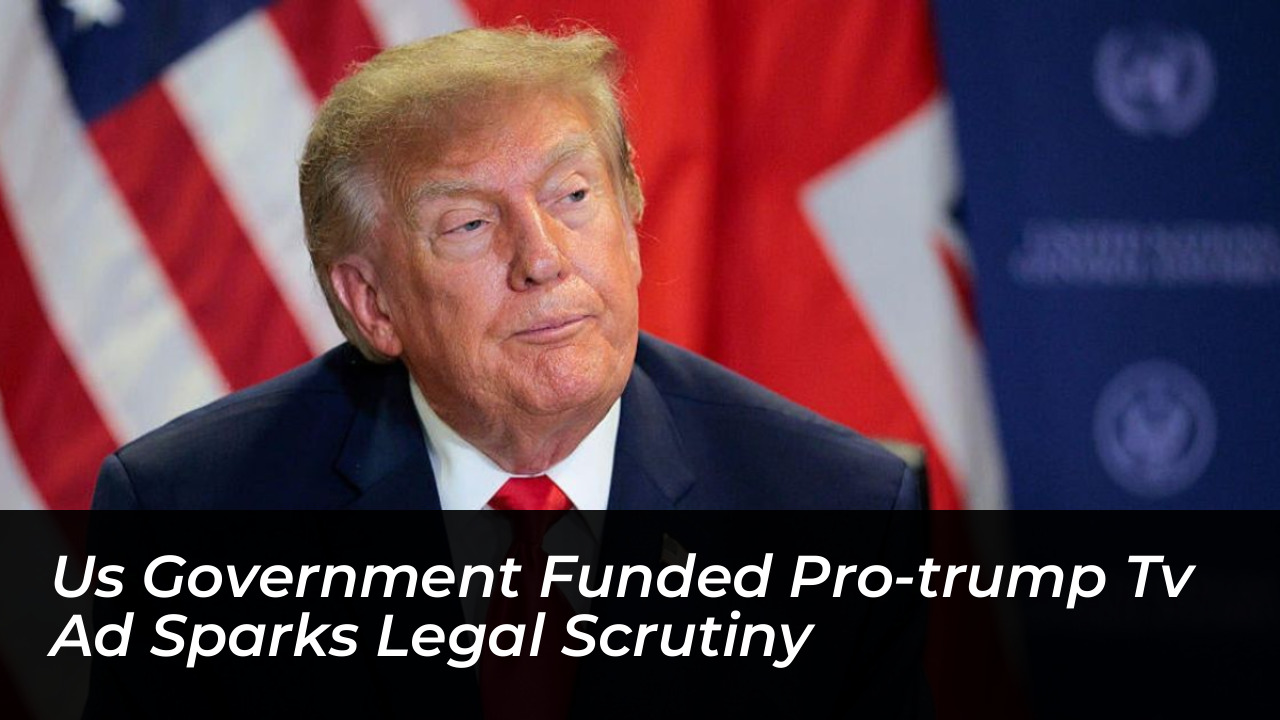
A federally funded television commercial promoting President Donald Trump aired across national cable and broadcast networks, provoking swift pushback from legal scholars and federal lawmakers. The 30-second spot featured a prominent visual disclaimer at the bottom of the screen reading Paid for by the U.S. Government. The appearance of state-funded media promoting a sitting president sparked intense debate regarding executive authority, public procurement laws, and ethics rules governing federal property.
- Broadcasting Details and Initial Media Placement
- Tracking the Initial Media Buy
- Public Discovery and Media Leak
- Visual and Audio Composition of the Commercial
- Message Content and Voiceover
- Visual Sequencing and Endorsements
- Legal Scrutiny: Hatch Act and Appropriation Anti-Propaganda Laws
- Statutory Restrictions on Executive Media Spending
- Congressional Oversight and Hatch Act Prohibitions
- White House Defense: The Public Service Announcement Classification
- Educational Framing versus Political Messaging
- Contrasting Traditional PSAs with Executive Promotions
- Music Licensing and Intellectual Property Questions
- Synchronization and Performance Rights
- Historical Context of Executive Branch Advertising Spending
- Precedents in Federal Public Relations Campaigns
- Systemic Gaps in Federal Public Relations Oversight
- Comparative Analysis of Government Ads
- Conclusion
This unprecedented media buy collided directly with federal appropriations law and long-standing statutes preventing the misuse of public funds for personal or partisan promotion. While administration defenders framed the broadcast as a standard public service announcement focused on civic pride, ethics watchdogs and congressional investigators flagged the expenditure as a potential violation of federal anti-propaganda laws and the Antideficiency Act.
Broadcasting Details and Initial Media Placement
Tracking the Initial Media Buy
Media tracking firm AdImpact documented the commercial airing on prominent conservative cable news networks, including Fox News and Newsmax. Initial tracking data indicated the preliminary ad buy totaled approximately $14,000 across targeted media markets. Placements were strategically selected to run during high-profile evening opinion programs, most notably during Jesse Watters Primetime, ensuring maximum visibility among targeted political demographics.

The modest financial footprint of the initial buy suggested a testing phase for broader media deployment. Industry analysts noted that cable news buys of this nature typically serve to gauge audience response before scaling national advertising expenditures across larger networks and digital streaming platforms.
Public Discovery and Media Leak
The broadcast would likely have gone unnoticed by broader media outlets had it not been for investigative reporting. CBS News Miami investigative reporter Jim DeFede first alerted the public to the commercial after capturing and sharing video of the broadcast online. The digital leak generated immediate public confusion regarding the origin of the funding and the precise federal agency responsible for greenlighting the project.
As the video circulated across social media platforms, viewers and media analysts scrutinized the disclaimer at the bottom of the screen. The explicit acknowledgement that taxpayer funds financed the spot triggered rapid inquiries from Capitol Hill press corps and government accountability groups.
Visual and Audio Composition of the Commercial
Message Content and Voiceover
The advertisement opens with Donald Trump making a direct policy assertion regarding domestic ideology. Together we will defeat communism, socialism, and Marxism in America, Trump states in the voiceover. America will never be a communist country. The audio track utilizes the song Love Me by R and B artist JMSN, repeating the vocal phrase over rapid visual transitions designed to evoke strong emotional responses from viewers.
The juxtaposition of direct ideological warnings with contemporary R&B music created a distinct audio profile that diverged sharply from traditional, subdued government public service announcements. The verbal delivery mirrored campaign-style rhetoric rather than objective public administration messaging.
Visual Sequencing and Endorsements
The visual sequence blends official executive duties with campaign-style promotional footage. Viewers see fast-paced cuts of Trump speaking at political rallies, participating in the annual White House turkey pardon, standing beside military brass, and posing with the FIFA World Cup trophy. High-contrast red typography flashes across the screen with slogans reading LARGEST TAX CUTS IN HISTORY, REIGNITING AMERICAN MANUFACTURING, and DEFEND LAW AND ORDER AND POLICE.
The commercial also features a prominent clip of Ultimate Fighting Championship CEO Dana White speaking at the 2024 Republican National Convention, where he describes Trump as the toughest, most resilient person Ive ever met. The inclusion of partisan convention footage further blurred the line between official state communication and political campaigning.
Legal Scrutiny: Hatch Act and Appropriation Anti-Propaganda Laws
Statutory Restrictions on Executive Media Spending
Federal appropriations law establishes clear boundaries regarding how executive agencies expend taxpayer dollars on public communications. Standard riders attached to annual congressional appropriations bills strictly prohibit executive branch agencies from utilizing public funds for publicity or propaganda purposes that Congress has not explicitly authorized. These statutory firewall provisions prevent sitting administrations from converting public treasuries into self-promotional machinery.
In addition to annual appropriations limitations, the Antideficiency Act mandates that government officials may only expend funds for purposes explicitly authorized by statutory law. Utilizing discretionary agency funds to generate media assets that emphasize personal background or partisan convention appearances challenges longstanding administrative law boundaries.
Congressional Oversight and Hatch Act Prohibitions
Congressional leaders reacted immediately to the broadcast. Representative Jamie Raskin, the ranking Democrat on the House Judiciary Committee, raised major ethics and legal concerns regarding the spot. Raskin stated that using public funds for campaign-style promotional videos could constitute felony conversion of government property under federal criminal statutes. Raskin also highlighted potential civil and administrative violations under the Hatch Act.
The Hatch Act prohibits federal employees within the executive branch, excluding the President and Vice President, from using official agency resources or position authority to influence political campaigns. Civil servants, agency media specialists, or political appointees involved in scripting, editing, or purchasing airtime for campaign-style promotional videos face potential administrative penalties or termination if investigators determine their actions violated federal statutory neutralities.
White House Defense: The Public Service Announcement Classification
Educational Framing versus Political Messaging
The White House rejected claims of impropriety, categorizing the commercial as an official public service announcement. Administration spokespersons asserted that the video serves an educational purpose by highlighting national values and encouraging civic pride. These public service announcements are about reminding Americans to love their country and understand what makes it worth defending, at home, at our borders, and abroad, a White House spokesperson stated. The ad is educational and unapologetically patriotic.
Executive officials emphasized that the commercial lacks explicit campaign mechanics. Because Donald Trump was not actively on an electoral ballot at the time of the broadcast, and because the commercial contains no direct call to vote for a specific candidate or legislative bill, administration lawyers maintained the ad complies with standard executive messaging mandates.
Contrasting Traditional PSAs with Executive Promotions
Critics counter that traditional government public service announcements focus on clear public welfare topics, such as public health initiatives, disaster readiness, or military recruitment, rather than highlighting individual executive accomplishments and convention endorsements. Standard federal campaigns are designed to inform citizens of available services or safety guidelines, whereas the disputed ad centered heavily on personalized executive achievements.
Music Licensing and Intellectual Property Questions
Synchronization and Performance Rights
The commercials inclusion of JMSN’s track Love Me introduces additional legal exposure regarding federal intellectual property procurement. Executive agencies must adhere to strict licensing requirements when acquiring synchronization and performance rights for commercial music used in public broadcasts. Musicians and record labels frequently challenge political campaigns and government bodies over unauthorized music usage.
When federal agencies purchase commercial broadcast rights, media procurement contracts must explicitly clear synchronization rights across cable and digital channels. If executive media buyers failed to secure appropriate licenses from rights holders prior to placing the spot on Fox News and Newsmax, the federal government could face copyright infringement claims from music publishers alongside administrative ethics reviews.
Historical Context of Executive Branch Advertising Spending
Precedents in Federal Public Relations Campaigns
Government-funded media campaigns have previously drawn intense congressional scrutiny over costs and messaging strategies. The Department of Homeland Security previously launched a multi-million-dollar public outreach initiative featuring high-profile media channels to urge self-deportation and outline border enforcement measures. While past administrative public relations efforts focused primarily on specific department mandates or legislative programs, the broad visual focus of the current 30-second ad marks a distinct operational shift.
By combining official presidential actions with political convention speeches and personalized political slogans, the campaign highlights persistent structural questions about where legitimate agency information ends and state-funded personal promotion begins.
Systemic Gaps in Federal Public Relations Oversight
Reports from the Congressional Research Service document a significant administrative oversight gap regarding executive advertising budgets. No single federal entity exercises centralized control over the myriad public relations and media procurement budgets scattered across independent executive departments. This decentralized structure allows individual agencies to authorize targeted media buys without rigorous preliminary review from central procurement watchdogs.
Comparative Analysis of Government Ads
| Metric | Standard Federal PSA | Disputed Executive Commercial |
|---|---|---|
| Primary Purpose | Public health, safety, or military recruitment. | Executive promotion and ideological messaging. |
| Visual Assets | Informational graphics, agency spokespersons. | Political rallies, convention footage, executive actions. |
| Legal Precedent | Explicitly authorized by agency statutory missions. | Challenged under anti-propaganda appropriations riders. |
| Statutory Risks | Minimal, standard administrative compliance. | Potential Hatch Act and Antideficiency Act violations. |
Conclusion
Congressional oversight committees are expected to issue formal financial records requests and subpoenas to trace the precise agency budgets used to fund the ad buy. Lawmakers aim to identify the specific civil servants and political appointees who authorized the production and placement of the commercial.
The controversy underscores the structural challenges of regulating executive branch media spending in an era of polarized digital and cable broadcasting. Without centralized oversight and stricter enforcement of anti-propaganda appropriations laws, the boundary between official state communication and personalized executive promotion will remain a focal point of legal and political contention.