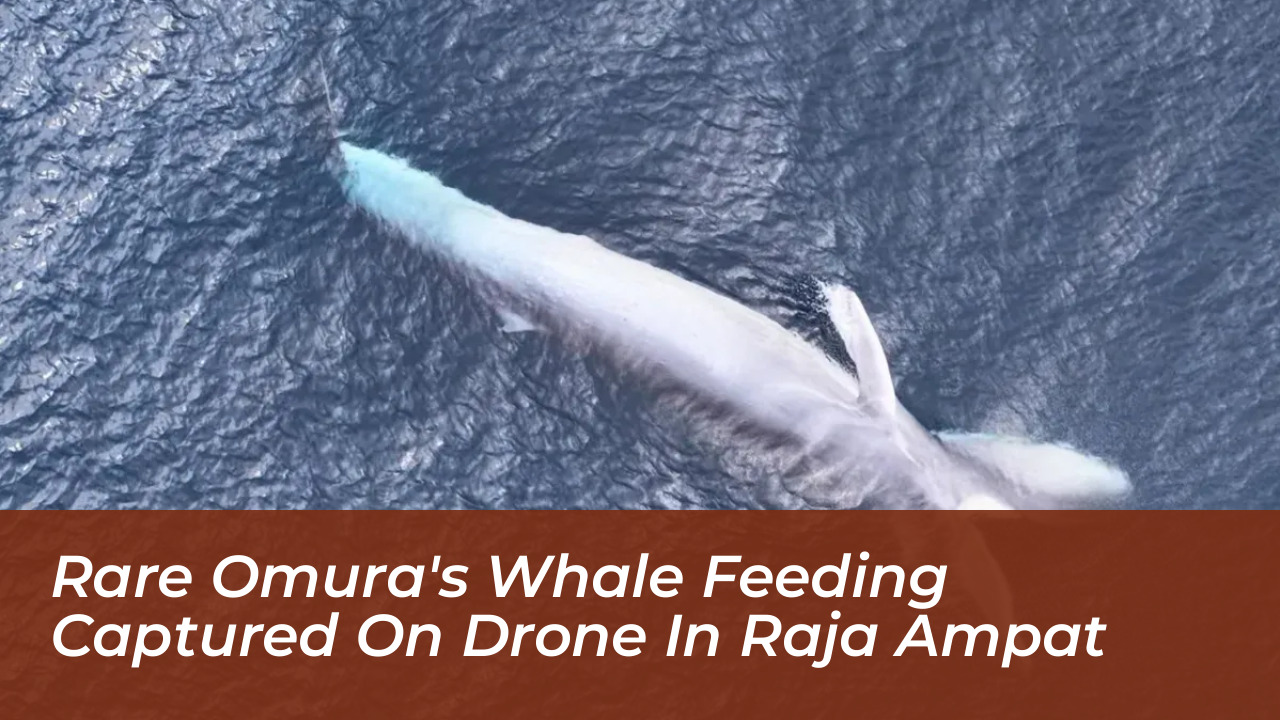


In March 2026, researchers documented a rare feeding event involving an elusive Omura’s whale in the Dampier Strait, located within Indonesia’s Raja Ampat archipelago. This drone footage provides a unique look at the behavior of one of the ocean’s most mysterious species.
The Sighting in Raja Ampat
Dr. Mark Erdmann, executive director of the shark conservation initiative ReShark, captured the encounter during a conservation cruise with Silolona Sojourns. Aboard the MY Silolona, the crew identified the whale after spotting its subtle spout. Although Omura’s whales reach lengths of approximately 12 meters-roughly the size of a shipping container-they are notoriously difficult to detect and study.
“Though rarely noticed by tourists to Raja Ampat, the Omura’s whales are resident year-round,” Dr. Erdmann noted. The drone footage shows the whale’s feeding strategy, capturing the animal as it lunges and opens its mouth to consume large swarms of krill, filtering the water through its baleen plates.
The Elusive Omura’s Whale
The Omura’s whale (Balaenoptera omurai) is one of the least understood baleen whales. Formally identified as a distinct species in 2003, it was previously mistaken for a smaller type of Bryde’s whale. Due to their elusive nature and preference for tropical waters, scientists lack precise data regarding their total population and distribution.
Key Characteristics and Challenges
- Physical Identification: They are identified by a single central ridge on their head, whereas the Bryde’s whale typically features three.
- Conservation Status: The species is listed as Data Deficient on the IUCN Red List, making sightings in Raja Ampat vital for research.
- Threats: Like other rorqual whales, they face risks from vessel strikes, fishing gear entanglement, noise pollution, and coastal development.
The Importance of the Dampier Strait
Marine biologists consider the Dampier Strait a critical corridor for cetacean migration. The year-round presence of Omura’s whales suggests that this region serves as an essential foraging ground. Researchers are increasingly using citizen science and collaborations with organizations like the Indo Ocean Project and CETASI to gather visual and acoustic data. This information is necessary to map their habitat and ensure their protection within the Coral Triangle.
As drone technology becomes more accessible, experts hope that frequent documentation of these “ghostly” giants will demystify their behavior and lead to more effective conservation strategies in Indonesian waters.