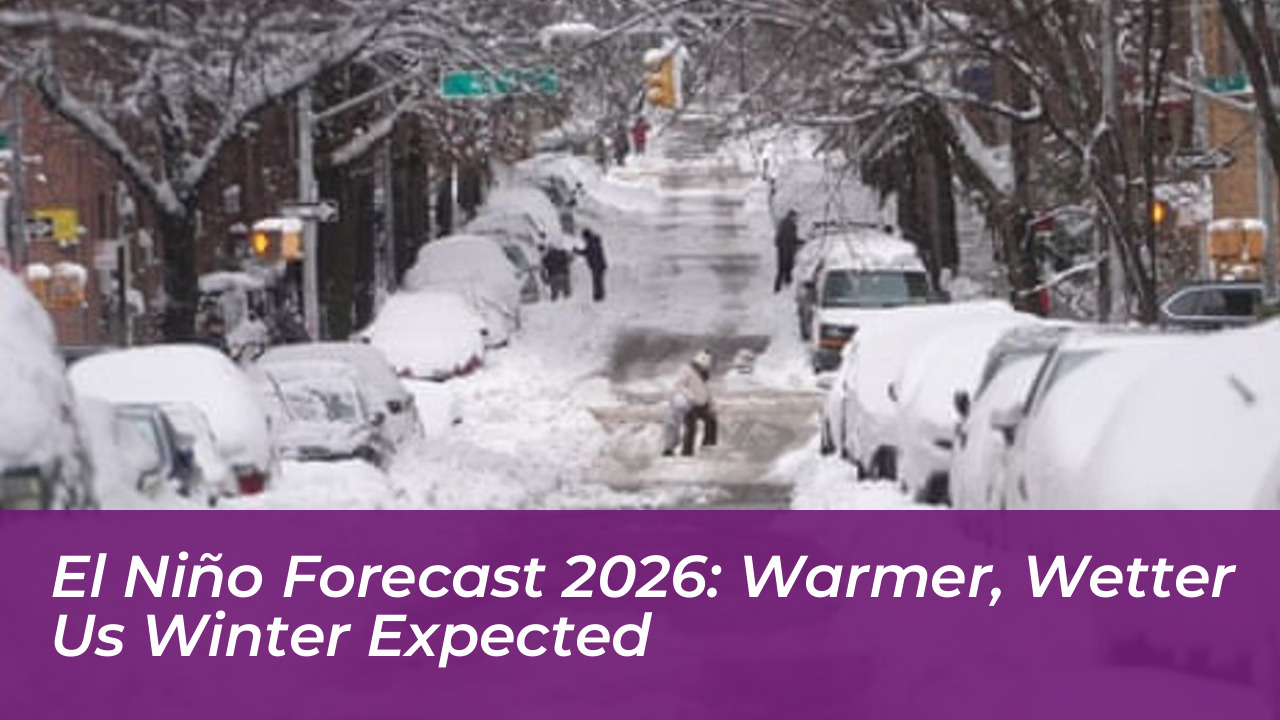

A potentially record-strength El Niño is expected to significantly reshape winter weather across the United States for the 2026-2027 season. According to the National Oceanic and Atmospheric Administration (NOAA), this climate pattern will bring generally warmer temperatures, increased precipitation, and elevated flood risks to many regions.
The federal outlook, released on Thursday, October 15, identifies specific regional impacts. These include heightened flood risks in the West, below-average snowfall across much of the North, and a greater chance of severe winter storms across parts of the South. Federal forecasters note that the current El Niño climate pattern will influence weather conditions throughout the season, potentially reaching its peak intensity in December.
National Temperature and Precipitation Projections
NOAA forecasts above-normal precipitation across parts of 39 states. Temperatures could exceed seasonal averages across more than half of the contiguous United States. Warmer-than-average temperatures are favored for northern California, the Pacific Northwest, the Midwest, the Mississippi Valley, much of the East, Alaska, and Puerto Rico or the U.S. Virgin Islands.
Conversely, wetter-than-average conditions are most likely across the southern tier, stretching from the Southwest to the Southeast, as well as along the entire Eastern Seaboard. Ken Graham, director of NOAA’s National Weather Service, explained the meteorological mechanism driving these shifts.
As we know from decades of observations, a very strong El Niño will likely bring a southward and eastward shift to the jet stream for the contiguous U.S. This tilts the odds toward stormier weather across the South. While higher chances of rain and snow may bring relief to drought-afflicted areas, too much precipitation on dry soil can fuel destructive flash floods and mudslides. Now is the time for communities and individuals to plan ahead for the upcoming winter.
Regional Impacts and Drought Relief
The projected shift in weather patterns should alleviate ongoing drought conditions across several parts of the country. Drought metrics are forecast to improve or end completely in the Southwest, the Southern Great Plains, the Southeast, and parts of the East Coast.
However, the outlook is not uniform. Drought conditions are favored to develop or worsen across parts of the northern Rockies, along with northeastern Oregon and eastern Washington. Meanwhile, areas in the Intermountain West, the northern Plains, the Ohio Valley, and Puerto Rico face equal chances of falling below, near, or above average in total seasonal precipitation.
City-Specific Outlooks: The Midwest Experience
In major metropolitan areas like Chicago, local meteorological offices are preparing residents for a milder season. The National Weather Service in Chicago estimates a 50% to 60% chance of above-normal winter temperatures.
The region could experience significantly less seasonal snowfall than usual. However, federal and local forecasters caution that milder baseline averages do not eliminate severe risks. Sudden cold spells and significant, isolated snowstorms remain entirely possible throughout the winter months.
New Forecasting Tools and Warnings for 2026-27
To better protect communities during extreme weather events, NOAA has implemented crucial technological upgrades to its winter weather products for the 2026-27 winter season:
- Probabilistic Precipitation Portal: This newly operational platform allows emergency managers and the public to view low-end, expected, and high-end amounts of snow, ice, and rain via interactive maps, tables, and graphics.
- Particularly Dangerous Situation Wording: The National Weather Service will now integrate “Particularly Dangerous Situation” (PDS) phrasing into select Blizzard Warnings and Ice Storm Warnings to alert the public to rare, historic-severity storms that pose an imminent threat to life.
NOAA reminds residents that seasonal outlooks provide statistical probabilities for temperature and precipitation trends rather than exact daily forecasts. Snowfall accumulations, in particular, remain unpredictable more than a week in advance. Communities are urged to monitor updates from the Weather Prediction Center and consult official safety resources at weather.gov.