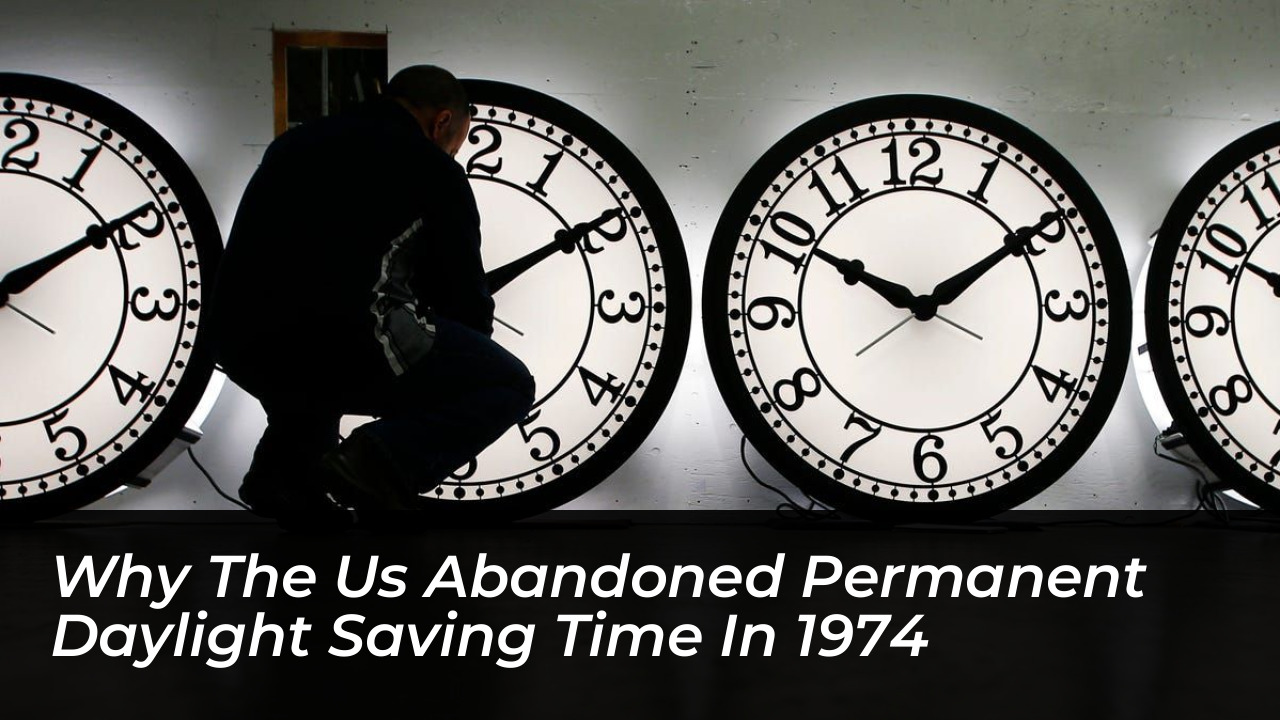

As lawmakers and federal officials continue to debate proposals like the Sunshine Protection Act to keep clocks locked on daylight saving time year-round, the United States carries a stark historical precedent. More than fifty years ago, America tried permanent daylight saving time. The experiment unraveled in less than a year after tragic road safety concerns emerged during dark winter mornings.
The policy was born out of crisis. It shifted national focus toward energy conservation before colliding with the sobering reality of children traveling to school in pitch-black conditions.
The Origins of the 1970s Permanent Daylight Saving Experiment
The push for year-round daylight saving time began during a severe national energy crisis. In 1973, President Richard Nixon signed the Emergency Daylight Saving Time Energy Conservation Act into law. Conceived as a two-year experiment, the legislation aimed to reduce electricity and fuel consumption by shifting an hour of daylight from the morning to the evening.
Initially, the idea enjoyed overwhelming public backing. Public support approached 80% just before the measure took effect in January 1974. Citizens welcomed the prospect of brighter winter afternoons, assuming the transition would be seamless. However, public sentiment plummeted once the policy met reality, dropping to 42% by February 1974 as late winter sunrises became the norm.
Tragedy Strikes: Child Fatalities Derail the Policy
The primary catalyst for the swift repeal of permanent daylight saving time was an alarming spike in early morning traffic accidents involving school-age children. Because standard sunrise times were pushed significantly later-with the sun rising as late as 9 a.m. in certain parts of the country-children across America began walking to school and waiting for buses in complete darkness.
The dangers materialized almost immediately. According to reports from the period, including coverage by the Pensacola News Journal and the Associated Press, eight children in Florida alone died in traffic accidents within the first two weeks of the year-round daylight saving experiment. By contrast, only two early morning traffic fatalities had been recorded during the same period in 1973.
The tragic losses included young victims across the state, such as:
- An unidentified 14-year-old boy in Jacksonville
- 16-year-old Charles Van Iderstyne of Boca Raton
- 13-year-old Robert T. Allen of Casselberry
- Six-year-old Richard Toudt of Tampa
- A 17-year-old girl in Gulf County
Parents and lawmakers nationwide grew intensely alarmed as reports of pre-sunrise vehicle strikes mounted. This public pressure and safety advocacy forced Congress to reverse course.
Congressional Repeal and Return to Standard Time
Faced with backlash and undeniable safety hazards during the darkest weeks of winter, Congress voted to curtail the experiment. Later in 1974, legislation was enacted to repeal year-round daylight saving time. This restored standard time during the winter months to ensure safer, sunnier conditions for children heading to morning classes.
While subsequent Department of Transportation studies noted modest energy savings-ranging from 0.4% to 1.5%-and debated the precise nationwide statistical impact on traffic accidents, the political and social consensus was clear. The human cost of dark morning commutes outweighed the marginal energy benefits.
The Modern Debate and Ongoing Legislative Stalls
Decades later, the debate over abandoning the semi-annual clock change continues to surface in Washington. Modern proponents of permanent daylight saving time argue that eliminating the biannual transition reduces sleep disruption, minimizes heart attack risks associated with the spring forward shift, and boosts afternoon retail and recreation economies.
Federal proposals, such as the Sunshine Protection Act, have periodically advanced through the House of Representatives with bipartisan support. However, these bills consistently stall in the Senate. Lawmakers and public health advocates frequently invoke the lessons of the 1974 experiment, reminding the public that year-round daylight saving time creates unavoidable safety trade-offs by trading bright winter afternoons for dangerously dark morning school routes.