A child who gets $7 a week and spends all $7 on Friday has learned nothing about money, except that money disappears fast. A child who writes the $7 down, watches it shrink by $1.50 on sweets and grow by $2 for helping wash the car, learns something much more useful: where money comes from, where it goes, and what is left at the end of the week. That is the whole idea of an allowance tracker. It is not a test, and it is not a punishment for spending. It is a small weekly record that turns pocket money into a lesson a child can see.
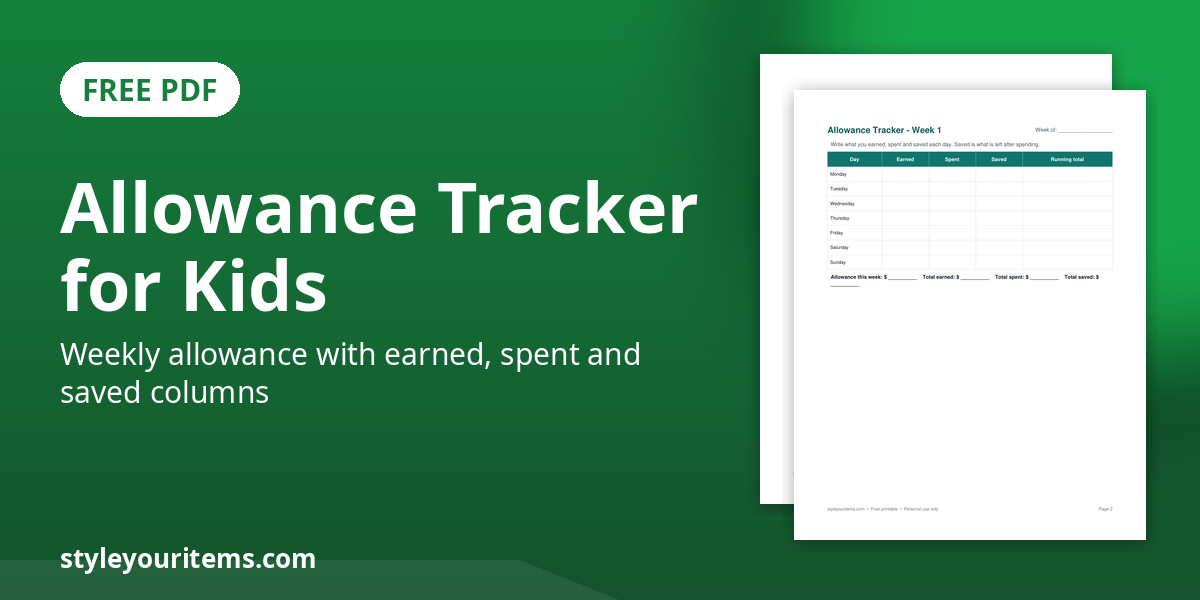
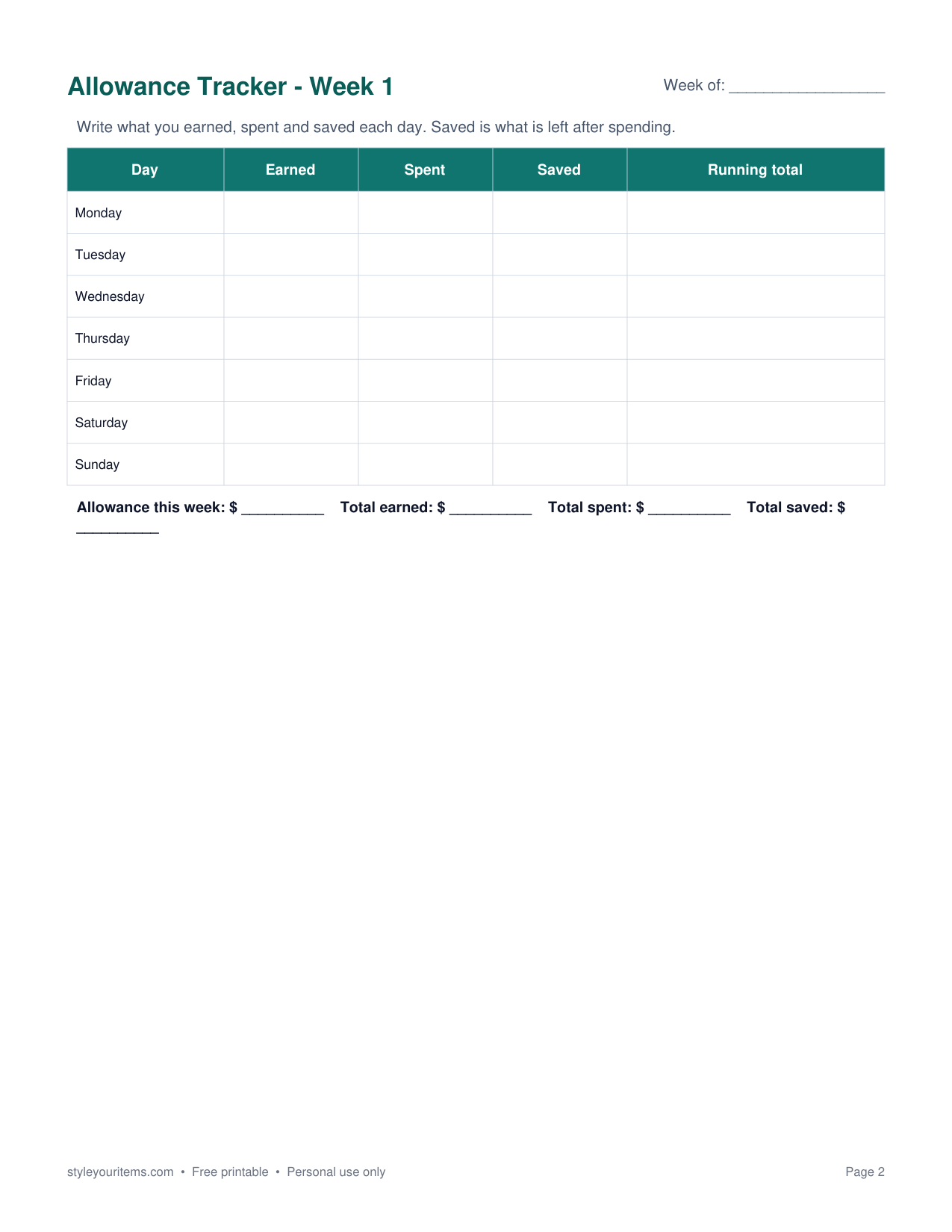
This free printable allowance tracker for kids has four weekly sheets, one for each week of the month, plus a savings-goal page at the back. Each day has four columns: Earned, Spent, Saved and Running total. The child writes down what came in, what went out, and what is left, and the running total shows the money growing or shrinking day by day. If you want a tracker for your own money too, the free printable financial goals tracker works the same way for adults. You can also browse the full Money & Budget collection for more ways to keep track of money at home.
One filled-in week, so the columns make sense
Here is what a week might look like for Maya, aged 9, who gets $7 allowance on Monday and earns extra money for small jobs. Her sheet shows the four columns working together.
| Day | Earned | Spent | Saved | Running total |
|---|---|---|---|---|
| Monday | $7.00 | $0 | $7.00 | $7.00 |
| Tuesday | $2.00 | $1.50 | $0.50 | $7.50 |
| Wednesday | $0 | $0 | $0 | $7.50 |
| Thursday | $0 | $3.00 | -$3.00 | $4.50 |
| Friday | $0 | $0 | $0 | $4.50 |
| Saturday | $5.00 | $2.00 | $3.00 | $7.50 |
| Sunday | $0 | $0 | $0 | $7.50 |
At the bottom of the sheet Maya writes the week totals: earned $14, spent $6.50, saved $7.50. The week tells a story she can read back. Tuesday’s sweets cost $1.50. Thursday’s comic cost $3 and the running total dropped to $4.50, which is exactly why the comic felt expensive. Saturday’s $5 for helping a neighbour put the total back up to $7.50. Nothing here is a lecture. The numbers do the teaching, because Maya can see that earning more and spending less are the only two ways the total grows.
What is inside the PDF
The PDF has six pages: a cover and four weekly sheets, one for each week of the month, followed by a savings-goal page. Every weekly sheet has the same layout: a “Week of” line at the top, seven rows, and the four columns, Earned, Spent, Saved and Running total. At the bottom of each sheet there is a line for the week totals: total earned, total spent and total saved. The savings-goal page has a table for up to four goals, with a price, the number of weeks to save, and the amount to save each week, plus two rows of ten colour-in boxes, one box for every $1 saved towards the goal, and a line for the month total saved.
How to start a child on the tracker
- Print the four weekly sheets and the goal page. Letter or A4 at 100 percent scale, single-sided so the child can write freely. One set covers a month.
- Pick one savings goal together. A toy, a book, a game, anything with a price the child knows. Write it on the goal page first, because saving is easier when there is a reason to save.
- Work out the weekly amount. Divide the price by the number of weeks until the child wants it. A $20 toy in five weeks means $4 a week, and that number goes in the “Save each week” column.
- Write down allowance on the day it arrives. The habit that matters most is writing money down the day it moves. A tracker filled in on Sunday from memory is a tracker full of guesses.
- Count the money together at the end of the week. Coins in a jar, notes in an envelope, or a number in a bank app: the running total on the sheet should match the real money. If it does not, find the missing $1.50 together.
Five ways to keep a child interested
- Let the child choose the goal. A goal a parent picks feels like homework. A goal a child picks feels like a plan, and a plan gets followed. The free printable 52-week savings challenge tracker is a good next step for a child who outgrows weekly sheets and wants a whole year of saving.
- Pay for jobs, not for being good. Allowance is the regular payment. Extra jobs, like washing the car or helping a neighbour, are how a child earns more, and the Earned column is where that extra money shows up.
- Never take the tracker away as a punishment. If tracking stops when a child overspends, the child learns to hide spending instead of recording it. An overspent week is the most useful week to write down.
- Celebrate the saved column, not the spent column. When the running total reaches the goal, colour in the boxes on the goal page together. The 100 envelope challenge tracker uses the same colour-in idea for a bigger target.
- Keep it short and weekly. Five minutes on Sunday evening is enough: add up the week, write the totals, colour a box or two. A tracker that takes half an hour gets abandoned by week two. The free printable study planner for kids can sit next to it for homework, so money and school each have their own page.
Questions people ask
What age is this tracker for?
It works best from about age 7, when a child can add and subtract small amounts. Younger children can use it with a parent writing the numbers, and the colour-in boxes on the goal page work for any age.
Should a child save everything, or spend some too?
Spend some. A tracker where every dollar is saved teaches nothing about choosing, and choosing is the skill. A simple split works well: save a fixed amount for the goal first, then spend the rest freely, and write both down.
What if the running total goes negative?
That means the child spent more than they had, which is a normal mistake and a good lesson. Write the minus number honestly, and talk about how to get back to zero: no spending for a few days, or one extra job. Do not lend the money yourself to fix it, because then the tracker stops being true.
How does the savings-goal page work?
Write the goal and its price, count the weeks until the child wants it, and divide. That gives the amount to save each week. Every time $1 is saved towards the goal, colour in one box. When all the boxes are coloured, the goal is paid for. The free printable weekly review planner can help a parent keep the Sunday check-in regular, five minutes a week.