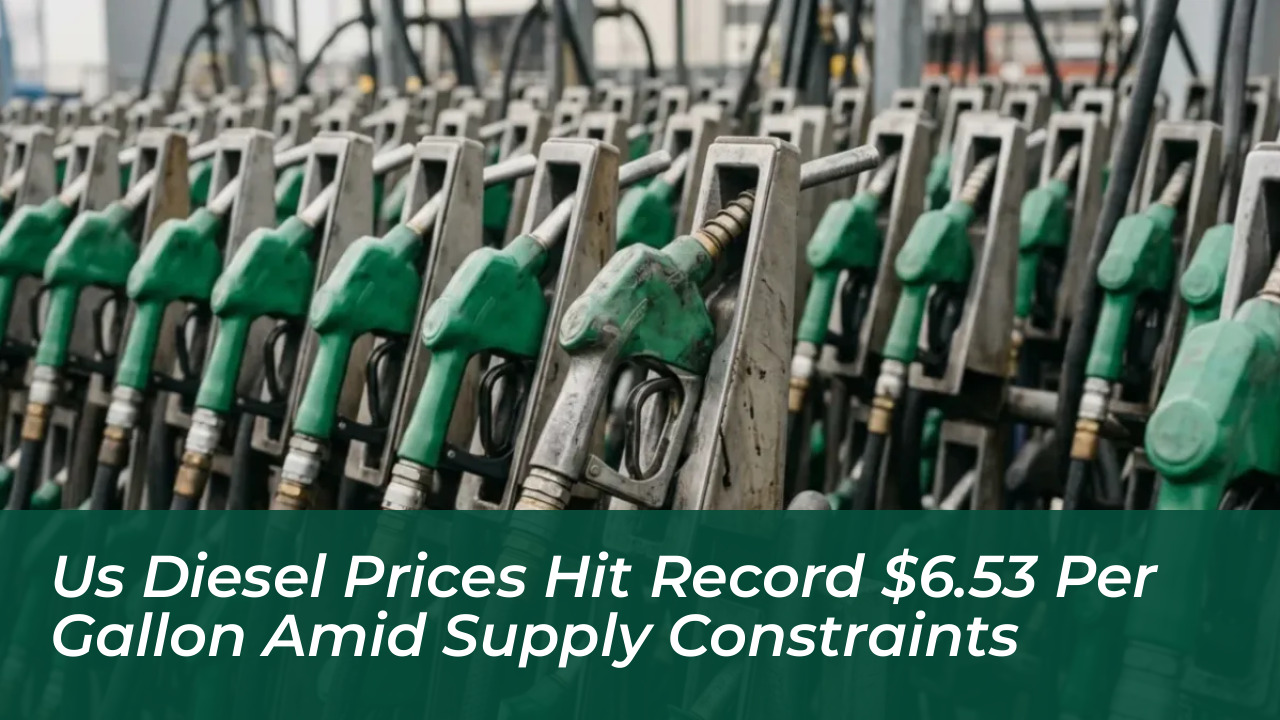

U.S. on-highway diesel fuel reached a record-shattering average of $6.53 per gallon on September 21, 2026, according to data from the Energy Information Administration (EIA). This dramatic surge represents an 89% increase since January 2026 and comfortably eclipses the previous federal tracking peak of $5.81 per gallon established in June 2022. Driven by a combination of international conflicts, disrupted shipping routes, and critical refining capacity shortages, the record-high fuel costs are rippling across the entire economy. They impact freight operators, agricultural businesses, and everyday consumer goods.
The Causes Behind the $6.53 Diesel Price Record
Unlike standard gasoline, diesel fuel requires more complex, capital-intensive processing and specialized refining steps. When global supply chains experience disruptions, diesel production is uniquely vulnerable. Analysts attribute the current record-breaking prices to a convergence of international supply shocks rather than a simple shortage of crude oil.
Global energy markets have faced dual-front pressure throughout 2026. Ongoing military conflicts involving the United States and Iran have disrupted vital shipping lanes, including tanker traffic through the Strait of Hormuz. Simultaneously, the continued war between Russia and Ukraine has restricted regional refining output, curbed Russian fuel exports, and damaged Middle Eastern refining infrastructure. Consequently, global distillate stocks have plummeted to historic lows, creating intense competition for available refined products.
How Record Diesel Prices Impact the Broader Economy
Because heavy logistics, agriculture, and manufacturing rely heavily on diesel-powered equipment, the price spike extends far beyond commercial trucking fleets. Economists note that nearly every consumer good is touched by diesel logistics at some point in its supply chain.
- Agriculture: Tractors, combines, and refrigerated trailers burn substantial amounts of diesel during planting, harvesting, and distribution.
- Freight and Logistics: Long-haul trucking and rail transport face thousands of dollars in added operational costs per vehicle annually. Carriers typically pass these expenses along via fuel surcharges.
- Construction: Heavy machinery such as excavators and cement mixers rely entirely on diesel, increasing the cost of residential and commercial building projects.
- Public Services: School buses, municipal transit systems, and city garbage trucks operate on tight taxpayer-funded budgets that absorb the immediate impact of high fuel costs.
Global Storage Trends and Future Industry Outlook
Interestingly, the record retail prices coincide with an unusual trend in commercial storage. According to brokerage data from The Tank Tiger, available storage capacity across North America and the Caribbean rose to 13 million barrels, as lessees declined to renew storage contracts. Industry experts explain that paying for a storage tank makes little sense when virtually no excess diesel is available to store.
The EIA forecasts that retail diesel averages may moderate into 2027, projecting a yearly average of $5.07 for 2026 and $4.40 for 2027. However, that projected relief hinges entirely on tanker traffic returning to normal through the Strait of Hormuz and damaged Middle Eastern refineries resuming standard operations. Until these bottlenecks are resolved, high pump prices will continue to act as a primary rationing mechanism for global energy markets.
Frequently Asked Questions About Record Diesel Prices
Why are diesel prices rising faster than regular gasoline?
Diesel production requires more complex and capital-intensive refining steps than regular gasoline. Global constraints on middle distillate refining capacity and a lack of substitutable processing units make diesel far more sensitive to supply chain shocks and geopolitical conflicts.
What was the previous record high for U.S. diesel prices?
Prior to the September 2026 peak of $6.53 per gallon, the previous all-time federal tracking record was $5.81 per gallon, which was established in June 2022.
How does the Federal Reserve’s interest rate policy affect diesel prices?
The Federal Reserve’s interest rate hikes are designed to slow down borrowing-driven inflation across the broader economy. However, higher interest rates do not directly lower fuel prices, as the current diesel surge is driven by physical supply disruptions and refining bottlenecks rather than excessive consumer borrowing.
Why does a spike in diesel prices affect grocery and retail costs?
Almost all consumer goods rely on diesel-powered transport at various stages of production and delivery-from the tractors harvesting crops to the semi-trucks and freight trains restocking supermarket shelves. When fuel costs double, transportation and shipping surcharges quickly translate into higher retail prices.
When are diesel prices expected to decrease?
Energy agencies like the EIA project potential price relief heading into 2027, provided that Middle Eastern shipping lanes reopen fully and offline refineries resume regular production. However, short-term volatility is expected to persist until global distillate inventories recover.