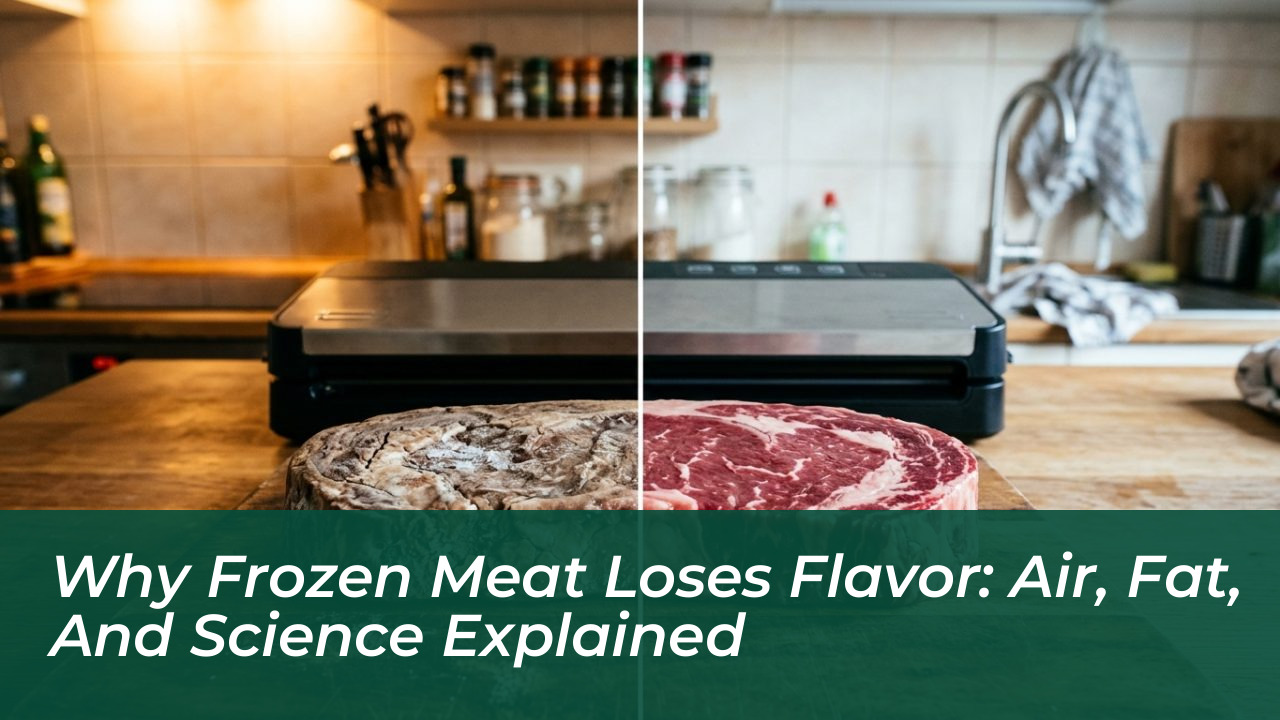

Raw meat kept continuously at 0 degrees Fahrenheit or below remains safe to eat indefinitely. However, peak culinary quality begins breaking down within one to twelve months depending on the specific cut and fat structure. Food scientists trace dried-out textures and cardboard-like odors not to bacterial spoilage, but to cellular moisture evaporation and fat oxidation caused by direct air contact.
Every trip to the grocery store raises a practical question once food hits the sub-zero chill: why does a whole roast taste fresh after six months while ground beef develops a stale flavor after only three? The answer lies in the physics of exposed surface area, chemical fat composition, and how household packaging handles circulating oxygen.
The Critical Line Between Food Safety and Quality
A widespread misconception assumes that meat turns dangerous after its recommended freezer window lapses. According to guidelines from FoodSafety.gov and the USDA, continuous sub-zero temperatures completely halt the growth of harmful bacteria. Properly frozen items never become microbiologically unsafe over time, but safety does not guarantee taste.
Dry sub-zero air pulls moisture out of muscle tissue, creating the leathery, discolored patches known as freezer burn. At the same time, ambient oxygen reacts with lipids in the meat, causing oxidative rancidity. These chemical transformations do not cause foodborne illness, but they ruin texture and produce bitter, oxidized off-flavors.
Why Ground Meat Fails Far Faster Than Whole Roasts
The operational lifespan of raw protein in cold storage is governed by physical shape. Grinding beef, pork, poultry, or veal destroys dense muscle fibers and turns a single cut into millions of tiny pieces with massive surface area. Every particle comes into contact with trapped ambient air during processing.
Because oxygen is distributed evenly throughout ground meat rather than resting only on the outer edge, fat oxidation accelerates rapidly. Uncooked ground meats maintain peak quality for only 3 to 4 months. Raw sausage suffers an even shorter window of 1 to 2 months because added sodium acts as a chemical catalyst that speeds up lipid degradation.
Storage Lifespans by Meat Cut and Processing Style
To keep meals tasting fresh, home cooks need to manage inventory according to cut geometry and fat types. Saturated fats in beef and lamb resist rancidity far better than the unsaturated fats abundant in pork and poultry. Pork fat contains higher ratios of unsaturated fatty acids, causing it to oxidize nearly twice as fast as beef fat. Fatty pork cuts should always be consumed near the earlier end of their storage window.
Meat Cut Quality Reference Table
- Raw Sausage (all varieties): 1 to 2 months
- Ground Beef, Poultry, Pork, Lamb: 3 to 4 months
- Stew Meat: 3 to 4 months
- Pork, Beef, & Lamb Steaks or Chops: 4 to 6 months
- Chicken or Turkey Pieces (breasts, drumsticks): Up to 9 months
- Large Roasts (beef, pork, lamb): Up to 12 months
- Whole Chicken or Turkey: Up to 12 months
- Ribs (beef short ribs, pork spare ribs): 4 to 12 months
How Bone Edges and Packaging Compromise the Chill
While rib racks can theoretically hold up to 12 months thanks to their bulk density, the physical structure poses an unexpected hazard. Exposed rib bones easily tear through protective layers, letting cold air flood the surface. Wrapping bone ends with folded foil or freezer paper before outer sealing neutralizes this puncture risk.
Supermarket trays offer virtually zero long-term defense against air migration. The thin stretch wrap and porous foam bases sold in meat departments are manufactured strictly for short-term chilling. When keeping meats in original packaging beyond two months, the USDA advises overwrapping the entire container with heavy-duty aluminum foil, freezer paper, or placing it inside an airtight bag.
The Best Practical Protocol for Frozen Meat Storage
Maximizing shelf life comes down to removing air pockets completely before ice crystals form:
- Divide into usable portions: Separate bulk purchases into exact meal-sized batches so you never thaw more than necessary.
- Flatten ground proteins: Press minced meat into flat, thin slabs inside plastic bags; these freeze rapidly, thaw uniformly, and store efficiently.
- Shield the contact surface: Vacuum sealing is the gold standard because it extracts oxygen entirely. Without a vacuum machine, press heavy plastic wrap tightly against the surface, then overwrap with heavy-duty foil or place in an airtight freezer bag.
- Label completely: Mark every package with the cut name, weight, and the exact date it entered cold storage.
Spotting Meat That Has Passed Its Prime
When retrieving older packages, watch for dry, grayish-brown patches. If minor freezer burn occurs, trim away the affected areas prior to cooking. If the surface is heavily dried out, switch cooking techniques from dry-heat searing to moist braises and slow stews, where added liquids counteract moisture loss.
If the meat smells distinctly stale or produces a cardboard-like flavor upon tasting, rancidity has set in. While it will not make anyone sick, no amount of seasoning can mask the stale flavor profile of oxidized fats. Check your freezer inventory today and see which cuts are approaching their optimal flavor deadlines. Regular rotation and airtight wrapping ensure you get the absolute best taste from every grocery dollar.
Frequently Asked Questions
Does frozen meat ever become unsafe to eat if kept at 0°F indefinitely?
No. According to the USDA, meat kept continuously at 0°F or below remains safe to eat indefinitely because sub-zero temperatures completely halt bacterial growth. Quality, however, decreases over time due to air and fat oxidation.
Why does ground beef spoil or lose quality faster than whole roasts?
Grinding destroys dense muscle fibers, creating millions of tiny pieces with massive surface area. This exposes every particle to trapped ambient air, accelerating lipid oxidation and moisture loss.
What causes freezer burn on frozen meat?
Freezer burn is caused by cellular moisture evaporation and surface dehydration when dry sub-zero air pulls moisture out of muscle tissue through microscopic gaps in packaging.
Can you eat meat that has developed freezer burn?
Yes. Freezer burn affects quality, texture, and flavor rather than safety. You can simply trim away heavily dried-out or discolored sections before cooking the remaining meat.
How can home cooks prevent freezer burn without a vacuum sealer?
Press heavy-duty plastic wrap tightly against the entire surface of the meat to force out air pockets, then overwrap the package securely in heavy-duty aluminum foil or place it inside an airtight freezer bag.