Meta transformed its hardware and artificial intelligence roadmap during the annual Meta Connect keynote conference. Chief Executive Officer Mark Zuckerberg abandoned the broad and often ambiguous metaverse framing of past years, anchoring the company’s entire hardware and software ecosystem to a single proprietary artificial intelligence agent known as Muse. Rather than rolling out a single hero product, Meta delivered a cohesive array of physical form factors designed to integrate Muse into daily life through voice, real-time video, and contextual background tasks. The headline announcements include the featherweight Meta VR Glasses, the pocket-sized Muse Charm keychain wearable, an expanded Ray-Ban Meta smart glasses lineup featuring camera-free options, and FDA-cleared hearing aid functionalities. These hardware releases represent a calculated strategy to scale hardware distribution independently of third-party mobile platforms while addressing growing consumer demands for privacy, utility, and comfort in wearable computing.
- Introduction to Meta Connect 2026
- Meta VR Glasses: Specifications and Architecture
- Optics and Display Performance
- Processing and Control Systems
- Muse Charm: The Keychain AI Companion
- The Evolving Smart Glasses Lineup
- Camera-Free Privacy Frames
- Ray-Ban Meta Generation 3 and Display Updates
- FDA-Cleared Hearing Aid Integration
- Muse AI Agent and Ecosystem Expansion
- Frequently Asked Questions
- What is the primary function of the Muse AI agent?
- How much do the new Meta VR Glasses cost?
- Do the camera-free smart glasses include audio features?
- Conclusion
Introduction to Meta Connect 2026
The strategic shift away from speculative virtual worlds toward practical, everyday artificial intelligence defines the current era of consumer electronics. Meta spent billions building the architectural foundation of the metaverse, but consumer adoption stalled due to the physical discomfort of heavy headsets. By pivoting toward the centralized Muse AI agent ecosystem, the company addresses the core friction points of wearable technology. The keynote address on September 24, 2026, marked a mature phase for the company where hardware serves as an invisible conduit for intelligence rather than an isolated entertainment peripheral.
The strategic focus centers on lightweight physical form factors that users can wear or carry throughout the day without fatigue. Whether through audio-only frames designed for corporate offices or featherweight optical displays, the hardware architecture prioritizes ergonomics and seamless software integration. This approach ensures that users interact with ambient intelligence naturally, moving away from desktop computers and mobile app grids toward context-aware personal assistants.
Meta VR Glasses: Specifications and Architecture
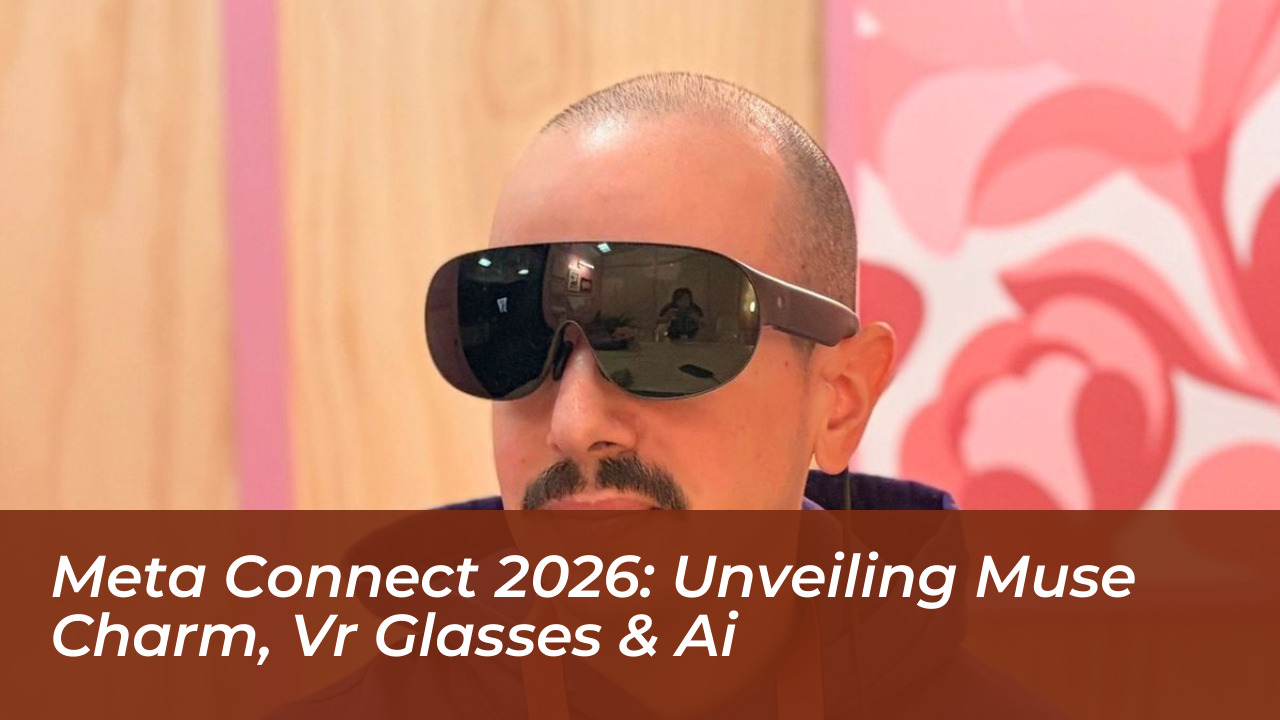
The most technically ambitious hardware reveal of the conference is the device officially designated as the Meta VR Glasses. Priced at $1,299.99 and scheduled to ship in spring 2027, this device diverges sharply from the bulky strap-around design of traditional headsets like the Meta Quest 3. It establishes a new standard for ergonomic spatial computing.
Weighing approximately 100 grams, the Meta VR Glasses achieve a mass reduction of roughly eighty percent compared to the 515-gram Quest 3. Meta accomplished this dramatic weight reduction by decoupling the heavy processing and power components from the optical frame. The computing hardware, battery, and thermal management systems reside within an external, pocket-sized compute puck connected to the glasses by a flexible cable.
| Specification | Meta VR Glasses | Meta Quest 3 |
|---|---|---|
| Weight | ~100 grams | 515 grams |
| Display Technology | 5K Micro-OLED (37 Pixels Per Degree) | LCD (Fast-Switch) |
| Processor | Qualcomm Snapdragon Reality Elite | Qualcomm Snapdragon XR2 Gen 2 |
| Control Input | Eye tracking and fingertip gestures | Handheld controllers / Hand tracking |
| Battery Life | Up to 3 hours (continuous media playback) | ~2 to 2.5 hours |
| Price Point | $1,299.99 | $499.99 (Base model) |
| Launch Window | Spring 2027 | Available Now (Released 2023) |
Optics and Display Performance
The optical assembly utilizes high-resolution 5K micro-OLED panels delivering 37 pixels per degree. This high pixel density eliminates the screen-door effect visible on older generation headsets, creating a visual fidelity that rivals physical monitors. Text rendering appears crisp, making multi-window productivity comfortable for extended work sessions.
The display system achieves IMAX Enhanced certification, supporting multi-panel virtual displays and cinematic media consumption via streaming services such as Disney+, YouTube, HBO Max, and Prime Video. The optics provide a 70-degree field of view, tailored specifically for media viewing, spatial computing, and casual gaming rather than full room-scale athletic virtual reality.
Processing and Control Systems
Driven by Qualcomm’s Snapdragon Reality Elite processor housed inside the external compute puck, the system runs advanced computer vision models locally. Built-in sensors track eye movements and fine fingertip gestures with high precision, removing the requirement for bulky handheld controllers for more than 75 launch games and productivity applications.
The external puck also supports 45-watt fast charging and delivers up to three hours of continuous high-resolution media playback per charge cycle. Thermal management vents quietly along the perimeter of the puck, keeping the wearable frame completely silent and cool against the user’s face.
Muse Charm: The Keychain AI Companion
Positioned as a playful, physical bridge to the company’s software ecosystem, the Muse Charm introduces a novel form factor to consumer electronics. Resembling a palm-sized black device attached to a braided wrist-loop cord, the keychain pendant operates without an integrated camera to alleviate public surveillance concerns.
The hardware configuration includes an integrated fingerprint sensor for rapid physical authentication and instant access, alongside a small digital display capable of rendering a dynamic avatar representing the Muse assistant. An embedded microphone and speaker array facilitates natural voice interaction while on the move. Direct pairing capabilities link the charm with the user’s primary mobile device and cloud account.
Meta is targeting a winter release window in December, though pricing details remain unannounced. The device serves as a dedicated communication conduit for users who want continuous access to Muse without needing to unlock a smartphone or navigate through mobile applications.
The Evolving Smart Glasses Lineup
Meta expanded its smart glasses ecosystem across five distinct product variants, balancing fashion collaborations with functional utility. The diversification of the lineup ensures that users can access AI assistance in professional environments where cameras are strictly prohibited.
Camera-Free Privacy Frames
Following sustained criticism and policy enforcement actions against users who tampered with recording indicator lights on earlier camera-equipped models, Meta introduced its first camera-free smart glasses. Available in Ray-Ban Clubmaster and Burbank styles, these audio-only frames retain built-in speakers, microphones, and AI assistant capabilities while omitting the camera entirely.
This design targets professional offices, gyms, and educational institutions where camera-based eyewear faces strict social or administrative bans. Employees and students can wear the frames comfortably, listening to notifications and interacting with Muse via voice commands without causing privacy concerns.
Ray-Ban Meta Generation 3 and Display Updates
The third-generation camera-equipped smart glasses introduce several hardware refinements, including an upgraded six-microphone array that reduces background noise by approximately ninety percent. This acoustic upgrade makes voice dictation reliable even in loud urban environments or windy outdoor settings.
Battery life increases by one full hour, and Dolby Atmos spatial audio capture capabilities are scheduled for a post-launch software update. Meta also confirmed broader availability for the Meta Ray-Ban Display model, which integrates a discreet digital display directly into the lens for glanceable notifications.
FDA-Cleared Hearing Aid Integration
In a major practical milestone for the keynote, Meta confirmed that its glasses lineup can function as FDA-cleared hearing aids. Users complete a guided hearing test through the companion application, and the glasses automatically calibrate amplification levels to compensate for mild to moderate hearing loss.
Available in the United States later in the year for a one-time fee of $149 or included within a Meta One subscription tier, this medical-grade feature offers a cost-effective alternative to traditional clinical hearing aids. It normalizes assistive audio technology by embedding it inside mainstream consumer fashion frames.
Muse AI Agent and Ecosystem Expansion
Hardware was merely the delivery mechanism for the event’s true focus: the Muse artificial intelligence agent. Zuckerberg described the technology as an approach toward personal superintelligence, capable of performing continuous background tasks rather than simply answering isolated text prompts.
Muse now supports real-time voice and video modalities, allowing users to hold extended multi-modal conversations while the assistant executes background workflows. To accelerate developer adoption, Meta introduced a token invite program granting users one billion tokens upon invitation. Retail partnerships expanded to include Walmart, Best Buy, Gap, Sephora, Wayfair, Expedia, and Instacart, facilitating agent-mediated commerce across physical and digital storefronts.
Frequently Asked Questions
What is the primary function of the Muse AI agent?
Muse operates as a personal superintelligence that handles continuous background workflows, voice interactions, and multi-modal tasks across Meta hardware devices.
How much do the new Meta VR Glasses cost?
The Meta VR Glasses retail for $1,299.99 and are scheduled to ship in spring 2027.
Do the camera-free smart glasses include audio features?
Yes, the camera-free Ray-Ban models retain built-in speakers and microphones for notifications and voice commands.
Conclusion
The announcements at Meta Connect mark a definitive evolution in hardware strategy, moving away from speculative concepts toward practical, daily utility. By anchoring physical devices to the versatile Muse AI agent, Meta establishes a robust ecosystem that spans featherweight spatial computing glasses, privacy-focused audio frames, and pocket-sized wearables.
As the winter launch of the Muse Charm arrives and anticipation builds for the spring 2027 rollout of the Meta VR Glasses, the company demonstrates its commitment to ambient computing. These developments position Meta to capture significant market share in the wearable technology sector while defining how humans interact with artificial intelligence in the physical world.