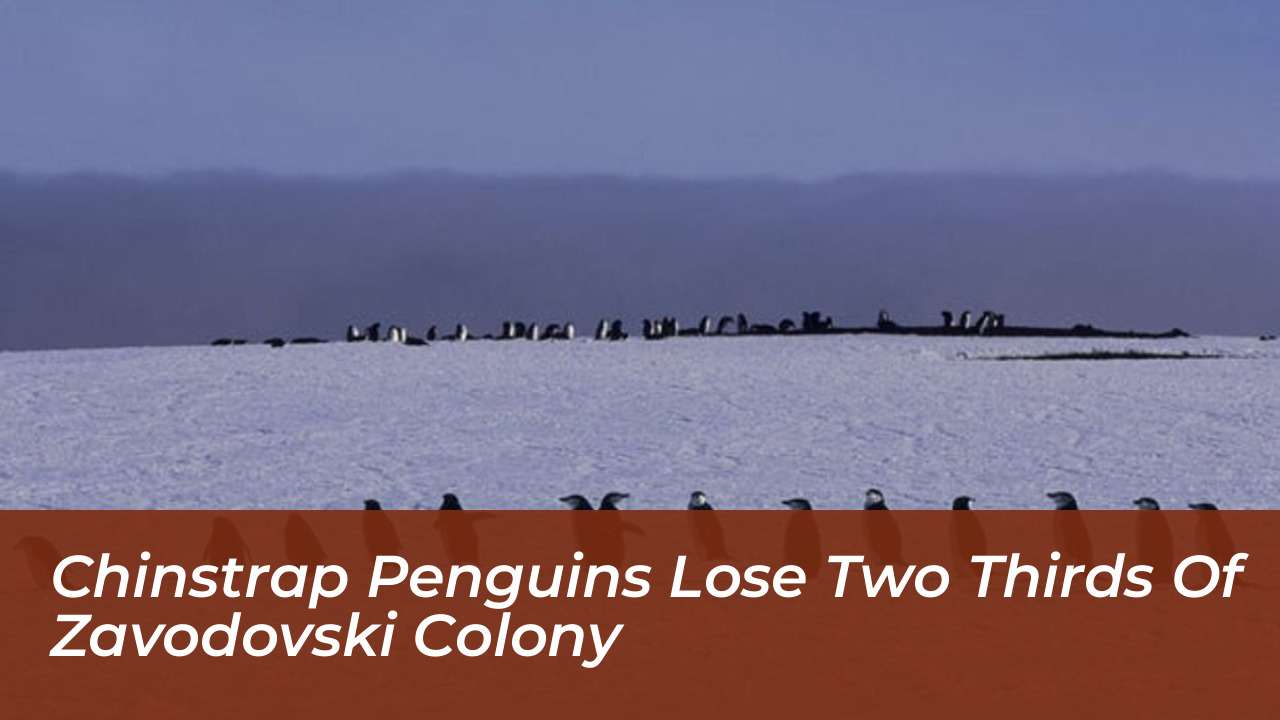


Zavodovski Island, a remote volcanic outcrop near Antarctica, has lost nearly two-thirds of its chinstrap penguin population over a 15-year period, according to a landmark study published in the journal Current Biology. Researchers from the British Antarctic Survey (BAS) discovered that the island’s occupied chinstrap penguin nests plummeted by 63% between 2011 and 2025. This loss strips the location of its long-held status as home to the world’s largest penguin colony.
A Dramatic 15-Year Population Crash
The comprehensive study, released on October 7, documented a severe drop in breeding numbers from approximately 1.09 million individuals in January 2011 down to 402,000 by 2025. In total, the island lost more than 680,000 chinstrap penguins. Lead researcher and BAS penguin ecologist Prof. Norman Ratcliffe described the event as an enormous population crash that has raised urgent concerns regarding the stability of maritime Antarctic food webs.
With this steep decline, Zavodovski has ceded its title as the world’s largest penguin colony to Cape Adare in Antarctica’s Ross Sea, where over a million Adélie penguins reside. Scientists are now urging the International Union for Conservation of Nature (IUCN) to reclassify chinstrap penguins from “least concern” to “endangered.” They point to accelerated habitat stress driven by human-induced climate change.
Climate Disruption and the Krill Shortage
Researchers have heavily linked the collapse to climate-driven changes in ocean temperatures and food supplies. Chinstrap penguins are ecological specialists whose diets rely almost exclusively on Antarctic krill. These tiny, shrimp-like crustaceans depend heavily on sea ice for shelter and nourishment.
Winter temperatures around the Antarctic Peninsula have climbed up to 5°C above pre-industrial levels, causing ocean waters to warm significantly. This thermal shift has forced krill populations to migrate further south into the Weddell Sea. Chinstraps prefer foraging in cooler northern waters and lack suitable alternative nesting sites further south. As a result, they are effectively trapped away from their primary food source, suffering an ongoing population decline of roughly 7% per year.
The study successfully ruled out several alternative theories for the decline:
- Volcanic Activity: While Zavodovski is dominated by the active Mount Curry volcano (aptly dubbed “Mount Asphyxia”), a major eruption in 2016 sent ash clouds northeast over uninhabited areas. Data shows that a steady linear decline predated this event and continued uninterrupted past it.
- Interspecies Competition: Ample nesting space on the island ruled out overcrowding or competition for physical territory.
- Overfishing: Local krill harvesting is strictly prohibited within the island’s surrounding Marine Protected Area.
Macaroni Penguins Thrive While Specialists Struggle
In a striking ecological contrast, a second species nesting on the island-the macaroni penguin-has managed to thrive amidst the changing conditions. Data showed that macaroni numbers on Zavodovski increased from approximately 338,000 in 2011 to 433,000 in 2025, officially outnumbering the chinstraps.
Scientists attribute this divergence to the macaroni penguin’s adaptable, generalist diet. Unlike chinstraps, macaronis forage in warmer northeastern waters and supplement their diets with fish and alternative crustaceans. Researchers note that this rapid shift represents the most dramatic change in community composition ever recorded at a single Antarctic location.
Environmental experts view the crisis on Zavodovski Island as a critical warning sign for global biodiversity. As polar ecosystems transition into sub-Antarctic states, highly specialized species face mounting extinction risks. This highlights the cascading impacts of rapid global heating on the planet’s wildest habitats.