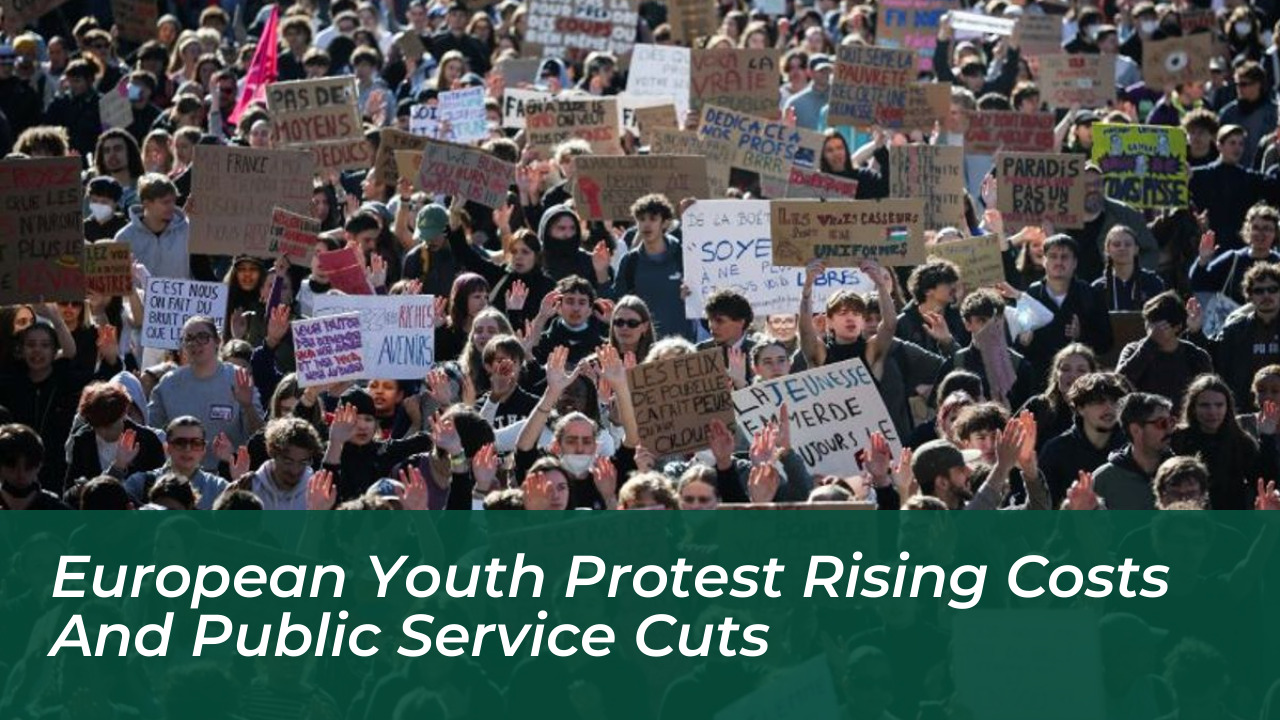

Young people across Europe are protesting rising living costs, increasingly unaffordable housing, and intense pressure on public services. The demonstrations began with school grievances in France in September 2026. They have rapidly spread to countries including Albania, Belgium, Greece, Italy, Portugal, and Spain. Students and other demonstrators are challenging economic conditions that have severely weakened their expectations of achieving a higher standard of living than their parents.
The spreading unrest directly confronts governments led by French President Emmanuel Macron, Italian Prime Minister Giorgia Meloni, Spanish Prime Minister Pedro Sánchez, and Portuguese Prime Minister Luis Montenegro. While their political positions differ, each administration faces growing public frustration over household expenses, employment prospects, and access to essential services, according to reports from Al Jazeera.
Escalating Economic Pressures and Eurostat Data
According to Eurostat, the European Union’s statistical agency, consumer prices in France, Italy, Spain, and Portugal increased by between 59% and 78% from 2000 to 2026. Spain recorded the largest cumulative rise at 78%, followed by Portugal at 71%, Italy at 68%, and France at 59%.
These inflationary pressures have severely impacted young demographics. In August 2026, unemployment among under-25s stood at 15.4% across the European Union, compared with 6.1% for the population as a whole. Additionally, in 2025, 24.2% of Europeans aged 15 to 29 were at risk of poverty or social exclusion, compared with 20.9% of the overall population.
National Breakdown of the Protests
The unrest manifests differently across European nations, driven by distinct local triggers that quickly merge into broader anti-government and economic grievances:
- France: Protests began over education funding cuts and deteriorating school conditions before merging with nationwide demonstrations over fuel prices and declining purchasing power. Interior Minister Laurent Nunez reported that 550,000 people protested nationwide, including 110,000 in Paris.
- Belgium: Demonstrations initiated by university students over higher registration fees and public spending cuts in Wallonia led to intense clashes in Brussels and Liege, prompting police to deploy water cannons.
- Spain: Soaring rents-which have doubled over the past decade-have fueled massive housing protests. The housing crisis intensified after the eviction of 87-year-old Maricarmen Abascal, who died on October 7, leading Prime Minister Pedro Sánchez to call a snap general election for November 29, 2026.
- Portugal: Peaceful marches in Lisbon and Porto highlighted low wages, inflation, and a severe housing crisis. Property prices in Lisbon have more than doubled since 2017, putting immense pressure on young workers.
- Italy: Protests over stagnant wages and high living costs in cities like Milan and Rome escalated into nighttime clashes, resulting in numerous arrests and injured police officers as frustration boiled over.
- Albania: Student demonstrations concerning university conditions and tuition costs converged with broader economic discontent, leading to intense protests outside the Ministry of Education and the Supreme Court in Tirana.
Political Disillusionment and the ‘Gerontonomics’ Divide
Experts point to demographic imbalances as a root cause of systemic policy neglect. Political scientist Tim Vlandas coined the term “gerontonomics” to describe an economy where older voters-who accounted for 22% of Europe’s population in 2025, up from 17% in 2005-create incentives for governments to prioritize pensions and consumption over social investment and future growth.
This age divide is clearly reflected at the ballot box. In France, polls ahead of the April 2027 presidential election show that 77% of young voters back either the far-right National Rally or the populist left-wing La France Insoumise. Deep disillusionment is widespread, with 74% of voters under 30 in France, 69% in Italy, and 59% in Spain stating that the political class neither represents nor listens to them.
“Young people are not apathetic, and we are not uninterested in politics. We are angry, and we are not going to sit back and do nothing,” said Lenaïk Dumont, president of the Federation of Francophone Students of Belgium (FEF).
Frequently Asked Questions
What triggered the youth protests across Europe in late 2026?
The protests were initially triggered by school funding cuts and deteriorating education conditions in France during September 2026. They quickly expanded to encompass soaring living costs, unaffordable housing, inflation, and public spending cuts across multiple European nations.
Which countries are most affected by the demonstrations?
The most prominent demonstrations have occurred in France, Belgium, Spain, Portugal, Italy, and Albania, with secondary student movements and labor actions appearing in countries like Greece, Ireland, Germany, and Austria.
How much have consumer prices risen in southern Europe since 2000?
According to Eurostat data, consumer prices in France, Italy, Spain, and Portugal increased by between 59% and 78% from 2000 to 2026, with Spain leading at 78% and Portugal following at 71%.
What is ‘gerontonomics’?
‘Gerontonomics’ is a term coined by Oxford political scientist Tim Vlandas to describe an economy where an aging voter base incentivizes politicians to prioritize pensions and older demographics over long-term social investment for youth.
How are young Europeans expressing their political frustration?
Aside from street demonstrations and student strikes, young voters are shifting heavily toward anti-establishment, populist, and radical political parties, while expressing deep disillusionment with mainstream political institutions.