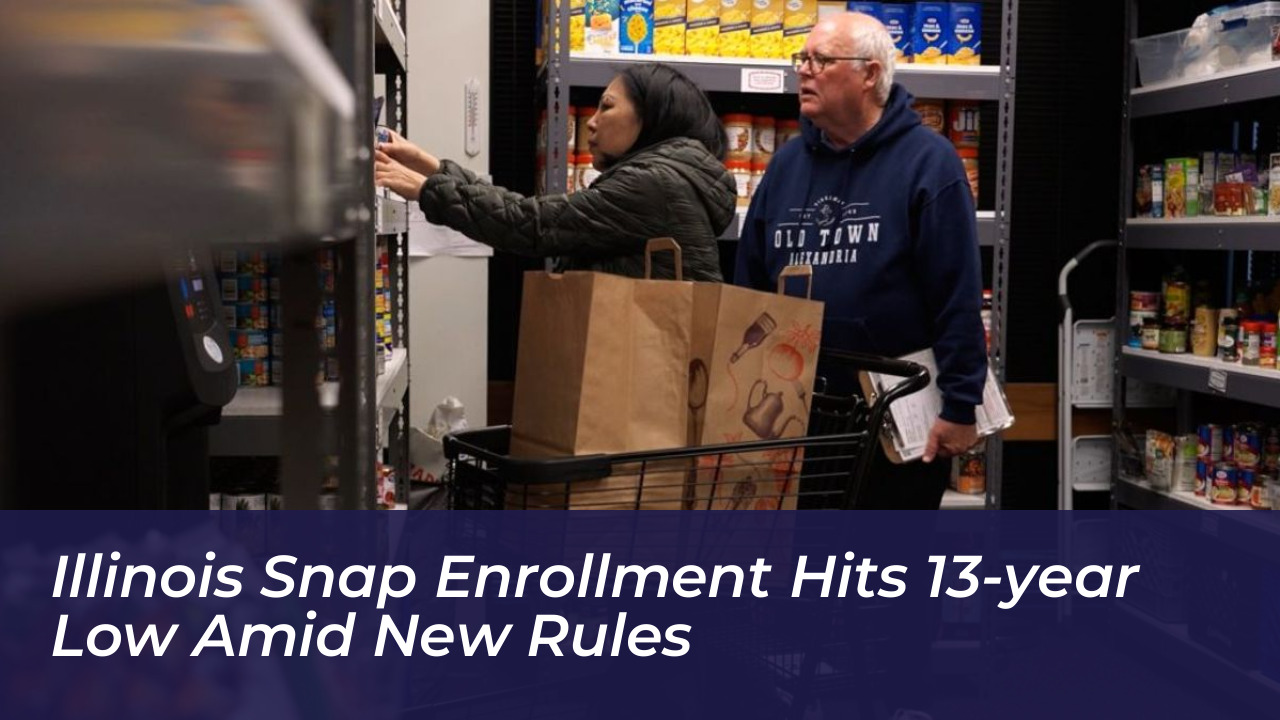

Illinois has recorded its lowest Supplemental Nutrition Assistance Program (SNAP) enrollment in 13 years. Just over 1.4 million residents received food assistance as of August 2026. This milestone marks a decline of more than 23% compared to August 2025. Expanded federal work requirements and funding adjustments across the state drove this drop.
The downturn represents the ninth consecutive month of falling food stamp participation in Illinois. The most dramatic drop occurred after May 1. New federal eligibility rules took effect then for able-bodied adults without dependents. Participation dropped 13.2% between April and August. This shift removed hundreds of thousands of recipients in a few months.
Impact of Federal Work Requirements on Enrollment
Stricter federal guidelines shifted who qualifies for food assistance in Illinois. Able-bodied adults without dependents who missed steps to meet the new work mandates faced immediate benefit terminations. Between late April and late May, the state saw historic monthly losses in its active roster.
Geographic distribution of the remaining SNAP recipients reveals stark regional differences across the state:
- Chicago: Accounts for nearly a third of all state recipients, with approximately 16.5% of the city’s population enrolled.
- Southern Tip: The Alexander-Pulaski area recorded the highest participation rate in the state at nearly 27%.
- Collar Counties: Kane-Kendall recorded the lowest participation rate at 4.7%, closely followed by McHenry County at 5.1%.
State Response: The FRESH Program
Illinois lawmakers allocated $70 million to cushion the economic blow for residents losing food assistance. They established the Families Receiving Emergency Support for Hunger (FRESH) program.
Beginning August 1, the FRESH program issued a one-time $400 payment to eligible Illinois residents. This went to people whose SNAP benefits ended or dropped under the updated federal rules. State officials clarified that the emergency payment offers short-term financial relief. It does not restore individuals to active SNAP enrollment.
Rising Error Rates and Financial Pressures for Taxpayers
Active enrollment is shrinking, but Illinois faces compounding financial liabilities. These are tied to federal compliance penalties and administrative cost-shifting.
Data from the U.S. Department of Agriculture shows that Illinois’ payment error rate climbed to 14.67% in fiscal year 2025. This rate measures overpayments and underpayments, up from 11.56% the previous year. This rate ranks as the fifth-highest in the nation. Overpayments account for more than 90% of the errors.
Under 2025 federal regulations, states with error rates above 10% must pay a penalty. This penalty can reach up to 15% of total benefit costs. For Illinois, this could mean an estimated $700 million annually. Illinois qualified for a one-year delay due to the scale of its error rate. This pushed initial penalty enforcement to October 2028. However, other operational expenses hit the state budget immediately.
Beginning in the federal fiscal year starting in October, states must cover 75% of SNAP administrative costs. This replaces the historical 50% split. In response, Illinois lawmakers increased appropriations for SNAP administration to more than $100 million in the current budget, up from $60 million previously.