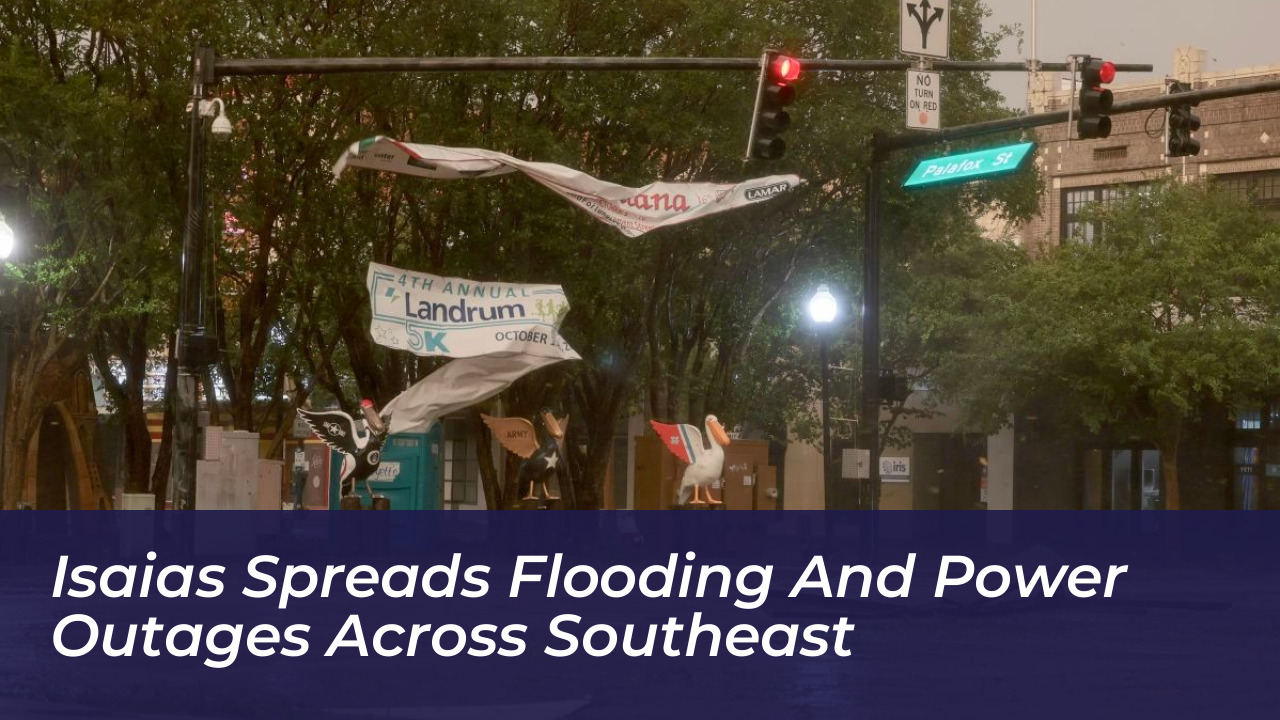

The remnants of Isaias moved inland across the southeastern United States, bringing heavy rain, damaging winds, and the continued threat of isolated tornadoes. The storm, which initially made landfall near Destin, Florida, as a Category 2 hurricane, left more than 874,000 customers without electricity across Florida, Alabama, and Georgia, according to PowerOutage.com.
Although Isaias weakened into a post-tropical cyclone, hazardous conditions persisted across the region. Authorities urged residents to avoid unnecessary travel while emergency crews assessed damage and cleared debris from blocked roads and compromised bridges.
Impact Across Florida, Alabama, and Georgia
Before weakening, Isaias struck Florida with sustained winds of 105 mph and a destructive storm surge of 5 feet. The weather system marked the first hurricane landfall in the United States since Hurricane Milton came ashore south of Tampa as a Category 3 hurricane two years earlier.
As the storm tracked further inland, its impacts multiplied across state lines:
- Florida: Bore the brunt of the initial landfall, accounting for hundreds of thousands of power outages and severe coastal flooding.
- Alabama: Experienced heavy downpours and high winds, prompting federal emergency declarations for Baldwin, Mobile, and Escambia counties, alongside reservation lands of the Poarch Band of Creek Indians.
- Georgia: Felt escalating wind and rain impacts as the post-tropical system tracked northward, pushing regional outage numbers higher.
Emergency Response and Federal Preparations
President Donald Trump approved states of emergency for impacted areas, assisting local and federal partners in cutting through bureaucratic red tape to deliver rapid disaster relief. The Federal Emergency Management Agency (FEMA) deployed urban search-and-rescue teams, incident management assistance teams, and regional distribution centers stocked with essential supplies, including clean water, food, and emergency generators.
State governors and municipal leaders implemented strict safety guidelines ahead of the storm. In Destin, Mayor Bobby Wagner issued firm warnings to residents who chose to defy mandatory evacuation orders in zones A and B, stating that emergency responders would be unable to assist until conditions improved after landfall.
Outlook and Expected Weather Trajectory
Meteorologists noted that while sustained maximum winds dropped significantly, the post-tropical cyclone still posed widespread atmospheric threats. Rainfall totals ranging from 4 to 8 inches-with isolated maximum amounts up to 15 inches-triggered life-threatening flash floods from the Florida Panhandle northward into southern Alabama, southwest Georgia, and the southern Appalachians.
Emergency management agencies advised citizens residing within active warning zones to remain indoors, avoid flooded roadways completely, and monitor local weather updates as the storm system transitioned toward the Tennessee Valley and the broader Mid-Atlantic region.