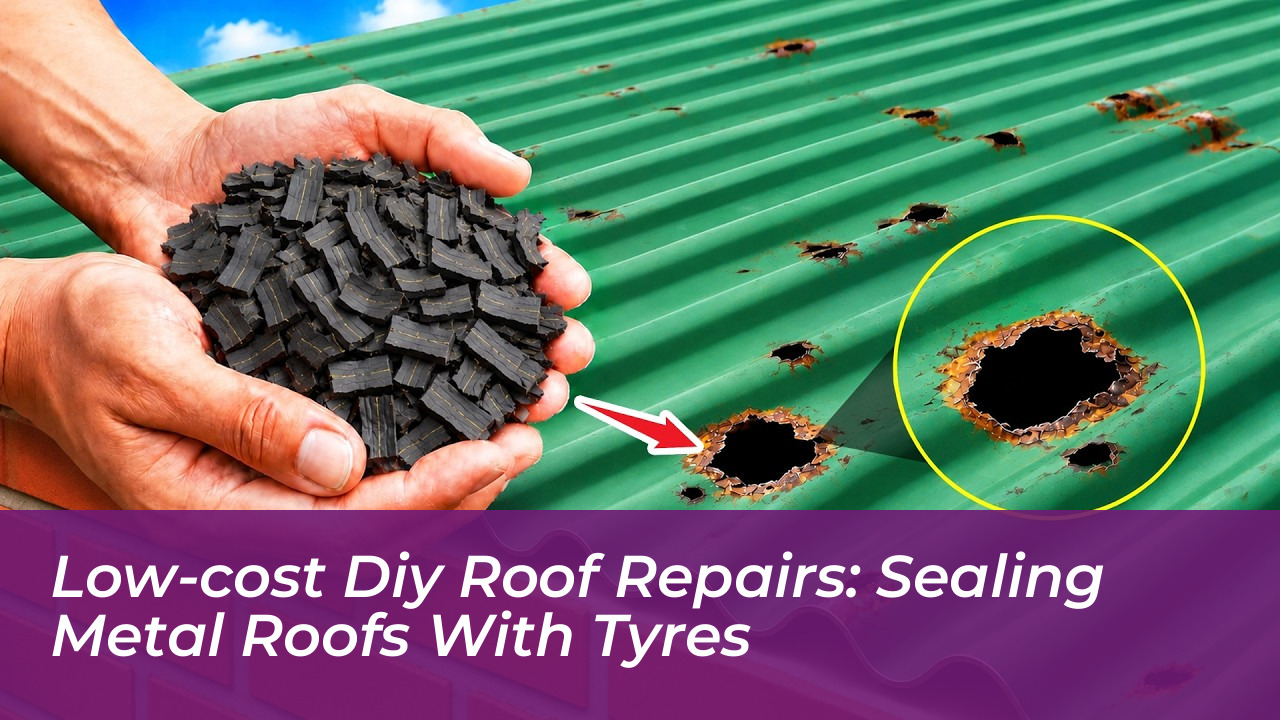

Across the United Kingdom, agricultural outbuildings, garden workshops, and livestock shelters regularly endure brutal freeze-thaw cycles and relentless driving rain. When corrugated galvanised iron expands and contracts throughout the seasons, it frequently tears open rigid fillers or breaks brittle silicone beads. To combat water ingress caused by rusted screw holes, hairline splits, and storm-driven debris, rural property owners are turning to a low-cost agricultural method: repurposing discarded vehicle tyres to seal fractured metal roofs.
While modern roofing membranes often command high prices at builders’ merchants, the vulcanised rubber inside an ordinary tyre carcass offers identical commercial-grade water shedding properties completely free of charge. Repurposing flexible automotive rubber resolves mechanical roof stress by creating an elastic gasket that moves naturally alongside the metal sheet.
The Structural Logic Behind Salvaged Vulcanised Rubber
Vehicle tyres are engineered to withstand extreme road friction, thermal shock, ultraviolet degradation, and chemical exposure. These properties make tread and sidewall rubber ideal for harsh rooftop environments where standard exterior mastics eventually degrade and peel away.
When an aged corrugated roof develops a puncture or split along its profile, moisture quickly wicks beneath the iron, attacking purlins and structural rafters. Applying a rigid metal scab often leads to accelerated galvanic corrosion if dissimilar metals contact one another in damp air. In contrast, automotive rubber introduces an insulating, hydrophobic barrier that prevents metal-on-metal friction and stops rust from spreading across the profile.
Beyond weatherproofing, upcycling tyres removes toxic, non-biodegradable waste from rural fly-tipping blackspots and farm scrap heaps. Repurposing scrap materials transforms an environmental nuisance into a resilient, decades-long defensive barrier.
Workshop Fabrication: Turning Scrap Tread into Custom Flashing
Executing a reliable fix requires transforming a stiff, curved tyre carcass into flat, workable gasket strips. While steel-belted radial sections provide puncture resistance, the bead and sidewall areas are considerably easier to cut and shape to match the undulating contours of corrugated iron.
- Deconstruct the tyre carefully: Use a sharp, lubricated utility knife or a reciprocating saw fitted with a metal-cutting blade to carve away the pliant sidewall from the heavy steel tread band.
- Degrease and scour the patch: Scrub the rubber strip thoroughly with soapy water and a stiff wire brush to remove road grime, mould release agents, and oxidation.
- Form the water barrier: Cut the rubber patch at least five to eight centimetres larger on all sides than the puncture or fracture on the roof sheet.
- Bed the repair: Apply a generous bead of high-grade external polyurethane-based roofing sealant or bitumastic mastic to the underside of the rubber patch to ensure complete perimeter cohesion.
Securing the Seal Across Corrugated Profiles
A rubber patch must adhere flush against the alternating ridges and valleys of the iron panel to prevent standing water from pooling behind the top edge. Position the custom-cut rubber section directly over the fracture, aligning the patch so that upper edges tuck neatly under the overlapping roof sheet whenever possible.
Fasten the patch through the crest of the corrugation rather than the trough, utilising heavy-duty self-drilling roofing tek screws fitted with broad EPDM washers. Clamping the tyre rubber firmly against the metal creates continuous compression, sandwiching the mastic and locking out driving wind and horizontal rain.
Critical Safety Precautions and Structural Limitations
Working on aged agricultural buildings demands extreme vigilance. The Health and Safety Executive (HSE) consistently warns that corrugated roofing materials-particularly aged iron or weathered fibre cement-become dangerously brittle over time and can fail catastrophically without warning under human weight.
Never stand directly on corrugated roofing sheets or walk along screw lines during maintenance. Always distribute physical weight evenly across adjacent trusses by using roof ladders or staging boards fitted with crawling battens.
It is equally vital to understand the limits of DIY upcycling. Rubber tyre patches serve well for sealing isolated rust holes, tree branch punctures, and minor seam splits on outbuildings, carports, and hay sheds. However, if structural roof purlins have rotted, or if entire sheets have deteriorated into structural rust flakes, spot repairs cannot restore load-bearing safety, and the building will require comprehensive structural renewal.
Upcycling robust waste materials like scrap tyres provides an immediate, zero-cost remedy that keeps rural workshops dry through the wettest winter months. Taking time to prepare the rubber surface and selecting high-grade flexible mastics ensures that rural ingenuity performs just as effectively as high-priced industrial patch kits.