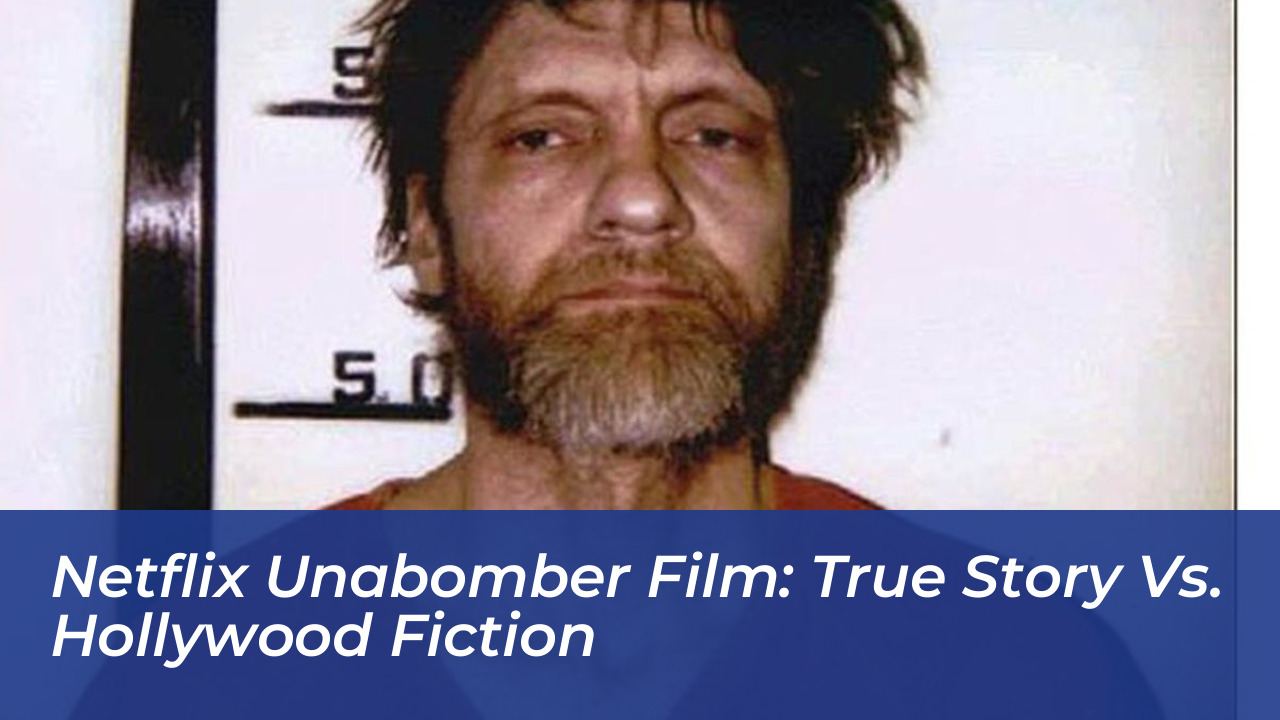
Netflix expands its true crime catalog with a feature film titled Unabomber. The movie examines the life of Ted Kaczynski, the mathematics prodigy who carried out a nationwide mail bombing campaign between 1978 and 1995. Janus Metz directs the project, which stars Jacob Tremblay as the young Kaczynski, Russell Crowe as Harvard psychologist Henry Murray, and Shailene Woodley as an FBI agent. While the film uses real historical events as its foundation, the production applies significant artistic licenses. Viewers often struggle to separate verified historical facts from cinematic embellishments. This breakdown explores the true story behind the Netflix film, examining the Harvard experiments, the multi-decade FBI manhunt, and the specific narrative changes introduced on screen.
- Who Was Ted Kaczynski? The Rise of a Mathematical Prodigy
- The 17-Year Reign of Terror
- The Harvard Psychological Experiments
- Fact Versus Fiction in the Netflix Film
- Historical Reality Versus Netflix Portrayal
- The Forensic Linguistics Breakthrough and the Family Tip
- Post-Arrest Legal Strategy and Sanity Debates
- Frequently Asked Questions
- Did Ted Kaczynski plead insanity in court?
- Where is Ted Kaczynski now?
- How many bombs did the Unabomber send during the campaign?
- How accurate is Shailene Woodley’s character in the Netflix film?
Who Was Ted Kaczynski? The Rise of a Mathematical Prodigy
Ted Kaczynski demonstrated exceptional intellectual abilities at an early age. He skipped two grades and entered Harvard University at just 16 years old on a scholarship to study mathematics. Kaczynski later earned a doctoral degree from the University of Michigan and briefly served as an assistant professor at the University of California, Berkeley. His academic trajectory pointed toward a traditional, highly successful career in higher education, marked by complex mathematical research and steady institutional advancement.
Despite his academic promise, Kaczynski experienced a profound alienation from modern society. By the early 1970s, he abandoned his academic career entirely and relocated to a remote, off-the-grid cabin near Lincoln, Montana. Living without electricity or running water, he spent his days reading, studying survivalism, and watching the surrounding wilderness transform under industrial expansion. From this isolated base, he transitioned from a disillusioned academic into a committed domestic terrorist, preparing to strike the technological infrastructure he blamed for destroying human freedom.
The 17-Year Reign of Terror
The UNABOM campaign, designated by the Federal Bureau of Investigation as an acronym for University and Airline Bombing, ran from May 1978 to April 1995. During this 17-year span, Kaczynski mailed or planted 16 explosive devices across the United States. His targets consistently pointed toward his ideological grievances, specifically focusing on universities, computer scientists, corporate executives, and the airline industry. Each device was meticulously crafted by hand using wood, metal, and primitive electronics scavenged from scrap yards.
Official Federal Bureau of Investigation records confirm that these calculated attacks killed three people and injured 23 others, many of them permanently maimed. The case triggered one of the longest, most complex, and most expensive manhunts in United States history. Task force investigators spent nearly two decades analyzing bomb fragments, interviewing witnesses, and chasing dead ends across multiple state lines without realizing that the suspect lived completely isolated from modern conveniences.
The Harvard Psychological Experiments
The Netflix film dedicates substantial screen time to Kaczynski’s formative years at Harvard University. Historical records confirm that Kaczynski participated in a controversial psychological study directed by professor Henry Murray, portrayed by Russell Crowe in the film. During his sophomore year, Kaczynski volunteered for the study, anticipating a series of intellectual, philosophical debates about personal values. Instead, Murray subjected the young volunteers to aggressive, highly stressful interrogations designed to test emotional resilience under pressure.
Students wrote essays detailing their personal philosophies and deepest secrets. Murray’s research team then weaponized those writings to mock, belittle, and psychologically dismantle the participants while filming their reactions. Kaczynski spent approximately 200 hours as a subject in these grueling sessions. Psychologists and historians have debated the lasting impact of this study on Kaczynski for decades. However, researchers emphasize a critical distinction: while participation in the Murray experiment is a documented historical fact, no definitive evidence proves that the study directly caused Kaczynski to become a serial bomber.
Fact Versus Fiction in the Netflix Film
Netflix categorizes the project as a drama inspired by true events. This framing grants the filmmakers the freedom to combine timelines, dramatize private conversations, and introduce composite characters to streamline a decades-long investigation into a two-hour runtime. Understanding these creative alterations helps viewers evaluate the film accurately rather than accepting every cinematic scene as absolute historical truth.
Shailene Woodley stars as FBI agent Joanne Miller, who serves as the central investigator hunting the Unabomber. This specific character is entirely fabricated for the script. Woodley confirmed in interviews that Joanne Miller represents an amalgamation of numerous real-life detectives, postal inspectors, and forensic analysts who worked on the actual task force. Condensing a massive, multi-agency investigation into a single fictional protagonist allows the film to maintain a tight narrative focus, even if it blurs the lines of historical documentation.
Historical Reality Versus Netflix Portrayal
| Event or Element | Historical Reality | Netflix Film Portrayal |
|---|---|---|
| Ted Kaczynski’s Education | Entered Harvard at 16, earned a Ph.D. in mathematics, and taught at UC Berkeley. | Accurately portrayed as a brilliant academic prodigy with early social detachment. |
| Henry Murray’s Study | Kaczynski participated in 200 hours of stressful interrogation experiments. | Dramatized to suggest a direct psychological catalyst for future violent behavior. |
| FBI Agent Joanne Miller | No single agent named Joanne Miller led the entire multi-agency investigation. | Fictional amalgamation representing the broader task force of analysts and agents. |
| The Manifesto Publication | Published in 1995 after threats of further bombings coordinated with major newspapers. | Featured as the pivotal, dramatic clue leading directly to family recognition. |
| The Cabin Arrest | Arrested by the FBI on April 3, 1996, at his Montana property. | Recreated with high tension, highlighting the physical raid on the remote cabin. |
The Forensic Linguistics Breakthrough and the Family Tip
The turning point in the real Unabomber case came from the killer’s own words, which ultimately sealed his downfall. In 1995, Kaczynski forced the publication of his 35,000-word manifesto, titled Industrial Society and Its Future, in The New York Times and The Washington Post, promising to halt his bombing campaign if the text reached a mass audience. David Kaczynski, Ted’s brother, and his wife Linda read the published manifesto out of general curiosity.
They noticed striking similarities in the vocabulary, phrasing, and ideological viewpoints between the text and old essays written by Ted years earlier. David reported his suspicions to the FBI through legal counsel, providing documents that allowed federal forensic linguists to confirm the match. This linguistic breakthrough provided the probable cause necessary for a federal judge to issue a search warrant. On April 3, 1996, federal agents arrested Ted Kaczynski at his remote property, recovering live explosives and handwritten journals.
Post-Arrest Legal Strategy and Sanity Debates
Following his capture, Kaczynski fought a bitter battle against his own legal counsel regarding his mental state. His defense team planned to enter an insanity plea, arguing that his paranoid beliefs indicated severe mental illness. Kaczynski fiercely opposed this strategy, preferring to face execution rather than be labeled mentally unstable, because he wanted the world to view his actions as a rational political protest against modern technology.
The legal standoff created unprecedented constitutional questions regarding a defendant’s right to direct their own defense. Psychologists evaluated Kaczynski and diagnosed him with paranoid schizophrenia, yet he maintained coherent reasoning throughout the legal proceedings. In 1998, rather than enduring a public trial where his sanity would become the central spectacle, Kaczynski accepted a plea deal resulting in four life sentences without the possibility of parole.
Frequently Asked Questions
Did Ted Kaczynski plead insanity in court?
No, Ted Kaczynski strongly rejected an insanity defense. He fired his lawyers when they attempted to present psychiatric evidence on his behalf, maintaining that his actions were rational and politically motivated.
Where is Ted Kaczynski now?
Ted Kaczynski passed away on June 10, 2023, while incarcerated at the Federal Medical Center in Butner, North Carolina, where he had been transferred due to declining health.
How many bombs did the Unabomber send during the campaign?
Over the course of 17 years, Kaczynski mailed or placed 16 explosive devices, resulting in three fatalities and 23 injuries.
How accurate is Shailene Woodley’s character in the Netflix film?
Shailene Woodley plays a fictional composite character named Joanne Miller, who represents the collective efforts of hundreds of real FBI agents, analysts, and postal inspectors.