
If someone knocks on your door claiming to be an Internal Revenue Service (IRS) agent and demands immediate cash, prepaid debit cards, or wire transfers, close the door. Never hand over money, personal financial records, or execute on-the-spot payments to anyone standing on your doorstep claiming to represent the federal tax authority. Understanding legitimate field procedures, verifying official credentials, and knowing what to ask for instead is your strongest defense against aggressive tax impersonation scams.
The IRS rarely appears at private residences or businesses without extensive advance warning sent through the United States postal mail. To protect taxpayers from aggressive fraudsters and reduce unnecessary panic, the agency enacted a major policy shift that drastically curtailed unannounced home and business visits. Recognizing the difference between legitimate field representatives and criminal impostors can save you from severe financial loss and identity theft.
Who Actually Has the Authority to Visit Your Property?
While spontaneous drop-ins are no longer the standard operating procedure for the agency, field work has not disappeared entirely. The IRS operates with four distinct types of field officials, each tasked with specific administrative or investigative objectives across the country:
- Audit agents: These representatives examine financial records, ledgers, and previously submitted tax returns. Standard protocol mandates that taxpayers receive formal written notification by mail prior to any physical meeting.
- Revenue officers: Tasked with addressing unresolved tax debts or delinquent, unfiled tax forms. They routinely send official letters-such as the standard Letter 725-B-or place phone calls to establish an appointment before arriving.
- Criminal investigators: Special agents who build cases against serious financial and federal tax crimes. They are permitted to make unannounced visits, but they do not collect money or demand tax liabilities at your doorway.
- Fuel compliance inspectors: Specialized inspectors conducting physical audits on commercial facilities that produce, store, or distribute taxable fuels. These commercial inspections can take place without prior notice.
When revenue officers attempt to resolve unpaid balances or missing filings, their primary step involves setting up an agreed-upon conference through formal written channels rather than catching homeowners off-guard.
The Two Badges Every Legitimate Field Officer Must Carry
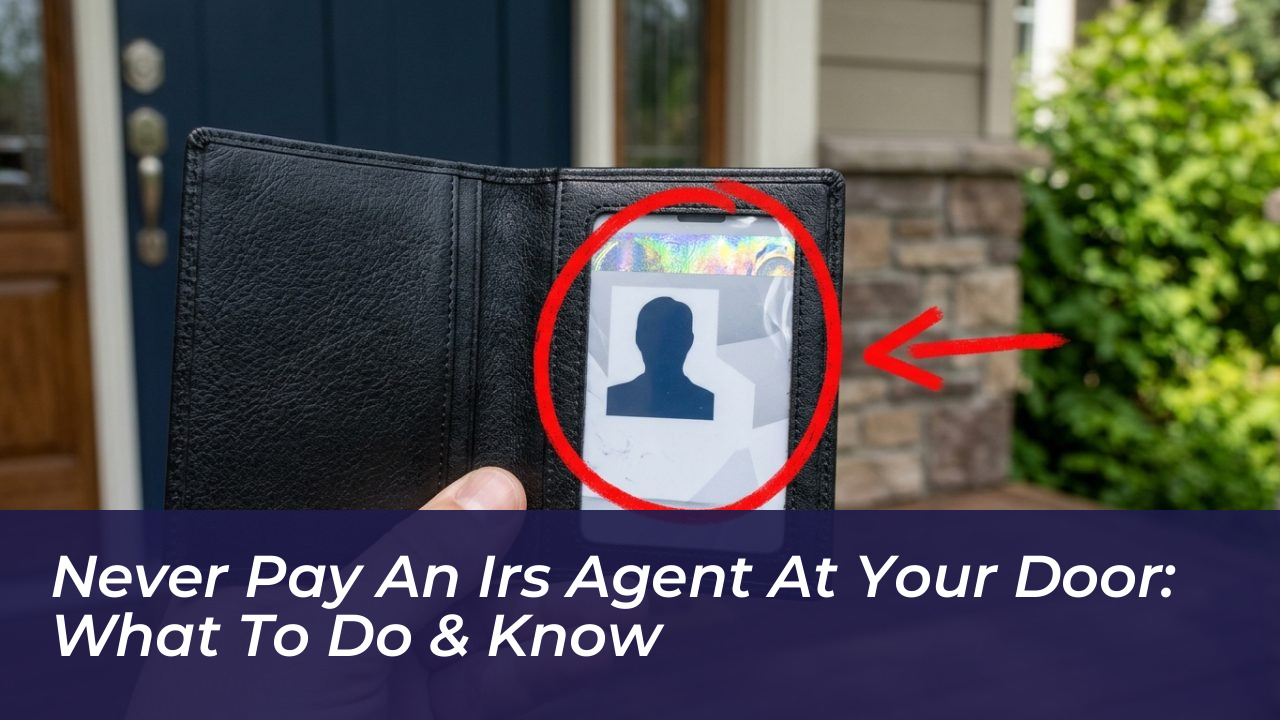
Real agency employees are trained to present proper government identification immediately upon arrival. You have the absolute right to examine these credentials carefully before sharing any information, answering questions, or allowing someone past your entryway.
Civil enforcement personnel-including revenue officers, audit agents, and fuel inspectors-must carry two separate official documents:
- Pocket Commission: An internal, serial-numbered identification booklet produced directly by the IRS that displays the employee’s photograph, legal name, and official authority.
- HSPD-12 Personal Identity Verification (PIV) Card: A secure, smart-card government credential issued to federal employees, complete with a photograph, watermarks, and agency registration numbers.
Criminal investigators from the IRS carry specialized federal law enforcement credentials, badges, and firearms, but they will never ask for immediate cash settlements, credit card numbers, or peer-to-peer app transfers. If an individual at your door claims to represent the federal government but produces only a generic badge, a business card, or refuses to let you examine both required credentials, they are not adhering to standard federal protocol.
Official Field Roles vs. Common Scam Tactics
Fraudulent callers and door-to-door scammers rely heavily on emotional shock, urgency, and fear. Knowing the exact dividing line between official agency operations and criminal behavior keeps your identity and finances safe.
- Official IRS Protocol: Sends written correspondence (such as Letter 725-B) long before revenue meetings; personnel carry both a Pocket Commission and an HSPD-12 card; criminal agents identify themselves via federal law enforcement credentials; payments are handled exclusively through secure, official U.S. Treasury portals and methods.
- Impostor Red Flags: Demands immediate settlement on the spot without prior notice; shows only a single unofficial badge or refuses credential checks; threatens instant arrest by local police, immediate property seizure, or sudden deportation; requires payment via wire transfer, gift cards, prepaid debit cards, or cryptocurrency.
Criminal impostors often threaten immediate arrest, property seizure, or severe legal penalties if you refuse to pay immediately. Genuine federal tax investigators lack the legal authority to unilaterally arrest individuals on their front porch for unpaid balances, nor do they collect money during criminal inquiries.
What to Do and What to Ask For When Someone Knocks
If you find yourself facing an unexpected visitor claiming to be a tax official, maintain your composure and follow a strict protective protocol:
- Ask for Identification First: Politely request to inspect both their IRS Pocket Commission and their HSPD-12 PIV Card. Examine the photographs and details closely.
- Request Written Verification: Ask for the official paperwork associated with their visit, such as Letter 725-B, which outlines the exact purpose of the inquiry.
- Decline Immediate Entry and Payment: Firmly state that you will not provide immediate cash, payments, or access to your home without independent verification and legal counsel.
- Verify via Official Channels: Cross-reference the agent’s credentials and badge numbers through official agency resources on IRS.gov or by calling the Treasury Inspector General for Tax Administration (TIGTA) at 800-366-4484.
- Consult a Tax Professional: If a legitimate revenue officer or auditor has contacted you regarding real tax obligations, involve a certified public accountant (CPA), enrolled agent, or tax attorney to handle subsequent communications.
Never give out sensitive personal details, bank account numbers, Social Security numbers, or tax documents to an unannounced visitor until you have thoroughly verified their identity through official government channels.
Frequently Asked Questions
Can a legitimate IRS agent collect money at my door?
No. Legitimate IRS revenue officers, auditors, and special agents never collect cash, demand immediate payment on your doorstep, or accept payments via gift cards, prepaid debit cards, wire transfers, or digital applications like Zelle or Venmo. All official tax payments go directly to the U.S. Treasury through secure online portals or mailed checks.
What is Letter 725-B and why is it important?
Letter 725-B is the official correspondence sent by the IRS to notify taxpayers of an impending in-person meeting with a revenue officer. It establishes an appointment time and provides contact information so you can independently verify the legitimacy of the agent before any face-to-face interaction occurs.
Are unannounced IRS visits completely illegal now?
While the IRS drastically reduced surprise visits to protect taxpayers from scams, rare exceptions still exist. Unannounced visits can occur in very limited circumstances involving specific criminal investigations, the formal delivery of legal summonses, or extreme cases of severe tax noncompliance.
What should I do if an IRS criminal investigator knocks on my door?
If an IRS Criminal Investigation (CI) special agent visits your home or business, you are likely the subject or target of a federal criminal inquiry. You have a Fifth Amendment right to remain silent and a Sixth Amendment right to counsel. Politely inform them that you will not answer substantive questions without your attorney present and call a criminal tax defense lawyer immediately.
How can I report a fake IRS agent who visited my home?
If you suspect someone is impersonating a federal official at your door, halt all interactions immediately and record as many details as possible-including physical descriptions, vehicle information, and badges shown. Report the incident directly to the Treasury Inspector General for Tax Administration (TIGTA) at 800-366-4484 and file a complaint with the Federal Trade Commission (FTC).