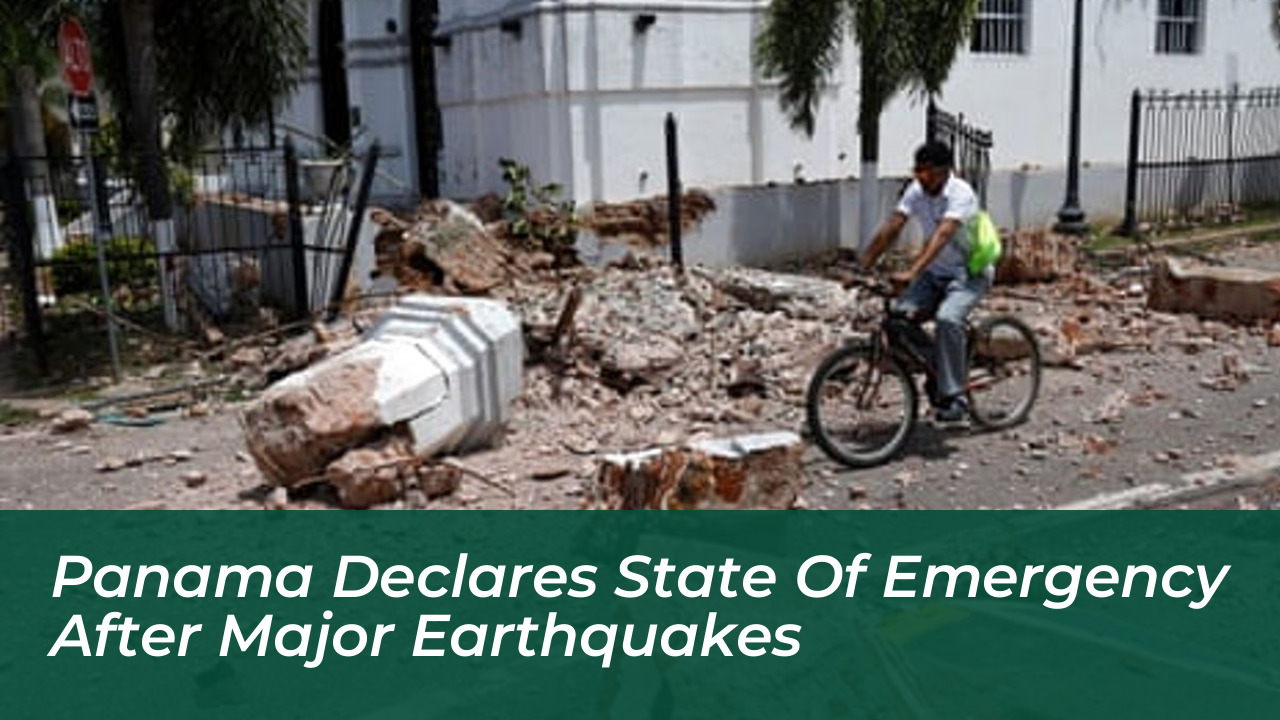

Panama has declared a national state of emergency after a series of powerful earthquakes struck the country. The disaster damaged buildings, roads, and public facilities across all 10 provinces and two Indigenous territories. The initial tremor was recorded initially as an 8.0 by the US Geological Survey and later revised to a 7.7 magnitude. It hit on Friday near Pitaloza Arriba in Herrera province at a depth of 10 kilometers. A subsequent 6.6-magnitude quake and more than 100 aftershocks followed, prompting widespread mobilization by federal authorities and emergency response teams.
President José Raúl Mulino labeled the event a major disaster. He visited the central region of Penonomé to directly coordinate the response and urge calm among residents. The Cabinet Council officially approved the state of emergency to accelerate resource allocation, coordinate humanitarian aid, and streamline infrastructure reconstruction.
Infrastructure Damage and Regional Impacts
The National Civil Protection System (Sinaproc) reported that approximately 420 homes sustained damage ranging from minor cracks to total destruction. Structural impacts were also documented across roughly 420 public schools, 21 healthcare facilities, seven hotels, at least 13 churches, and nine bridges. In Los Santos province, the town of Tonosí was temporarily cut off, leading officials to deploy air assets to deliver vital supplies.
In Veraguas province, rising water levels on Cañas Island forced the emergency evacuation of about 300 residents to local shelters. Former President Ricardo Martinelli shared media reports showing severe structural collapse at his property in Soná. Despite the widespread structural toll, the Panama Canal Authority confirmed that shipping operations through the global trade channel remained unaffected and fully operational.
Emergency Response and Humanitarian Aid
Sinaproc Deputy Director General Malitzie Rivera confirmed that 27 people sustained minor to moderate injuries and were transported to regional medical centers for treatment. No immediate fatalities were reported. The Ministry of Public Security deployed eight helicopters, four aircraft, and nearly 400 specialized agents from the National Border Service (Senafront) to assist with logistics, medical evacuations, and supply chains.
The Ministry of Education, led by Ventura Vega, suspended classes nationwide to safeguard students, teachers, and staff while structural engineering teams evaluate school facilities. Meanwhile, the Single Emergency Management System (SUME) reinforced regional hospitals in Penonomé and Aguadulce with additional paramedics and emergency medical personnel.
International Solidarity and Financial Assistance
Regional leaders from Colombia, Ecuador, and Guatemala issued formal messages of solidarity and offered immediate disaster assistance. Financial institutions also mobilized support for Panama’s recovery. The Development Bank of Latin America and the Caribbean announced a $250,000 direct donation alongside a credit line of up to $50 million dedicated to emergency response and infrastructure rehabilitation.
Authorities continue to urge citizens to remain alert, heed official guidance from Sinaproc, and avoid traveling through compromised roadways near the epicentral zones while structural specialists complete comprehensive damage assessments.