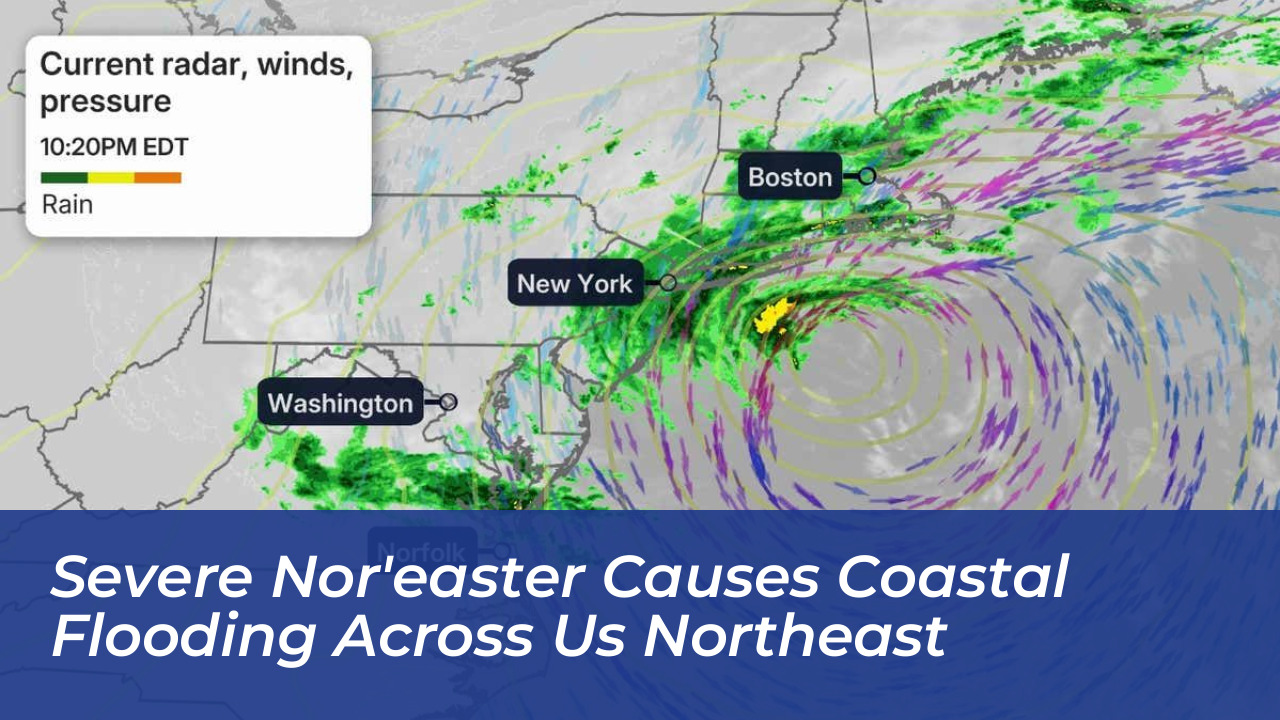
A volatile and highly unusual early-season nor’easter slammed the United States East Coast, paralyzing communities from North Carolina to New England and triggering widespread coastal flooding. This severe weather event disrupted regional infrastructure, grounded thousands of flights, and left hundreds of thousands without power as destructive storm surges battered vulnerable shorelines.
- Meteorological Anatomy of the Late-September Nor’easter
- Unusual Atmospheric Dynamics and Stalling Pivot
- Full Moon Astronomical Tides and Foliage Amplification
- Widespread Coastal Flooding and Infrastructure Devastation
- Water Surges and Localized Inundation
- Highway Washouts and Severe Beach Erosion
- Regional Impact Metrics Across East Coast Sectors
- State-by-State Weather Breakdown
- Regional Power Outages and Utility Failures
- Grid Collapse Across Five States
- Hazardous Field Conditions for Repair Crews
- Transportation Gridlock and Mass Transit Disruptions
- Aviation and Marine Operations Halted
- Highway System Blockages and Abandoned Vehicles
- Event Cancellations and Economic Aftershocks
- Professional Sports and Entertainment Rescheduling
- Mass Gathering Postponements
- Emergency Declarations and Government Response Protocols
- State Executive Leadership Actions
- First Responder Deployments and Rescues
- Long-Term Vulnerability of Northeast Coastal Infrastructure
- Aging Seawalls and Vertical Wave Deflection
- Future Urban Planning and Zoning Reassessments
- Frequently Asked Questions
- What caused the late-September nor’easter to stall?
- Why was the storm surge so severe during this event?
- How did full tree foliage impact power outages?
- What major events were canceled due to the storm?
Meteorological Anatomy of the Late-September Nor’easter
Unusual Atmospheric Dynamics and Stalling Pivot
The storm system developed as a powerful low-pressure center tracking northward off the mid-Atlantic coastline. Unlike typical winter systems that skirt past the continent into the open Atlantic, this meteorological disturbance executed a rare, stalling pivot back toward the New Jersey shore. This stationary loop trapped the coastline under persistent, gale-force northeasterly winds for multiple days.
Meteorologists at the National Weather Service recorded sustained wind speeds exceeding 50 to 60 miles per hour across exposed coastal sectors. Notable peak gusts included a 56 mph reading at John F. Kennedy International Airport in New York and a 60 mph gust at Nantucket Memorial Airport in Massachusetts. Coastal infrastructure absorbed the brunt of the kinetic energy as ocean overwash breached protective dunes.
Full Moon Astronomical Tides and Foliage Amplification
The timing of the storm exacerbated its destructive potential significantly. Striking in late September, deciduous trees retained full canopies of dense foliage. The extra surface area caught significantly more wind load than bare winter branches. This dynamic amplified the frequency of snapped limbs, compromised root systems, and widespread power grid failures.
Moreover, the event coincided with a full moon cycle, elevating astronomical tide levels and compounding the storm surge impact. The combination of high astronomical tides and persistent onshore winds forced water levels well above normal thresholds, creating unprecedented challenges for municipal drainage systems throughout the region.
Widespread Coastal Flooding and Infrastructure Devastation
Water Surges and Localized Inundation
Coastal communities transformed into maritime waterways as storm surges and torrential downpours overwhelmed drainage infrastructure. Preliminary data from the National Oceanic and Atmospheric Administration indicated that water levels surged more than 3 feet above normal high-tide marks along the Jersey Shore and within New York Harbor. Low-lying municipalities experienced severe inundation, prompting swift water rescues and localized evacuations.
In Ocean City, New Jersey, all municipal bridges temporarily closed as municipal roads vanished beneath saltwater. Footage from Surf City and Manasquan showed residents navigating residential streets via canoes and kayaks. Similar scenes played out in the New York City borough of Queens, where residents paddled through floodwaters near the Howard Beach subway station.
Highway Washouts and Severe Beach Erosion
Waterfront commercial properties sustained immense capital losses. Marina operators reported multi-thousand-pound vessels torn from storage lifts and cast adrift by ferocious wave action. In North Carolina, extreme ocean overwash severely damaged N.C. Highway 12 along the Outer Banks, severing physical access to Hatteras Island.
Dare County officials declared a state of emergency, restricting reentry to manage structural safety risks and prevent civilian entrapment. Beach erosion rapidly stripped sand away from protective dunes, leaving coastal foundations completely exposed to battering waves and accelerating structural threats to beachfront homes.
Regional Impact Metrics Across East Coast Sectors
State-by-State Weather Breakdown
The footprint of the storm stretched across multiple states, each experiencing unique localized hazards. The North Carolina Outer Banks endured 32 to 45 mph winds alongside devastating highway washouts and towering 12 to 15 foot waves. Meanwhile, the New Jersey Shore battled intense 60 to 70 mph gusts that caused severe coastal flooding and bridge closures.
Further north, New York Long Island and New York City managed subway flooding and structural property damage driven by 56 to 60 mph wind gusts. Massachusetts Cape Cod and the islands absorbed flight groundings and severe seawall wave reflection, with wind speeds reaching up to 65 mph.
Regional Power Outages and Utility Failures
Grid Collapse Across Five States
The combination of saturated ground soils, heavy rainfall totals ranging from 2 to 6 inches, and high-velocity wind gusts crippled power grids across five Northeast states. At the height of the storm, tracking data from PowerOutage.us confirmed that more than 100,000 residential and commercial customers lacked electricity.
New Jersey bore a heavy share of the electrical grid failure. FirstEnergy reported roughly 20,000 outages concentrated in Ocean County and Toms River. Jersey Central Power and Light logged in excess of 21,000 disconnected service connections, while Atlantic City Electric managed over 5,500 dark households. PSE&G Long Island worked continuously to restore power despite adverse field conditions.
Hazardous Field Conditions for Repair Crews
Repair crews faced dangerous working environments across every affected sector. Downed medium-voltage power lines tangled in fallen tree canopies created lethal hazards across roadways. Utility companies deployed specialized personnel to clear thoroughfares before attempting line reconstruction, delaying restoration timelines for isolated coastal pockets.
Saturated soils continued to compromise standing utility poles long after the peak winds subsided. Crews had to exercise extreme caution while stabilizing infrastructure to prevent secondary collapse events during ongoing repair operations.
Transportation Gridlock and Mass Transit Disruptions
Aviation and Marine Operations Halted
Regional transit networks experienced systemic disruptions as aviation, rail, and marine operations ground to a halt. The Federal Aviation Administration urged air travelers to verify flight statuses directly with carriers as ground stops and delays rippled outward from Northeast hubs.
FlightAware metrics highlighted widespread cancellations, with Boston Logan International Airport logging upwards of 260 canceled flights. Regional airports servicing tourist destinations such as Nantucket and Martha’s Vineyard suspended all inbound and outbound traffic. Ferry services between Long Island and Fire Island paused operations indefinitely as wave heights rendered marine transit unsafe.
Highway System Blockages and Abandoned Vehicles
Highway infrastructure suffered systemic blocks throughout the affected zones. Emergency officials closed coastal arteries, including sections of Ocean Avenue in Sea Bright, New Jersey. Motorists attempting to navigate flooded roadways abandoned stalled vehicles, forcing municipal towing units to clear transit lanes for emergency response vehicles.
Public transportation systems faced severe delays and localized shutdowns. Subways in New York City required continuous pumping operations to clear water intrusion from tracks and underground stations.
Event Cancellations and Economic Aftershocks
Professional Sports and Entertainment Rescheduling
The severity of the meteorological event forced the cancellation or rescheduling of numerous high-profile public events, professional sports fixtures, and cultural festivals, resulting in significant regional economic friction. Major League Baseball executives restructured schedules to mitigate safety risks. The Boston Red Sox and Chicago Cubs relocated the finale of their regular-season series to Florida at the home of the Tampa Bay Rays, following an improvised Friday doubleheader in Boston.
Major League Soccer postponed professional fixtures, while outdoor entertainment venues shut down operations to protect attendees and staff from dangerous wind gusts.
Mass Gathering Postponements
Mass gathering cancellations severely impacted autumn tourism and local economies. High-profile events included the Global Citizen Festival in New York City’s Central Park, which planned headliners such as Lauryn Hill, Wyclef Jean, and John Legend. Ed Sheeran postponed his sold-out stadium concerts at Gillette Stadium in Foxborough, Massachusetts.
Additionally, organizers shut down the three-day Oceans Calling music festival in Ocean City, Maryland, and postponed an Ironman triathlon event scheduled in New York. Numerous private gatherings, including destination weddings on Hatteras Island, faced abrupt cancellation as highway washouts trapped incoming travelers.
Emergency Declarations and Government Response Protocols
State Executive Leadership Actions
Executive leadership across multiple states activated emergency response protocols well ahead of peak tidal cycles. New York Governor Kathy Hochul and New Jersey Governor Mikie Sherrill issued formal state of emergency declarations, deploying state resources to vulnerable coastal municipalities.
Direct warnings from officials, including Nassau County Executive Bruce Blakeman, alerted residents regarding secondary tidal surges that threatened low-lying neighborhoods during subsequent high tide cycles.
First Responder Deployments and Rescues
Emergency management teams prepositioned high-clearance rescue vehicles and established municipal shelters to house displaced residents. Inflatable watercraft deployed rapidly to reach residents ignoring evacuation advisories who found themselves trapped by rising saltwater.
Coast Guard units also maintained active patrols along hazardous inlets, standing ready to assist mariners caught in the heavy seas triggered by the stalling storm system.
Long-Term Vulnerability of Northeast Coastal Infrastructure
Aging Seawalls and Vertical Wave Deflection
The intense coastal flooding exposed deep vulnerabilities in aging coastal protection structures. Stalled seawall repair projects in Massachusetts towns like Scituate and Cohasset left shorelines exposed to immense wave energy. The kinetic energy of waves crashing against vertical seawalls launched water 60 to 80 feet into the air, overwhelming secondary barriers.
Engineers noted that traditional hard stabilization methods often accelerate beach erosion during prolonged nor’easters, prompting a reevaluation of coastal defense engineering.
Future Urban Planning and Zoning Reassessments
Mounting pressure now falls on urban planners to update zoning laws and infrastructure guidelines. Long-term strategies must focus on elevating critical infrastructure, restoring natural salt marshes, and creating managed retreat frameworks against rising sea levels and increasingly volatile storm tracks.
Frequently Asked Questions
What caused the late-September nor’easter to stall?
The storm system developed a rare stationary loop driven by unusual upper-level atmospheric dynamics. Instead of moving out into the open Atlantic, the low-pressure center pivoted back toward the mid-Atlantic and New Jersey coastlines, trapping the region under gale-force winds for multiple days.
Why was the storm surge so severe during this event?
The storm coincided with a full moon astronomical tide cycle, which naturally elevated baseline water levels. Persistent northeasterly winds pushed massive volumes of water against the coast, resulting in storm surges exceeding 3 feet above normal high tides in areas like New York Harbor and the Jersey Shore.
How did full tree foliage impact power outages?
Because the storm struck in late September, deciduous trees still carried full canopies of dense leaves. This foliage caught significantly more wind load than bare winter branches, leading to widespread snapped limbs, uprooted trees, and extensive damage to overhead power lines.
What major events were canceled due to the storm?
High-profile cancellations included the Global Citizen Festival in New York City, Ed Sheeran’s stadium concerts at Gillette Stadium, the Oceans Calling music festival in Maryland, and several professional sports fixtures, including an MLB series finale relocated to Florida.